
On this day in 1920, Ray Chapman died, and so did the way baseball was played up until that point.
Chapman’s death signaled the end of the “Dead Ball” era and, in theory, the end of many of the “tricks” pitchers used to fool hitters, including the spit-ball, the scuff-ball, the grease-ball, the carved-up-on-my-belt-buckle-ball, and so on.
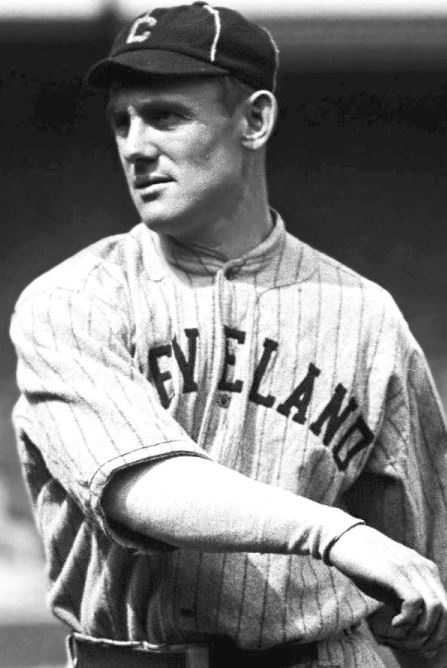
Chapman was a 29-year-old infielder for the Indians, their best, and was noted for hanging in tough against any pitcher and his willingness to “take one for the team”, i.e. getting hit by a pitch to get to first base. In his nine-year career, he had led the league in runs scored once, walks once, and plate appearances once. A solid guy.
On August 16, 1920, in the fifth inning of a game against the Yankees at the Polo Grounds, he stepped in to hit against Carl Mays, a submarine style pitcher who liked to throw inside. Mays hit Chapman on the left temple and the sound made by the impact reverberated through the Polo Grounds giving the fans the impression the pitch had been hit by Chapman. The ball hit him so hard that although he had been hit on the left temple, he bled from his right ear.
Chapman went down, was helped up and back to the dugout by team-mates, and died twelve hours later. The last words he uttered on a baseball field were, “I’m all right. Tell Mays not to worry”.
It was the only case of a player being killed by a pitch at the major league level, although there have been several serious and career-ending incidents since then.
Statistically, Mays had been a very good pitcher indeed, and went on to win over 200 games before he was done, including five seasons of 20 or more. He was a potential Hall-of-Famer and was last on the Veteran’s Committee ballot in 2007, when he was turned down for the final time. Most people say it was his complete lack of remorse for the Chapman incident that kept him out. “It’s not on my conscience,” Mays said 50 years later, just before his death in 1971. “It wasn’t my fault.”
At the time of the incident, umpires Billy Evans and William Dineen issued a statement that blamed Mays:
“No pitcher in the American League resorted to a trickery more than Carl Mays in attempting to rough a ball, in order to get a break on it which would make it difficult to hit.”
The next year, the rules about what kind of baseballs were allowed in play were changed. Until then, the same few balls were used throughout the game, and became very difficult for hitters to see after a few innings of abuse. After that, new, more tightly wound balls were used, and new ones were brought in whenever a ball was no longer white enough for a hitter to see clearly. The balls could be seen better and traveled farther when hit.
The “lively ball” era was born, and the home run would be king from then on. In 1919, the greatest slugger in baseball history and always a statistical outlier, Babe Ruth, led the league with 29 home runs, a total that exceeded the entire output for ten of the other MLB teams that year. In 1920, he hit 54 which exceeded the total for every other major league team except the Phillies, who had 64 in aggregate. Apart from Ruth’s 54, the 1920 Yankees had only 61 home runs hit by all other players combined.
But after the Chapman incident, the trend started changing radically, and, by 1930 the long ball was firmly established everywhere. The pitchers, or at least those that didn’t cheat, had lost their biggest advantages.

 Get Off My Lawn