Willie Mays Avenue

This week, we experienced another national paroxysm of “controversy”, the result of which is that a few more formerly obstinate people admitted what millions already found obvious: Donald J. Trump is a hyper-combative, utterly incompetent, ignorant narcissist who cannot do the job he finds himself in.

Also, he may or may not have proven himself to be a racist and Nazi sympathizer, though neither of those possibilities is nearly as important to the world as his utter incompetence.

On the plus side, a few monuments to the Confederacy have been torn down, thereby bringing the Civil War one baby step closer to conclusion, only 152 short years after the last shot was fired.

Also,  in some circles traveled only by the 1% , it has now become de rigueur to prove your bona fides on the subject of race by making some sort of gesture or speech about it, which doesn’t help all that much but doesn’t hurt either.

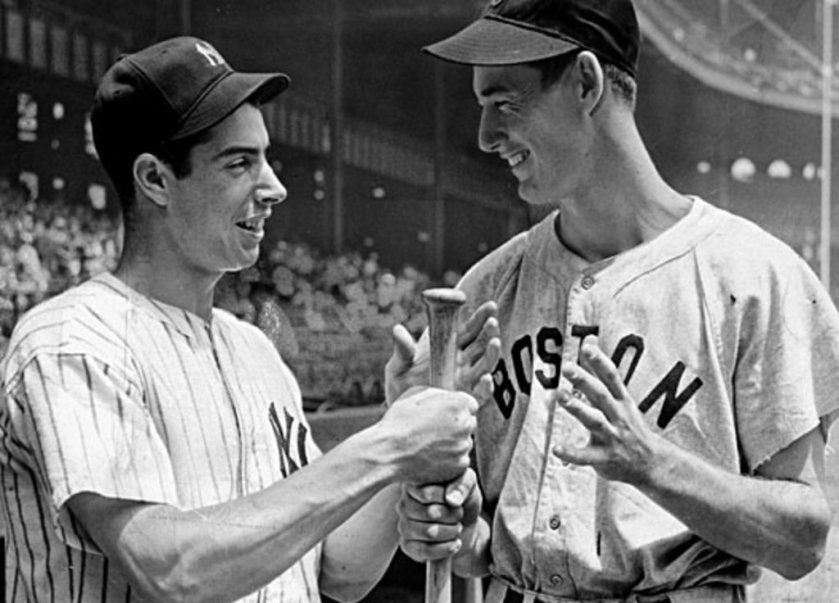
More than 40 years after the death of Tom Yawkey, Red Sox ownership is making little tiny noises about finally doing the right thing concerning the “legacy” of Tom Yawkey: killing it dead.

yawkey

Yawkey bought the Red Sox for himself a few days after he turned 30 years old in 1933 for $1.25 million, thereby sentencing the team and its die-hard fan base to decades of mediocrity. Yawkey had inherited $40 million from the lumber and iron empire built by his grandfather, and could finally access the money, having reached the age specified in the will.

Today, $40 million doesn’t buy that much. Maybe the privilege of watching David Price nurse a hangnail on the bench for two years, or maybe watching Pablo Sandoval eat hamburgers in the minors before recognizing you made another small mistake. But in 1933, it was real money.

Yawkey never earned or produced anything on his own, and treated the Red Sox as a private club, often taking batting practice with “his boys”.

He died in 1976, a year after the greatest World Series ever played, in which the Red Sox lost the seventh game and came up empty for the third time on his watch. They were one player short of success yet again.  The next year, Boston re-named part of Jersey St., on which Fenway Park’s main entrance sits, to Yawkey Way in honor of the great man. It’s been Yawkey Way since then.

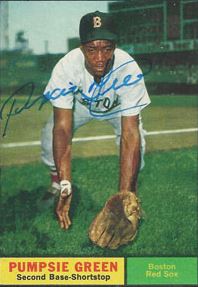
In his day, most people in Boston thought Yawkey was a peach of a guy, and most had no problem with his views on black people. He didn’t like them. The Red Sox were the last team in baseball to put a black player on the field, waiting until 1959, and they did so half-heartedly. Pumpsie Green was the man’s name, a .246 hitter with zero power over his five year career.

green

The Red Sox had the chance to sign Jackie Robinson and they passed. They did give him a tryout in 1945. A newly elected city councilman, Isadore Muchnick, campaigned to bring black players to Boston, and refused the usual formality of granting permission for the Red Sox and Braves to play on Sundays, unless they gave some guys from the Negro Leagues a tryout.

A day before the 1945 opener, Yawkey had Jackie Robinson, then of the Kansas City Monarchs, take the field for a look, along with Marvin Williams and Sam Jethroe. “We knew we were wasting our time”, Jackie said years later. No one from the press was there, and the whole charade lasted just a few minutes. It ended when someone from the stands yelled out. “Get those n—ers off the field”.

In 1945, the Red Sox weren’t alone in their antipathy. But in 1949, two years after Jackie was already in the majors and the direction of history was clear, the Red Sox passed on a 17-year-old prospect named Willie Mays, who they could have signed for $4500.

In the 1950’s, the Red Sox could have, and should have, had Ted Williams in left, Willie Mays in center, and Jackie Robinson at second. But Yawkey was too smart for that. Why try to win games with guys you don’t like when it’s so much more fun to relax with the guys you like?

yaz

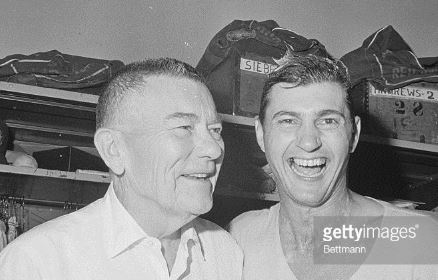
The above picture is Yawkey and Carl Yastrzemski, one of his favorites, after the “Impossible Dream” Red Sox backed into the 1967 World Series, surviving the closest pennant race in history.

Yaz had a season for the ages, playing a supernatural left field all year while winning the Triple Crown and M.V.P.  Wow.  He played great in the Series, too, hitting .400 with three home runs and an On Base Percentage of .500. He carried the team  into the seventh game, where the Red Sox put their Cy Young winner, Gentleman Jim Lonborg, on the mound with only two days rest to face the immortal Bob Gibson.  Gibson, of course, cruised to his third win of the Series, striking out ten and giving up only three hits, and ended the Red Sox season in the predictable fashion.

But a good time was had by all, right?

gibson

The Red Sox were short just one player, as usual. Just one Bob Gibson. Or Jackie Robinson. Or Willie Mays. And it took another 37 years on top of that to finally get over the hump.

yawkey1

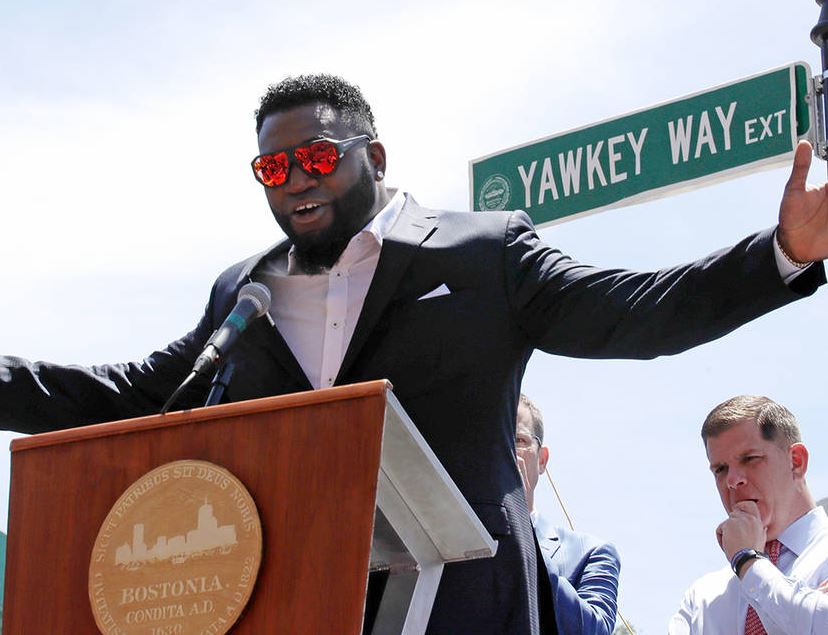
Now John Henry, principal owner of the Red Sox, is entertaining suggestions for re-naming Yawkey Way.  I think “Willie Mays Avenue” would work.

My plan would be that the next time I’m down there on game day, and I overhear some kid saying to his father, “Dad, why is this ‘Willie Mays Avenue’?  Willie never played here!”,  I’ll look at them both sadly and say, “Exactly.”

Ken Starr, please be quiet.

The other day Kenneth Starr said that the investigation of Special Counsel Robert Mueller might be overstepping its bounds, and should not turn into a “fishing expedition”. He said the original “gravamen” of the investigation was Russian collusion in the election, and that it would be inappropriate to go beyond this question into other areas.

On hearing this, everyone who remembers Ken Starr’s years-long quest to find something, anything, that would reflect badly on Bill Clinton threw up a little bit in their mouths. CNN filed this story under the headline “Ken Starr killed irony today”.

For those too young to remember, Ken Starr was the “Independent Counsel” charged with investigating the potential wrongdoings of Bill and Hillary Clinton in a failed 1970’s real estate development called “Whitewater”.  The Clintons lost money on this investment, there was never any wrongdoing found, and they were never charged with anything.  There was no “there” there.

Starr was appointed to head a three-judge panel to investigate “the scandal” in 1994, just a year and a half into the Clinton administration. Even though there was never anything to it, Republicans were bound and determined to keep the travesty going, and Starr moved from one subject to the next until, with the investigation finally winding down in 1998, he got wind of some inappropriate sexual conduct  between Clinton and an intern named Monica Lewinsky.

The Lewinsky scandal became a 24/7 cable news obsession in 1998, basically blocking out the sun and other real news for months on end. It led ultimately to Clinton’s impeachment trial for lying under oath about the nature of his relationship with Lewinsky.  He was absolved and continued in office.

Today is the anniversary of the 1998 bombings of the American embassies in Nairobi, Kenya and Dar es Salaam, Tanzania. The bombings were carried out by operatives of Osama bin Laden, and presaged the 9/11 attacks. 224 people were killed in the bombings, including 12 Americans, and 4500 were wounded.

On August 20, 1998, Clinton ordered a retaliatory attack on bin Laden’s sanctuary in Afghanistan and 70 missiles hit three al Qaeda sites there, killing 24 people, but not bin Laden. 13 missiles hit a pharmaceutical plant in Sudan, killing a night watchmen.

But because of the relentless and idiotic persecution of Bill Clinton by Ken Starr, who had clearly exceeded the “gravamen” of his original investigation, none of these events were regarded as particularly alarming or even newsworthy, and, tragically, none led to any increased effort to neutralize al Qaeda.

Instead, the events were reported, mainly but not exclusively by the young FoxNews network, as “wagging the dog”, meaning Clinton trying to create a distraction to get Monica Lewinsky off the TV for a day or two. A typical example of the coverage from the Washington Post:

Several Republicans yesterday raised the issue expressly. Sen. Dan Coats (R-Ind.) said: “After months of lies and deceit and manipulations and deceptions — stonewalling — it raised into doubt everything he does and everything he says,” Coats said.

Administration officials said yesterday they had anticipated criticism that Clinton was following a “Wag the Dog” strategy — so-named after the recent movie in which a president tries to draw attention away from a sexual scandal by staging a phony war — but had no choice but to ignore it.

Perhaps there is a legitimate discussion about Mueller’s scope to be had now, but Ken Starr should not be part of it. His past transgressions and current hypocrisy exclude him. I don’t think it’s going too far to say that without this biased, self-important, corrupt and disingenuous fool, we may well have succeeded in limiting al Qaeda’s ability to carry out the 9/11 attacks.

To Ken Starr, I would say, “Thanks for nothing and shut the fuck up.”

“Do you know who I am?”

The Judiciary Committee here at GOML headquarters has proposed new sentencing guidelines for anyone who uses the phrase, “Do you know who I am?” in the commission of a crime. All prison time should be doubled with no possibility of consideration for good behavior. Clearly, the “good behavior” ship has sailed and it isn’t coming back.

The answer to the question, “Do you know who I am?” is virtually always, “No ones gives a rat’s ass who you are, and be careful  suggesting you deserve special treatment, because you just might get it.”

A couple of days ago, a 23-year-old punk named Joseph Daniel Hudek IV assaulted a flight attendant and a couple of passengers while trying to open the emergency door of a plane an hour out of  Seattle heading to Beijing. Maybe he was trying to kill himself (and others). Maybe he was having a psychotic break. Maybe he’s a tweaker who had too much. Don’t know, don’t care. During the mêlée, he shouted “Do you know who I am?”, thus automatically disqualifying him from any sympathetic consideration of his actions.

hudek

Saying these words immediately establishes his guilt, irrespective of mitigating circumstances, such as mental illness. Saying these words is worse than fat-shaming, which, as the internet tells us,  is worse than just about anything else.

First of all, he’s nobody. But that really isn’t the point. He thinks he’s somebody, possibly Napoleon, or perhaps a super-hero who can fly without the assistance of an airplane. Or he thinks his mother is somebody, and therefore he is somebody. He was flying in First Class as a non-rev on a “dependent pass”, and apparently the mother works for Delta in some capacity. Also irrelevant.

After smashing a wine bottle over his head to no effect, the crew enlisted the help of some passengers who finally were able to get Joey into some comfy zip-ties. Here’s what the galley looked like at that point:

galley

In this country, even if you are “somebody”, you’re nobody. If the people you’re beefing with haven’t already taken your identity into consideration, trying to convince them of your “status” in the middle of a set-to only makes things worse.

Remember the “Nut Rage” incident a couple of years ago?  It was another “Do you know who I am?” incident. Cho Hyun-ah, at the time an executive of Korean Air and the daughter of its CEO, had a big jet turned around on the runway in New York and returned to the gate, inconveniencing hundreds of other passengers. The problem? Her macadamia nuts had been served in a bag, not on a plate.

From the link:

She has denied physically assaulting the chief steward, Park Chang-jin, who says she made him kneel and beg for forgiveness before jabbing him with a document folder.

She then ordered the plane to go back to the terminal at New York’s JFK airport to offload the attendant, who was fired on the spot before the plane proceeded on its journey. He has since been reinstated.

Her father, Korean Air chairman Cho Yang-Ho, has apologised for his daughter’s “foolish act”. Mr Cho also said his daughter would step down from all her posts in companies under the Cho family-owned Hanjin Group, which also owns Korean Air.

This is just the beginning of what should happen to this special snowflake, but it didn’t work out that way. She was sentenced to 10 months in prison, as the international outrage she sparked demanded, but the court suspended the sentence, so if she doesn’t turn any other jets around for two years, she won’t have to go to prison at all.

From this piece about the incident:

The episode cannot be explained “except by the fact that Vice President Cho Hyun-ah was a member of the chairman’s family,” said the civic group People’s Solidarity for Participatory Democracy. It said the case exemplified how the personal wishes of a member of the family that owns a leading South Korean conglomerate often override official regulations and common sense.

“No pilot is going to oppose an order from the daughter of the company owner,” said Lee Gae-ho, a lawmaker affiliated with the New Politics Alliance for Democracy, the main opposition party.

Fortunately, in the United States, being the daughter of the boss doesn’t give you the right to make policy that affects people’s lives.  Everyone knows we have nepotism laws that ensure we operate as a meritocracy.

I haven’t yet read this article,  which is entitled “Ivanka Trump takes father’s seat at G-20 leaders’ table in break from diplomatic protocol”, but I’m sure we have nothing to worry about.

Ivanka in charge

Fox and Chicken conclude secret talks

A meeting of the Fox and the Chicken took place yesterday in Hamburg, resulting in a historic agreement being reached on the future protection of the Henhouse.

fox

The meeting was unprecedented in that there were only four attendees, no notes were kept, and no media was present to record what was said. Only the Chicken has reported on the outcome so far, characterizing the meeting as “tremendous”, saying it had been an honor to meet with the Fox, and boasting that he made the Fox swear that he had never and would never enter the Henhouse for any reason.

coop

Talk radio stations and other “conservative” media heralded the event, noting that the Chicken was an extremely experienced negotiator who had a long history of always getting better “deals” than anyone else, and pointing out that the Fox had been a much more dependable ally of Chickens in general, and of the Henhouse in particular, than any “liberal” had ever been.

In return for assurances of the future security of the Henhouse, the Chicken agreed that all eggs produced therein would be licensed in perpetuity to the Fox.

The Fox has been an admirer of the Chicken for years, affectionately referring to him as “Tweety”, and has been quoted as saying the Chicken was the most handsome, talented, intelligent, and skilled partner he has ever had.

pootie


Jim Bunning

A very small number of people have achieved great success at the highest level of professional sports and gone on to be elected to national office. Jack Kemp comes to mind, and Steve Largent, both of whom were great pro football players and served in the House of Representatives.  And, of course, NBA Hall-of-Famer and U.S. Senator Bill Bradley. Am I forgetting anyone? My sincere apologies if so.

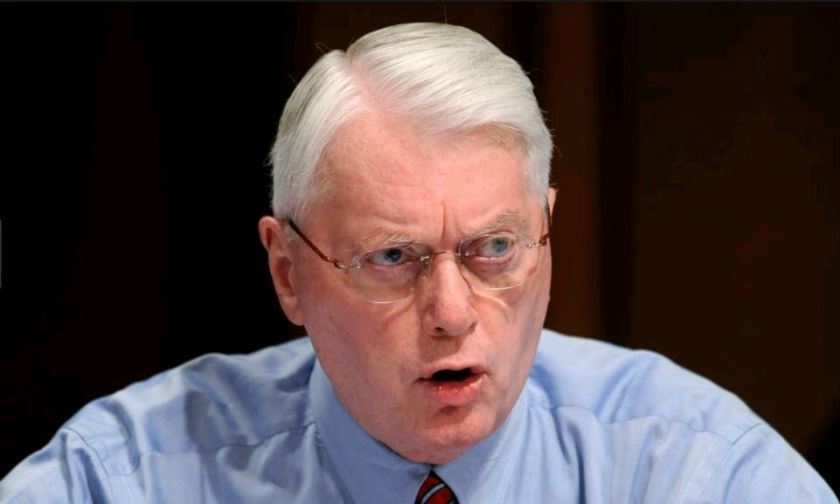
Jim Bunning joined this small group when he was elected to the U.S. House of Representatives in 1985.  He served six terms in the House, representing Kentucky’s 4th district. In 1998 he was elected to the Senate and re-elected in 2004. He was 85 when he died last Friday.

bunning

He led an interesting life, an impactful life, and ordinarily I’d feel happy to write a little about someone like that. But Jim Bunning did a lot of things as a congressman that make him an outlier, and not in a good way.  He often found himself at odds with fellow Republicans and often caused controversy.

In the Senate, he was routinely given the highest “conservative” score by those that calculate such things. He opposed Obamacare, of course. A Catholic with nine children, he was strongly anti-abortion. He made inappropriate remarks about his opponents and Supreme Court justices.

This NPR piece says,
As a politician, he was known as “blunt and abrasive,” according to Politico. “In 1993, for instance, he referred to President Bill Clinton as ‘the most corrupt, the most amoral, the most despicable person I’ve ever seen in the presidency.’ In 2009, he made headlines by predicting Supreme Court Justice Ruth Bader Ginsburg would be dead of cancer within nine months.”

Bunning single-handedly held up unemployment payments for millions of Americans during a two-day filibuster against $10 billion in stimulus spending.

According to this CNN piece, Bunning decided to leave the Senate in 2010 after tension with his own party.

“Unfortunately, running for office is not just about the issues,” Bunning said in a 2009 statement. “Over the past year, some of the leaders of the Republican Party in the Senate have done everything in their power to dry up my fundraising. The simple fact is that I have not raised the funds necessary to run an effective campaign for the U.S. Senate.”

The remark appeared to be a thinly veiled hit at fellow Kentucky Sen. Mitch McConnell, who was the Senate minority leader at the time.

Bunning butted heads with McConnell more than once and called him a “control freak”.  “McConnell is leading the ship, but he is leading it in the wrong direction. If Mitch McConnell doesn’t endorse me, it could be the best thing that ever happened to me in Kentucky.”

Asked by The New York Times in March 2009 whether he felt betrayed by some Republican colleagues, Mr. Bunning replied, “When you’ve dealt with Ted Williams and Mickey Mantle and Yogi Berra and Stan Musial, the people I’m dealing with are kind of down the scale.”

Reading that made me think back to the first time the name “Jim Bunning” penetrated my consciousness.

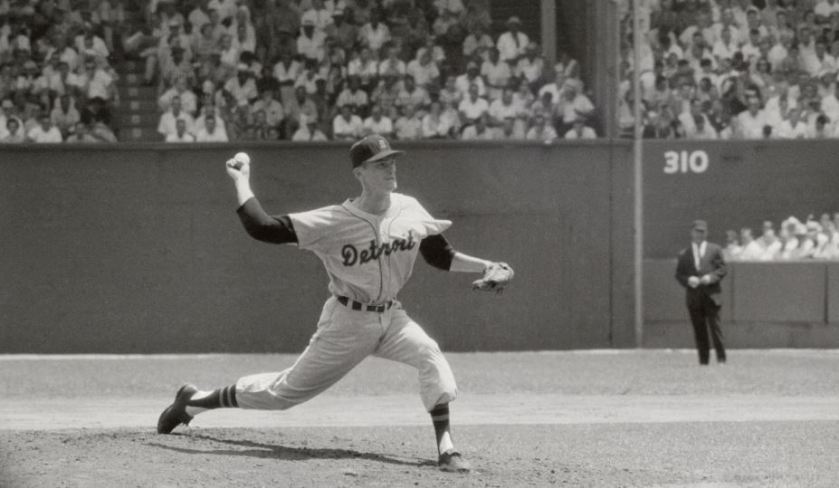
On July 20, 1958, he took the mound for the Detroit Tigers in Boston’s Fenway Park and pitched a no-hit, no-run game against the Red Sox. That had only been done twice before in the 46-year history of Fenway, both times by Hall-of-Famers. Walter Johnson did it in 1920 and Ted Lyons in 1926.

bunning2

Fenway is noted for its “Green Monster”, the huge wall in left field that appears to be just a few feet beyond the infield, and its lack of foul ground – hitters can stay alive on fouls that would be caught for outs in other venues.

It’s a hitter’s paradise and a pitcher’s nightmare. The Red Sox always tailored their line-ups for Fenway and routinely produced batting champs. Of course their own pitchers had to pitch in Fenway as well, so it didn’t translate too well into actual wins.

The line-up Bunning faced that day included a bunch of guys who were hard to get out on any day, and who were hitting over .300 at the time: Frank Malzone, Jackie Jensen, Pete Runnels, and, of course, the Greatest Hitter Who Ever Lived,  Ted Williams, who Bunning retired for the final out of the game.

The 26-year old Bunning was coming off a great 1957 season in which he led the American League with 20 wins. He had a side-arm delivery that gave right-handed hitters the impression the ball was coming at them from somewhere around third base. He was known for his combative nature, burning desire to win, and willingness to throw a “purpose pitch” when he thought it was needed, i.e. to hit an opposing batter to make him a little less comfortable digging in against him.

Bunning led the league in hit-batsmen four years in a row, and had 160 for his career. That’s more than anyone else in the last 90 years except for Tim Wakefield and Charlie Hough, both knuckle-ball pitchers who really didn’t know what was going to happen to the ball after it left their hands.  And if the knuckle-ball did hit a batter, everyone knew it was an accident and getting hit by the floater didn’t hurt a bit in any case.

Tiger team-mate Frank Bolling said, “If he had to brush back his mother, I think he’d do it to win.”

Bunning didn’t appreciate opposing players talking trash at him, either. He once threw at the always-talkative Red Sox center-fielder, Jim Piersall, for jawing at him too much. That one was a little unusual because Piersall wasn’t batting at the time, but waiting his turn in the on-deck circle.

Team-mate Larry Bowa told a story about Bunning’s approach, which is quoted in this NYT Obit, about a game that he pitched at Montreal in the early 1970s.

“The Expos had Ron Hunt, a guy who loved to get hit. Well, Bunning threw him a sidearm curveball, Hunt never moved, and it hit him. The ball rolled toward the mound, and Bunning picked it up. He looked right at Hunt and said: ‘Ron, you want to get hit? I’ll hit you next time.’ And next time up, bam. Fastball. Drilled him right in the ribs. And he said to Hunt, ‘O.K., now you can go to first base.’”

Bunning thoughtfully described pitching the no-hitter this way:

“For most pitchers like me, who aren’t overpowering supermen with extraordinary stuff like Sandy Koufax or Nolan Ryan, a no-hitter is a freaky thing.  You can’t plan it.  It’s not something you can try to do.  It just happens. Everything has to come together – good control, outstanding plays from your teammates, a whole lot of good fortune on your side and a lot of bad luck for the other guys.  A million things could go wrong – but on this one particular day of your life none of them do.”

He was traded to the Phillies in 1963, and was as effective in the National League as he had been in the American.  He pitched a “perfect game” (retired all 27 men he faced) against the Mets in New York on June 21, 1964, the first one pitched in the National League in 84 years, thereby revealing his previous comments about pitching a no-no to be overly modest.

To get elected to the Baseball Hall of Fame, you need to get 75% of the votes from the Baseball Writers Association of America, and you have only 15 years of eligibility after retirement. Bunning came close, but never got the nod from the writers. But in 1996, 25 years after he retired, he was voted in by the Veteran’s Committee, which included many players who had tried unsuccessfully to hit his pitching. “The writers never faced him,” Hall of Fame shortstop Luis Aparicio said at Bunning’s induction ceremony.

As a Boston baseball fan and someone who thinks government can actually solve problems once in a while, I always dreaded it when my team had to go up against Bunning. I didn’t like to see him standing on the pitcher’s mound opposing us and I didn’t like to see him standing in Congress opposing us either.

But give the devil his due: Jim Bunning knew what he wanted to do, did things not because they were politically expedient but because he believed in them, went about achieving his objectives in his own unique way, always fought hard, and never backed down.

Angry Germans on the move

This article in the Washington Post yesterday describes Angela Merkel giving a speech in which she says that Europe “really must take our fate into our own hands.”  She’s the leader of the most powerful country in Europe and is saying that, based on Trump’s behavior and words on his recent trip, they can no longer rely on U.S. support, that those days were  “over to a certain extent. This is what I have experienced in the last few days.”

Trump managed to piss off the Germans and all the other members of NATO on this trip, as only he can do. Here at GOML, we have mixed emotions about all this.

Our first, visceral reaction is, “yeah, good idea – fight your own battles for a change”. But then I realized I was taking a baby step towards falling under the spell of the man-baby’s populist, history-averse, fact-free, bullying, Make-America-Great-Again, ignorant blathering.

Hang on, I thought, I’m looking at the leader of Germany advocating German strength to over a thousand closet übermenschen in a Munich beer hall, and getting a prolonged standing ovation. We’ve seen this picture before,  and should understand where it can lead.

merkel

Today’s German loves to think of himself as an environment-respecting, tolerant, pacifist and conscientious objector, or, if he’s of a certain age, a heroic member of The Resistance. But scratch the surface and add a couple of liters of Weizenbock, and you’ve got, well, the same old German we’ve all learned to admire so much over the years. For 70-some years, they’ve been keeping their heads down and channeling all their energy into building expensive cars and whatnot, but now the man-baby has them stirring again.

In the comment section of the WaPo piece, someone calling himself AngryGermans, starts by rightly pointing out that the Germans have promised to spend 2% of their GNP on NATO by 2024 and they are not in arrears, as Trump has bloviated (is there no one who can correct him on these things?), and so on. But he finally works himself up to:

Everyone in Germany hates the thought to have nuclear weapons. That said, i don’t think we would hesitate to build them if needed. Yeah and Germany won’t take years for it, like North Korea or Iran. We can do that in weeks.

To which someone who sounds suspiciously like Stewie Generis replies,

The proof that Trump is an idiot: he’s now got AngryGermans bragging that they can build nuclear weapons in weeks and their leader getting a standing ovation in a Munich beer hall for advocating German strength (sound familiar?). Angry Germans have shown themselves, repeatedly, to be the greatest threat to peace and sanity the world has ever seen. Thanks, President Crazypants. Wait till you get a load of what angry Germans will do to the rest of us as soon as their economy turns south.

Anyway, how does it serve our interests to undo decades of European/American diplomacy intended to keep the Russian bear out of Europe and the Germans under our military control?

It doesn’t. But you know whose interests it does serve? Wait for it…

I’ll give you a clue: his name begins with “P” and rhymes with shootin’.

putin

Bird in a gilded cage

I generally have no sympathy for Melania Trump. Like the other Trump wives, she’s made her choices and can now live with them. She actually seems to have things pretty much her way, though, so no tears for her in any case. Doesn’t have to go to that backwater, D.C., doesn’t have to live with the man-baby, shops and gets her hair done at will.

I’m not aware if she has any “interests” beyond that, but that’s probably because I pay as much attention to Melania as I do Pippa Middleton, whoever that is.  All I know about Pippa is that he or she is in today’s Google news feed, and has something to do with being “royal” or whatever. It’s therefore probably not fair for me to have too many opinions about either of them – though being on everyone’s radar does seem like part of their shtick.

I do think it’s strange that on the one or two occasions that Trump has returned to New York since inauguration, he has actually stayed at his golf club in New Jersey, rather than Trump Tower with his lovely wife. Saving the taxpayers money, he explains. By creating yet another security nightmare at yet another location. Well, I guess he knows what he’s doing.

This picture is a bit sad, though. Even I have to admit that.

bird in a gilded cage

We’re used to seeing The First Lady walking dutifully behind The First Man-Baby, but Jesus Christ! Can’t these effing Saudis find one person who will talk to her? Or walk next to her? Or look at her? Isn’t there some American diplomat somewhere that could make this a little easier on her? How about a little dab of multiculturalism for the visiting dignitaries?

No. The women must remain as invisible as possible in the Kingdom. This is achieved in part by refusing to look at them when the infidels bring them along.

For the evening’s entertainment, the man-baby took part in a male-only traditional sword dance. So much fun.

sword

I’m not clear on where Melania spent the evening. Comparing nail polish with some of the wives somewhere out of sight? Couldn’t say.

Melania seems to me to be a bird in a gilded cage. I don’t know why anyone would aspire to this life or envy anyone in her position. Unlike the Saudi wives, however, it’s a role she chose for herself.

Mazel tov, fegelah.

A Hard Rain’s a-Gonna Fall

It was 54 years ago this week that a little-known folk singer named Bob Dylan told the most important figure in prime time television, Ed Sullivan, to take a hike.

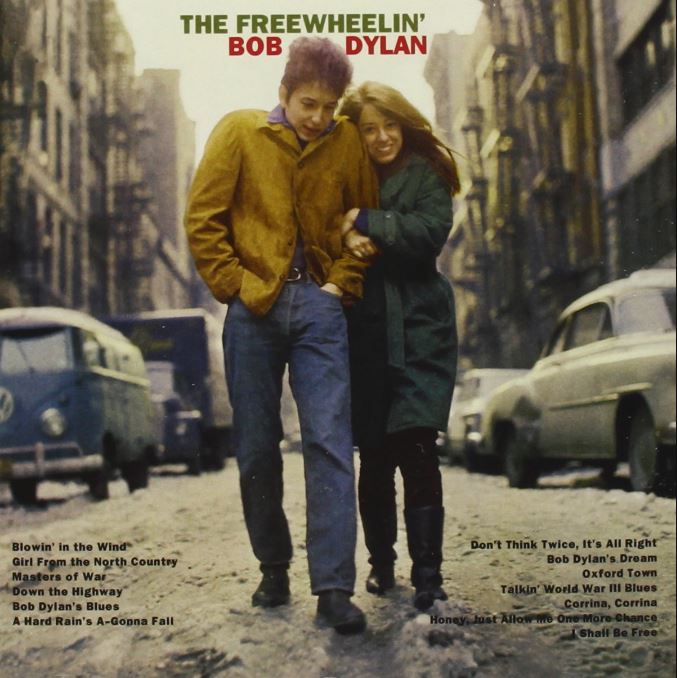
In May of 1963, Dylan had a small following based on playing clubs around Greenwich Village and the release of his first album a year before, called “Bob Dylan”, which contained only two original songs. His second album, “The Freewheelin’ Bob Dylan”, which would change  everything, had not come out yet.

freewheelin

Freeweheelin’ had a bunch of  soon-to-be-classic Dylan compositions on it, including “Blowin’ in the Wind”, “Girl from the North Country”, “Masters of War”, “A Hard Rain’s a-Gonna Fall”, and “Don’t Think Twice, It’s All Right”.

Before Freewheelin’ dropped, Dylan was like a lot of other people struggling to be heard. Unlike almost everyone else, though, he got a huge break in the form of an invitation to appear on the Ed Sullivan Show, which at that time was the biggest thing anyone could hope for. It was the country’s highest rated variety show – a guarantee of a huge national audience.

But on May 12, Dylan walked off the show because network censors rejected the song he planned on performing, “Talkin’ John Birch Paranoid Blues”. The song lampooned the loony right for its tendency to see a “Communist” everywhere they looked, and the network worried they’d be sued because the song equated the views of the Birchers with those of Hitler.

They asked Dylan to choose a different song and he told them to choose a different singer.

As you may know, The John Birch Society was co-founded by Fred C. Koch, the father of David and Charles Koch, who have been doing their best for some time now to ruin this country with their Dark Money.

An excerpt from Amazon’s description of “Dark Money: The Hidden History of the Billionaires Behind the Rise of the Radical Right”, by Jane Mayer:

Why is America living in an age of profound economic inequality? Why, despite the desperate need to address climate change, have even modest environmental efforts been defeated again and again? Why have protections for employees been decimated? Why do hedge-fund billionaires pay a far lower tax rate than middle-class workers?
     The conventional answer is that a popular uprising against “big government” led to the ascendancy of a broad-based conservative movement. But as Jane Mayer shows in this powerful, meticulously reported history, a network of exceedingly wealthy people with extreme libertarian views bankrolled a systematic, step-by-step plan to fundamentally alter the American political system. 
     The network has brought together some of the richest people on the planet. Their core beliefs—that taxes are a form of tyranny; that government oversight of business is an assault on freedom—are sincerely held. But these beliefs also advance their personal and corporate interests: Many of their companies have run afoul of federal pollution, worker safety, securities, and tax laws.
     The chief figures in the network are Charles and David Koch, whose father made his fortune in part by building oil refineries in Stalin’s Russia and Hitler’s Germany. The patriarch later was a founding member of the John Birch Society, whose politics were so radical it believed Dwight Eisenhower was a communist. The brothers were schooled in a political philosophy that asserted the only role of government is to provide security and to enforce property rights. 

The Kochs have changed the face of Congress by bankrolling candidates that can be relied upon to support their views, and by attacking their opponents with all manner of fake news, made-up scandals, and assorted dirty tricks.

One of the beneficiaries of the Koch largess has been Trey Gowdy, a partisan hack from South Carolina, who has been nicknamed “Hillary Slayer” for his absurd and relentless persecution of Hillary Clinton when he was chairman of the Benghazi hearings, a two-year long waste of the taxpayers’ money. His behavior more closely resembled that of a demented piranha than a U.S. Congressman.

pir1

Guess who Trump’s first choice for the next Director of the F.B.I. is?

trey1 Trey Gowdy

Just when you think Trump can’t top himself, he surprises you. At least this time we don’t have to fret about whether Trump will again be so clueless as to ask Gowdy for his loyalty. Everyone already knows the answer to that one.  And it’s another big day for the sons of the Birchers – the Kochs are smiling about this.

As Dylan said all those years ago, “A Hard Rain’s a-Gonna Fall.”

hardrain

Arkansas on a spree

So Arkansas has executed four people in the last eight days, after not executing anyone for twelve years. Wow.  This is really a disgrace.

lethal

Before I tell you why I think this is a disgrace, let me make most of you angry by telling you what my cousin Screwie Generis thinks. Screwie is a lot smarter than I am, and he thinks the death penalty is just fine. Here’s how he responds to some of the standard objections to the death penalty.

1.  “It’s cruel and unusual”.  Perhaps, but then almost everything about our prison system is cruel and unusual, starting with the absurdly high incarceration rate itself, and going all the way up to using prison as a warehouse for all our deinstitutionalized mentally ill. There is no logical basis for singling out the death penalty for its cruelty or unusualness.

2. “It’s used disproportionately against people of color”. This is not an argument to end the death penalty – it is an argument to use it more often on white offenders. The question isn’t what color the murderer is, but whether he committed a capital offense.

3. “It might make you feel better, but it won’t bring back the victim”. Exactly! Nothing can bring back the victim. Life imprisonment can’t do it. A slap on the wrist can’t do it. No punishment you can invent will bring back the victim. The point of capital punishment is that actions have consequences, and this is the correct price to be paid for ending someone’s life.

4. “It doesn’t deter crime”.  Nonsense.  It deters the shit out of the guy you’re executing. No more stabbing the corrections officers for you, sonny boy. Anyway, if deterrence was the main objective of capital punishment or any other punishment, we’re doing it all wrong.  You’d have to start by performing the punishment where those you’d like to deter can see it – in the public square or on TV, for example.

5. “It’s not justice, it’s revenge.” It’s both. But so what if it was just revenge? Why is that not an adequate justification? And, again, isn’t any other punishment also “revenge”?  The more important question is, did the guy commit the crime or not?

6. “It’s costly.” Quite beside the point. Everything we do as a society, both the right things and the wrong, has costs. This argument belongs somewhere else. Are you challenging me to think of a cheaper way to kill someone? Because I can do it if you are.

7. “The state has no right”. Hmmm.  What “right” does the state have to do anything at all? There are plenty of people out there who think the state has no right to collect income tax, to designate National Monuments, to seize land by eminent domain, or to do many other things that we now allow it to do. The state has whatever “rights” we grant to it.

8. “What if you execute the wrong guy?” OK, now you’re making sense. You cannot execute someone if there is any chance whatever that he is the wrong person. You just can’t do it. The Innocence Project has done some great work in this area, though I’m a bit puzzled by how Barry Scheck can use DNA to free both the innocent and the guilty (remember O.J.?)   It’s a really horrible thought that even one innocent person was ever put to death. But, again, this is less an argument against capital punishment than an argument against convicting innocent people. It would also be horrible (maybe even worse!) for an innocent man to spend his life in prison. But, yes, I get it: if you find out someone is innocent, and you haven’t yet executed him, you can release him. The standard for capital punishment cannot be the “beyond a reasonable doubt” standard that got him convicted, but must be raised to “without a molecule of doubt”.

9. “The murderer is a changed man – he’s rehabilitated and no longer the same guy who committed the crime”. Again, so what? I’m no longer the same guy I was when I (did something) 20 years ago. But I still did it. It still has repercussions for someone else. Can you just murder someone and say, “Hey, that was last week – I’ve grown!” and be absolved?  Should we give Poland a call and tell them to leave this guy alone?

10. “The poor guy has the I.Q. of a dust mite – he doesn’t know right from wrong.” He doesn’t know right from wrong, but you want to let him go free? No thanks.

11. “You must take the perpetrator’s background into account – he had a terrible upbringing and it’s understandable why he did the things he did.”  Puh-leeeze! First, tons of people had rough upbringings and did not choose to kill anyone.  In making this argument, you are denying free will, and, well, we’ll just have to agree to disagree on whether we have free will. But more importantly, think of the implications if we go along with it! You’re saying we have to set the murderer free because his step-father put cigarettes out on his chest when he was nine, and he can’t be held responsible for his actions. Fine. Release him. And when he does it again, you have to release him again because the back-story hasn’t changed. You’ve made the punk into James Bond – he has a license to kill.

Whew. OK. Enough from Screwie. But at this point you’re probably asking why, if I think Screwie’s arguments defending capital punishment merit repeating here, did I start by saying that what Arkansas is doing is a disgrace.

Arkansas is executing these guys because their supply of the lethal drugs that they use for executions is nearing its expiration date, and they think they might have trouble getting more.

Screwie might be able to convince me that there are valid reasons to defend capital punishment, but I can’t be convinced that running low on poison is one of them.


No True Frenchman

You know the “No True Scotsman” logical fallacy? It’s a ploy that makes any argument impervious to contradiction.

If Angus, who lives in Glasglow and who puts sugar on his porridge, is proposed as a counter-example to the claim that “No Scotsman puts sugar on his porridge”, the “No true Scotsman” fallacy would work this way:

(1) Angus puts sugar on his porridge.
(2) No (true) Scotsman puts sugar on his porridge.
(3) Therefore Angus is not a (true) Scotsman, and
(4) Angus’ putting sugar on his porridge does not disprove the claim that no Scotsman puts sugar on his porridge.

The other day, Marine Le Pen, the right wing “National Front” candidate running for President of France said that France wasn’t responsible for the Vél d’Hiv roundup. This was the action of July, 1942,  in which the French, without any help from the Germans, deported 13,000 “stateless” Jews, i.e. those that had fled to France from elsewhere in Europe, seeking French protection from the Nazis.

French police rousted them from their beds, sent 6,000 immediately to Drancy (a transit camp for Auschwitz in the Paris suburbs), and crammed the rest into an indoor bike track in the 15th Arrondisement called the Vélodrome d’Hiver for five days without food, water or toilets, before deporting them to be murdered.  They conducted the round-up to demonstrate to the Germans that they were reliable allies, in agreement with the German goals.

But “the French” didn’t do that, according to Le Pen, who said, “France wasn’t responsible for the Vel d’Hiv. If there was responsibility, it is with those who were in power at the time, it is not with France. France has been mistreated, in people’s minds, for years.” Le Pen wants true Frenchmen to be proud of France. Fair enough.

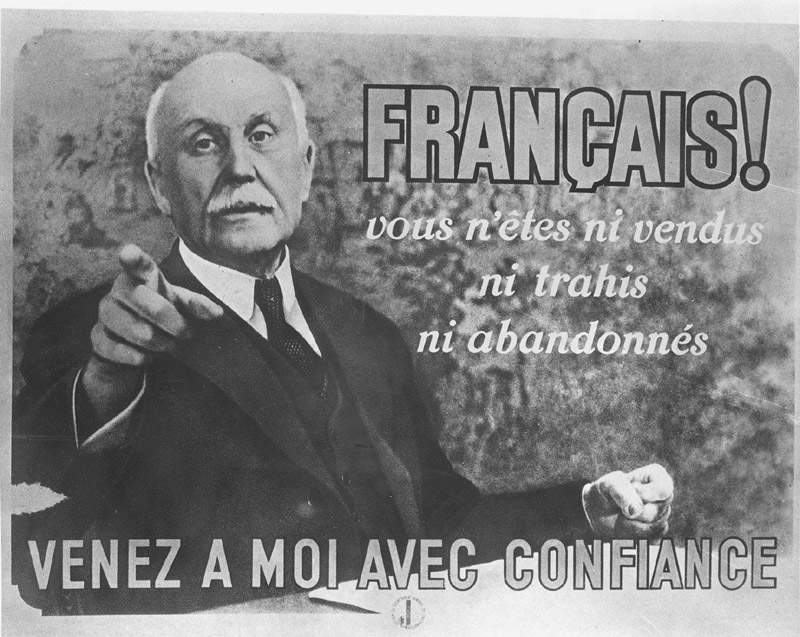
No, it was the Vichy regime then in power that was responsible, and they couldn’t really be French, because no true Frenchman could have done such a thing. Except that they were as French as any Frenchman has ever been – Philippe Pétain, the “war hero” of Verdun was at the head of the Vichy government, and was a beloved figure enjoying great popularity in France at the time of  the Vél d’Hiv episode.

Petain

petain2

And all the police that conducted the operation were, what, if not French? And all of the citizens looking on as the Jews were taken away were French as well. Some clucked their tongues and shook their heads at the scene, while many jeered and insulted the deportees. But they were all true Frenchmen.

As the years pass, and living memory of the events is gradually extinguished, there is a strong tendency on the part of those who interpret history now to confuse French dislike of or resistance to the Germans with some feeling of goodwill or responsibility toward the Jews. The way I see it, no one wants to be occupied by Nazis, but they might be able to find a silver lining in that cloud: the Christ-killers get what they’ve always deserved, and lots of choice apartments in the Marais become magically available overnight. Furnished, too!

According to this NYT piece,

Ms. Le Pen’s words also flew in the face of over four decades of historical research into the eager collaboration of the wartime French government, which had been installed in the spa town of Vichy. It was the French government’s police chief, René Bousquet — a favorite of the head of the government at the time — who organized the roundup, impressing his German counterparts with his energy.

“Vichy did not have a knife to its throat,” the historian Philippe Burrin wrote of the Vel d’Hiv roundup in his landmark book, “La France à l’Heure Allemande,” (“France Under the Germans”).

“Without the help of the police” — the French police — “the SS was paralyzed,” Mr. Burrin wrote. “The French authorities were entirely disposed to get rid of foreign Jews,” he wrote, referring to the officials’ offer to the Nazis, on that occasion at least, to hand over Jews who were not French citizens.

It always puzzles me that people who advocate for the removal of Jews from public life refuse to acknowledge that others have tried it before and succeeded.  And then call those who mention it liars and slanderers. It’s weird. They say they’d like to do it but are offended by the notion that someone did do it?

The antecedents and founders of Le Pen’s “National Front”, though French, might as well be Nazis. Attempts to explain how they are not Nazis make distinctions without differences. They hated the Jews, who they regarded as “the other” and a threat to French life.  The party was founded by Le Pen’s father,  Jean-Marie Le Pen, a convicted holocaust denier, who famously referred to the Nazi gas chambers as “a detail of history”. Marine finally kicked her father out of the party two years ago, and has been trying to “de-demonize” it, make it less odious and more acceptable to the true Frenchmen, with good success.

I’ll defer discussion of the frightening rise of blatant anti-semitism in France in recent years, and just say that  French sentiment is what it has always been, though the degree of the “blatant” fluctuates. Not much has changed since Dreyfus, Zola, and Herzl, or forever before that, despite the stark lessons of the intervening history.

Marine Le Pen is a true Frenchwoman. She has made it acceptable for French people to think and say things which have not been acceptable to think or say for decades. She has a lot of popular support, and the people who may well vote her in as the next President of France are also true Frenchmen.

The customer is never right

In corporate America today, the transformation is almost complete. The big ones are just about done eating the little ones. How many options does the consumer really have now when choosing a bank? Or an internet/cell/TV provider? Or an airline that flies a particular route? Even the grocery stores are coming under the the control of the increasingly few corporate parents.

As consumers have their choices reduced, and as companies who built their business on great customer service are acquired by companies that didn’t, the whole notion of trying to do right by the customer is becoming obsolete.

If you need to call Intergalactic Cable because they just added another $15 to your monthly bill for no apparent reason, you’ll soon realize the effort required to get that money back will cost you a lot more than $15 in time, effort and aggravation.

You wade through a maze of voice menus and finally arrive on “hold” listening to a recorded voice tell you repeatedly that your call is important to them. Your call is not important to them. It’s a giant pain in the rear end and they hope you just go away. But don’t forget to pay your bill promptly to avoid penalties.

When someone finally does answer, you soon realize they are entry-level employees in the Philippines or India or somewhere else where labor is cheap. They read from a script, often in an accent you have trouble comprehending. They have no authority to address your issue. They try to sell you additional “services”. Would you like to enroll in their auto-pay program? They’ll just go right into your account every month without you needlessly worrying about the details. So convenient!

You may be transferred and transferred again to other “customer service” people who also cannot help you. Sometimes you wind up back with the department you started with, but with a different person. Each step along the way requires you to provide extensive identifying information before you start all over trying to explain the problem. You’re fortunate if, after all this, you aren’t simply disconnected. And if you do achieve the goal you started out with – getting that $15 removed – you feel like you’ve won the lottery. But that $15 will reappear in two months and you can decide then if you’d like to repeat the experience.

If you’re dim enough to ask your insurance company to give you some money when you discover your car has been dented in the parking lot while you were shopping, your rates will be raised. The business model amounts to “you give us money, we give you nothing”.

The customer is not always right. The customer is a sucker to be fleeced.

The corporation has several constituencies that need to be served, and their interests conflict. First and foremost, management must be taken care of. The C-level few will get their obscene compensation packages whether the company does well or not, whether the products are faulty or not, and whether the customers complain or not.

After they’ve had their turn at the trough, the shareholders may or may not get some return on their investment, then the employees may or may not get some consideration, and then comes the customer. The customer gets nothing.

We’re supposed to feel good when we read a story like this one about Wells Fargo clawing back $75 million from two executives. Two! This is after six months of them  “investigating” themselves about the fraud which saw two million fake accounts created and 5300 employees fired. See, it was the employees who were actually the guilty ones! Why did these two jokers get paid so absurdly in the first place? Why does it take a media firestorm to get rid of them, and another to get some of the loot returned?

Here’s a piece  from last July that puts the nine-figure compensation of failed Yahoo CEO, Marisa Mayer, “in perspective”. She’s gone now. What would they have had to pay her if she actually did what they hired her to do, i.e. finally turn the company around?

You only get “accountability” from the guys at the top after they’ve exhausted all their other options. This week’s United Airlines fiasco is a case in point. First came the statements from the top about how procedures were followed and how proud they are of their employees. Then there was some talk about how they weren’t really the bad guys, because, see, it was actually law enforcement that screwed up. Then there was the obligatory blaming of the customer – he was “defiant” (as opposed to what?). Then there were some lukewarm “apologies” for having to “re-accommodate” some passengers (none of whom had actually been accommodated in the first place).

DC: Airline Industry CEO's Speak At Chamber Of Commerce

Only after it became clear that this wasn’t going away, that there would be lawsuits, that the paying customer was assaulted (lost his front teeth and was concussed!), that CEO Oscar Munoz is finally using some more-or-less appropriate language. As part of this mea culpa, he also said “It’s never too late to do the right thing,” Actually, after you’ve knocked out your customer’s teeth, it is a little late.

But if you believe for a minute that any of this is sincere, that it’s anything other than pathetic attempts at damage control, well, you’re the perfect customer for United Airlines and all the other mega corporations for whom competition in our “free-market” economy is not a worry.

Anyway, I started writing this because today I read something about the airlines overbooking policies that bothered me. I wrote the other day that it seemed to me that, since you pay for your ticket when “reserving” it these days, the airlines will have their money whether you fly or not, and that the overbooking policy now is nothing more than an opportunity for them to sell the same seat twice. The article I read today said no, not exactly, because when people who purchased a refundable ticket don’t fly, they might get their money back and then the airline loses.

First of all, I’m not worried about the airline “losing”. They’re doing fine. Second, I’d need to see some statistics about how many of the no-shows actually bought refundable tickets, because they often cost twice as much or more than the non-refundable ones. And third, the airlines have already protected themselves against the possibility of losing money on no-shows. The full-fare customers who did fly have simply paid an insurance premium for something that didn’t happen. It’s all profit for the airline, and loss for the customer.

So what’s the takeaway here? Uh, I’m not sure. We’ve gone pretty far down the road of corporate consolidation to turn that ship around at this point. And I think we can rule out hiring Marisa Mayer to fix things, or anyone at Wells Fargo. But, beyond that?

Bernie for President in 2020?


Remembering Roger Ebert

Roger Ebert died four years ago this week, after waging a long and harrowing battle with cancer. He was 70. He made an excellent film documenting his struggle called Life Itself, in which his courage, determination, and good humor are on ample display, despite being disfigured by surgery, and having to make innumerable concessions to the disease. He continued to work at that which he loved, writing about movies, under very difficult circumstances, until the end.

ebert

He wrote and talked about movies for over 45 years, mostly for the Chicago Sun Times, and was the first movie critic to win the Pulitzer Prize for Criticism. His early television series on P.B.S. with crosstown rival Gene Siskel, “Sneak Previews”, became the highest rated show ever on that network, and the “thumbs up or down” verdict they offered became a standard which has endured through the decades. This week, Netflix introduced it to their site.

The thing I liked most about Ebert’s writing was that he had not a molecule of the “critic’s disease” that seems to require most people to say something gratuitously negative about some part of the work, so as to show how smart they are. Or, perhaps, include obscure references that only a film historian would know or care about and which contribute little to the task at hand.

He wrote beautifully and his love of movies came through clearly. He was unpretentious in his tastes, and wrote from the point of view of the consumer of film, i.e. someone who had paid their money in the hopes of being entertained and engaged, and who was favorably disposed to the product by default.

Beyond that, his writing was extremely perceptive, and sometimes even prophetic. He helped you understand things you may not have noticed or were unable to articulate, and he whetted your appetite for seeing or re-seeing the movie he was writing about.

When Mike Leigh made his first movie in 1972, “Bleak Moments”, Ebert saw it and wrote,

I’ve never heard of Mike Leigh or his actors before. I don’t know where they came from, or what pools of human experience they were able to draw from. And I suspect that the sheer intensity of “Bleak Moments” may prevent it from getting a wide audience. Indeed, this particular story could never have been told in such a way as to appeal to everybody.

It is the task of film festivals to find films like this and give them a showing, so that they can survive and prevail. The 1972 Chicago festival has been filled with movies worth seeing and remembering. But if it had given us only “Bleak Moments,” it would have sufficiently exercised its mission.

What’s interesting to me about this is that Leigh did not make another movie for 17 years (he created screenplays only after improvising scenes with his cast, so he never had one to sell), but Ebert’s comments were correct, and correctly generous to an unknown talent. He makes you want to go find this movie and watch it, and to read more about Mike Leigh’s movies, an exercise that will certainly reward your effort.

If you want a break from current events or are bored with your regular reading diet, I recommend visiting this site, and choosing a movie you like, or perhaps one you never heard of, and reading what Ebert had to say about it.  You’ll learn something and enjoy the time spent – what more could you ask from a critic?

Art triumphs over fate

Henry James said, “One is touched to tears by this particular example which comes home to one so – of the jolly great truth that it is art alone that triumphs over fate.”

He was talking about the bronze tomb effigy of his friend, Elizabeth Boott Duveneck, that adorns her grave in Florence, where she died at age 41. He wrote about her and her home in Florence in his novels, Portrait of a Lady and The Golden Bowl.

A marble version of the tomb effigy was commissioned by her father for the Museum of Fine Arts in Boston. The effigy was made by her husband Frank Duveneck, as was the portrait of her, which hangs in the Cincinnati Art Museum. Click below to enlarge.

“The Last Day of Pompeii” is a painting done in 1833 by the Russian artist Karl Briullov. He had visited Pompeii in 1828 and was inspired by the subject of the eruption of Vesuvius in 79 A.D., which had destroyed the city and entombed its surprised residents in ash.

pompeii

When the Pompeii site was excavated, plaster casts were made of the cavities in ash left by the decomposed bodies of the trapped citizens, revealing their fate, i.e. how they were posed at the moment of their deaths.

Briullov exhibited his huge painting (21′ x 15′) in Rome to great acclaim, garnering attention that was unprecedented for a Russian artist abroad. He never made anything else that approached this success.

The painting inspired Alexander Pushkin to write a poem about it and Edward Bulwer-Lytton to write a novel, “The Last Days of Pompeii”, published in 1834. The book was very popular and had many memorable characters, including Glaucus, a handsome Athenian nobleman; Ione, a beautiful Greek aristocrat engaged to marry Glaucus; and Nydia, a young slave kidnapped from high-born parents who sells flowers to get money for her owners.

Nydia is blind and in love with Glaucus, but keeps silent about this because she knows he’s taken. When Vesuvius erupts, Nydia tries to lead Glaucus and Ione to safety, using her heightened sense of hearing, more useful than sight in the ashy chaos. She loses the two at one point, but somehow finds them again and ultimately leads them out. In the end, her unrequited love for Glaucus causes her to commit suicide.

The story of Nydia inspired Randolph Rogers to sculpt this piece in 1859, called “Nydia, the Blind Girl of Pompeii”.

nydia

Rogers’ work became the most popular American sculpture of the nineteenth century and was replicated 167 times in two sizes, according to him, with many fewer of the full sized version. He did this by making a full-size plaster model, and then having skilled Italian masons cut and polish new examples based on the model.

Several important museums have a version, including the Metropolitan Museum of Art in New York, The National Gallery of Art in Washington, The Art Institute of Chicago, and The Museum of Fine Arts in Boston. I took the below picture of the MFA version yesterday with my phone, which may explain the poor quality.

Nydia (2)

Since 2012, admirers of Nydia in the MFA are often struck by the painting on the wall next to her, which is entitled “Museum Epiphany  III”, done in a photorealist style by Warren Prosperi. It shows museum goers admiring art in the very gallery where the painting is hung. The woman at the left of the frame would be looking at the picture she’s in.

epiphany

So, to review: the eruption of Vesuvius and the excavations of Pompeii in the mid-eighteenth century inspired Briullov to create a brilliant painting, which inspired Bulwer-Lytton to write a widely read book, which inspired Randolph Rogers to make a greatly admired sculpture, which inspired Warren Prosperi to paint an extremely interesting picture, which inspired me to write this today.

This may or may not be what James meant by the triumph of art over fate, but it’s fun to think about it.

Resistance: Masha, Sophie, Mala

Masha

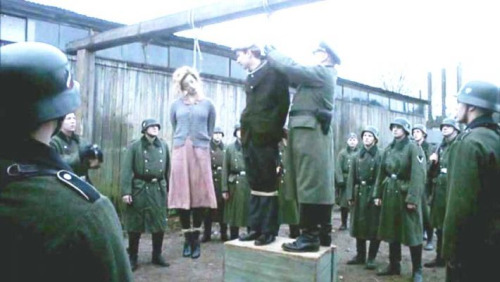
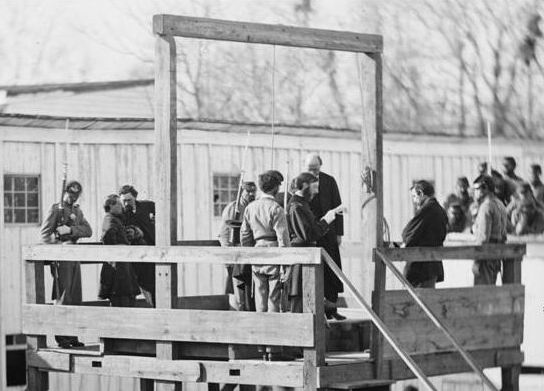
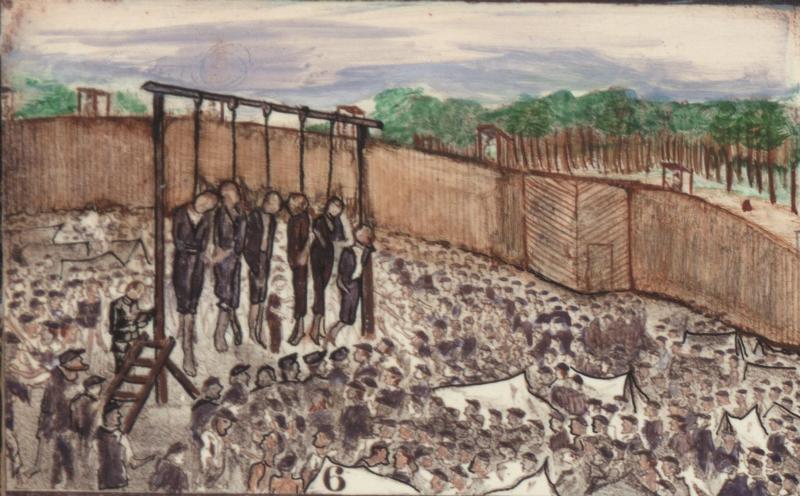
Masha Bruskina was hanged in German-occupied Minsk on October 26, 1941 at age 17, after being paraded through the streets carrying a sign saying, “We are partisans and have shot at German troops”. She wasn’t a partisan and had not shot at German troops. Her crime was that she helped captured Russian soldiers escape from an infirmary where she had volunteered as a nurse by bringing them civilian clothes.

masha

She was executed along with 16-year-old Volodia Shcherbatsevich and World War I veteran Kiril Trus, both members of the resistance. She liked to read, and had graduated from high school a couple of months earlier with good grades. When she was arrested, she wrote her mother, who she lived with, saying,

“I am tormented by the thought that I have caused you great worry. Don’t worry. Nothing bad has happened to me. I swear to you that you will have no further unpleasantness because of me. If you can, please send me my dress, my green blouse, and white socks. I want to be dressed decently when I leave here.”

masha2

Her body was left hanging for three days before being taken down and buried. All of her family members were murdered in the Minsk ghetto, and it is unlikely that Masha would have survived the war either.

A plaque at the site of the execution identified her only as “unknown girl” because Soviet authorities did not want to acknowledge her Jewish background. In 2009, her name was added to the monument, which now reads, in Russian, “Here on October 26, 1941 the Fascists executed the Soviet patriots K. I. Truss, V. I. Sherbateyvich and M.B. Bruskina”. There is also a street named for her in Jerusalem.

masha3

Sophie

After a “trial” lasting a few minutes, Sophie Scholl was sent to the guillotine and beheaded at age 22 on February 22, 1943 in Munich for the crime of treason, along with her brother, Hans. She had been a member of The White Rose, a handful of university students who had distributed some anti-Nazi leaflets. There were six leaflets in all and you can read them here.

The White Rose urged resistance to the Nazis, acknowledged their crimes and the complicity of all Germans, and saw that the war was lost, even in early 1943, after the defeat at Stalingrad.

sophie1

Sophie had five siblings. She liked to draw, and, like Masha, she liked to read. Her group of friends liked hiking, swimming, skiing, concerts, art , music, and so on. Her father was sent to prison in 1942 for making a remark critical of Hitler. Sophie almost certainly would have survived the war had she not acted as her conscience demanded.

A movie called “Sophie Scholl – the Final Days” was released in 2005, and got an Oscar nomination for the Best Foreign Film.

movie1

Malka

Malka (sometimes “Mala”) Zimetbaum was ordered to be burned alive in the crematorium at Auschwitz at age 26, on September 15, 1944. She may not have been alive when they threw her in, though, as she may have bled to death on the wheel-barrow that carried her there.

These pictures show Mala in 1941 in Antwerp, a sketch of her made in Auschwitz in 1944, and a couple of portrait photos.

She was born in Poland, the youngest of five children in a Jewish family, and had been raised in Belgium. In school, she excelled in math and languages.  She was sent to Auschwitz in September of 1942. She survived for two years in the camp, mainly because of her proficiency in Polish, Dutch, French, German, and Italian. She worked as a translator and courier. She was very well liked and respected by both guards and prisoners, and performed hundreds of kind acts and tried to save as many lives as she could.

Her crime was that she managed to escape Auschwitz with another prisoner, Edward “Edek” Galiński, a Pole who was in love with her.  On June 24th, 1944, Edek dressed as an SS guard using a uniform he had stolen, and escorted Mala through the camp gate under the pretense that she would be installing a sink which she was carrying. Their plan was to alert the outside world about what was going on in Auschwitz. They were free for 12 days and got about 50 miles away, where she was arrested trying to buy bread with gold they had taken from the camp.  Edek was watching nearby and gave himself up as he had promised he wouldn’t leave her.

They were taken to the infamous Block 11 in the main camp at Auschwitz. They tried to pass notes to each other, and Edek tried to sing opera arias near a window where he thought Mala was. They stayed in Block 11 until September 15, when they were taken to Birkenau to be executed on the same day. Galiński was hanged, shouting “Long live Poland!” as he died.

Mala took a razor out of her hair and slashed the veins at her elbows. There are various accounts of the next moments, some saying she slapped a guard’s face with her bloody hand and he grabbed her arm and broke it, then taped her mouth shut. Some said she had shouted at the guard that she would die with dignity while he would die in disgrace.

The people who bandaged her arms tried to do it slowly, hoping she could die on the wheelbarrow taking her to the crematorium, before being thrown into the flames.

Mala had been convinced she would have survived Auschwitz, given her privileged position in the camp and many allies, but she risked everything for a cause greater than herself. The camp was finally liberated four months after her death.  Information about these events came to light during the 1961 trial of Adolph Eichmann. You can read a little more about Mala here.

Faster than facts

Outrage in our time of universal connectivity and instantaneous communication is a fire than starts itself, is fanned by self-interested and ill-informed bystanders, engulfs the news cycle, and incinerates truth.  By the time it emerges that some awful thing never actually happened, we’ve all moved on and the damage can’t be undone. You can’t un-fry the egg.

The other day, United Airlines allegedly told some teenage girls they couldn’t board their flight and had to change clothes, as the “leggings” or “yoga pants” they had on were inappropriate for travel. Another passenger waiting to board the flight overheard this, took to twitter, and, well, I’m sure you know the rest of the story, because you’re alive and have access to the internet (or else you’re reading this with some superpower that I need to get right now – these broadband fees are killing me).

ZOMG! How can this happen? Those poor teenage victims! That awful sexist corporate behemoth, always oppressing the righteous and free! Those old white men, at it again! Who are THEY to tell US? A boycott must be called and the Evil Empire that is United Airlines must be defeated!  #leggingsgate

OK, everybody – slow your roll. Turns out none of it happened. At least not the way the Internet Justice League understood it. There’s more to it than the uninformed impression of the First Tweeter, which spontaneously ignited the conflagration. There usually is.

Turns out the two “victims” of this oppression were not told anything at all by the gate agent. Their family overheard the gate agent telling someone else they couldn’t fly and assumed it applied to them.  Then yet another person took the non-existent cause of the outraged girls to the internet, and the rest is history.

OK, but what about that first oppressed leggings wearer, yearning to be free? Wasn’t she a victim? Isn’t  the outrage still justified?

No. She was a “nonrev”, flying free.  See, airline employees and their families can fly standby from anywhere to anywhere else for no cost. They are non-revenue travelers, or nonrevs. It’s really the only benefit worth having for a lot of those airline jobs, which are pretty awful and poorly paid when you get right down to it.

The only thing the nonrevs have to do for this valuable privilege is adhere to a well-understood and apparently reasonable dress code. Here is the full United Airlines code for nonrev travel.

– any attire that reveals a midriff

– attire that reveals any kind of undergarments

– attire that is designated as sleepwear, underwear or swim attire

– mini skirts

– shorts that are more than three inches above the knee when in a standing position

– form-fitting lycra/spandex tops, pants or dresses

– attire that has offensive and/or derogatory terminology or graphics

– attire that is excessively dirty or has holes/tears

– any attire that is provocative, inappropriately revealing or see-through

– bare feet

– beach type rubber flip-flops

The airline does this because the nonrevs are, in a way, representatives of the business and it’s thought they should look professional, or at least, not offensive to the average paying flyer. It’s bad enough when you’re crammed into that middle seat in Coach to find out someone is up there in First who hasn’t paid a thing. And if their demeanor, including their appearance, is somehow objectionable, well, you’re an unhappy flyer and we don’t want that.

Now, perhaps you want to keep your outrage going despite this new evidence, and get on United’s case for their neanderthal nonrev policy. Well that’s a subject for another blog, the title of which might be, “Do employers have the right to demand anything at all from employees?”, or, maybe, “Is the concept of vulgarity obsolete?”

Today’s point is that journalism is dead. Fact-checking is dead. We prefer the internet, where everyone’s verison of things is as good as anyone’s, and, best of all, it’s faster than facts.


You better start swimmin’

Or you’ll sink like a stone.

It’s all happening so fast, now. You don’t see it coming. Or maybe you do, but there’s nothing you can do about it. And the weird, dystopian reality is that millions of people think it’s a good thing.

Just yesterday, three huge steps in the wrong direction were taken while our attention was focused elsewhere.

Maybe you were busy watching the  Devin Nunes shit-show. Or maybe you were pondering Trump’s brazen abdication of responsibility to his daughter and son-in-law, neither of whom is any more qualified for any of it than the man-baby himself, and neither of whom was elected, vetted, or approved by anyone but daddy.  Or maybe you’ve been marveling at Trump’s voracious appetite for spending our money on golf. After criticizing Obama for playing too much golf and asserting he wouldn’t have time for it, he’s spending money on golf at a rate eight times that of Obama.

No, none of that. Here are three other outrages that took place virtually unremarked just yesterday, and I’m not even sure they are the only three.

1. President Trump Risks the Planet.

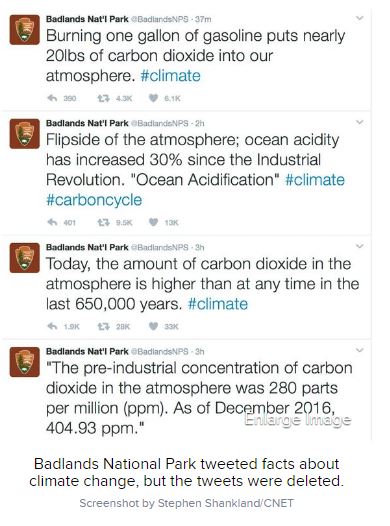
With a stroke of his pen, Trump undid all Obama’s climate change initiatives in the name of bringing back jobs to the coal industry. Oy vey. Where to begin on this one? I suppose you could start with my observations of just a few days ago.

As we’ve said before, those jobs aren’t coming back in any case. But at least now the operators won’t have to spend any money on compliance, so, you know, finally they’ll be able to afford those solid gold toilet seats on their Gulfstream G5’s. Nice, right?

jet

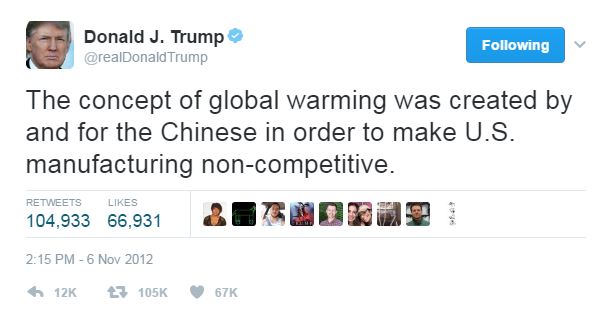
The miners that are still on the job can get back to work on that black lung thing they’ve got going, and, if Trump has his way, do it without health insurance. And the rest of us can laugh at how we didn’t fall for that Chinese hoax called “climate change”.

2. Congress blocks effort to get Trump’s tax returns.

Why? How does this make sense? Wouldn’t the Republican lawmakers want to assert just a little independence? Grab back just a little piece of the power assigned to the legislative branch that they’ve so eagerly abandoned? Clear the air on that Russia thing and other conflicts once and for all? Set and maintain a precedent that we’ve followed for decades so that future abuses, perhaps by their opponents, would be made less likely? Nah.

And all for fear of an attack-tweet from a toxic clown who’s going to drag them down anyway.

3. Your internet browsing history is now for sale without your permission or knowledge.

Huh? Wasn’t this something law enforcement needed a warrant to obtain? Wasn’t this the kind of thing the whole Snowden exposé was about?

It’s bad enough that all those lowly wage-slaves at your I.S.P. can chuckle about how you downloaded a movie illegally, or googled your high-school crush, or “anonymously” commented on some anti-Trump blog, or purchased sex-toys. Or whatever the hell you did that you assumed other people wouldn’t know about. Medical or financial information you thought was yours? No, it now belongs to them and anyone they sell it to.

Yes, they have every search term, every mouse click, every everything already packaged up and ready to go.  In the past, they couldn’t do it without your permission. Now they can. Now it’s a profit center for them to grow. Better think twice next time you press “enter”.

The Times They Are A-Changin’.

What, exactly, didn’t she know?

And when didn’t she know it?

This article in the Failing New York Times, entitled “I Loved My Grandmother, But She Was a Nazi”, really annoyed me.

The granddaughter writing the piece, Jessica Shattuck, is trying to understand what her German grandparents were thinking when they joined the Nazi party in  1937, before it was mandatory. Didn’t her beloved grandmother know what was happening to the Jews?

It boils down to,

 My grandmother heard what she wanted from a leader who promised simple answers to complicated questions. She chose not to hear and see the monstrous sum those answers added up to. And she lived the rest of her life with the knowledge of her indefensible complicity.

Jessica forgot to mention her grandmother didn’t give a rip about the Jews, who, if you believed everything the Führer said (as she explained that she did), were sub-human parasites responsible for Germany’s economic problems and defeat in WWI, and who were trying to drag Germany into another war.

The implication of the “indefensible complicity” thing is that the grandmother regretted her decisions and would have acted differently “had she known”.

First of all, the grandmother never says anything like that at all – the granddaughter invented the “indefensible complicity” idea on her own and is projecting it on her grandmother.  The grandmother’s regret is that Germany didn’t win the war, and Hitler’s promises didn’t come true. Oh, and also that everyone thinks she’s a monster. See, they wouldn’t think that if Germany had won – she’d just be the same sweet old grammy Jessica has always loved.

Secondly, the idea that she would have done something different “had she known” is preposterous. Done something like what? Joined the White Rose? Hidden a family of Jews under her bed for eight years in defiance of the Gestapo?  The fact is, the overwhelming majority of Germans were perfectly fine with Hitler’s idea of a Germany free of Jews. The less they had to “know” about how it would be done, the better for everybody.

Even the people who tried to kill Hitler, like Claus von Stauffenberg, didn’t do it because they objected to the murders of the Jews.  They did it because they saw that Hitler was crazy, that the war was lost, and that they could salvage something of Germany if they got rid of the guy who was ready to sacrifice everyone and everything for his drug-addled fantasies.

Lastly, the main thing to understand is that when a German of that generation says “we didn’t know”, they’re lying.

Maybe it’s true that they didn’t know the precise manner in which the Jews met their demise after they were arrested and disappeared, or after they saw them packed into the transports for “resettlement”.  But this would be a tiny last detail in a twelve-year-long progression of insults and crimes that every German saw going on right before his eyes, every hour of every day from 1933 on.

When you accept someone’s excuse of their ignorance of that last detail, you are agreeing that everything that went before, all of which they certainly did know about, was OK with them. And OK with you.

Shattuck asked her grandmother about Hitler’s endless inspirational speeches vilifying the Jews – didn’t grammy listen to those?  Grammy replied, “Hitler said a lot of things” and anyway she had her own concerns to think about – making ends meet, etc. OK, fair enough. It’s not quite “not knowing”, though.  But I won’t quibble about it.

Did she “not know” of the incessant headlines and cartoons in Der Stürmer harping on the Jews being Germany’s enemy and calling for their execution? Everyone in Germany saw this publication and its circulation absolutely skyrocketed during the years of the Reich. The publication was obscene in its Jew-hate (and Hitler thought didn’t go far enough!)

Anti-semitic cartoons in Der Stürmer

Did grammy “not know” of the removal of Jews from their residences to “Jew houses”, the confiscation of their property, the daily scenes of Jews being made to scrub sidewalks with toothbrushes or having their beards ripped off their faces? Grammy said she didn’t see those things out by where she lived. OK, I get it. Grammy lived in the suburbs with blinders on and ear plugs in for twelve years. And she joined a political movement whose principal goal was the “purification” of Germany without seeing what this meant for the “impure”.  Fine. She’s just a sweet little old lady, so why go on about it?

But here’s what every German knew, including grammy – what every German was required to know to keep their own teutonic hides intact: they were required to know the laws of the land. These laws prevented them from patronizing Jewish businesses, providing Jews with food, socializing with Jews and much much more.

The punishment for Jewish violation of any rule was arrest, interrogation by the Gestapo, and a trip to a concentration camp. If a German helped a Jew in any way or failed to report a Jew who violated a rule, that German was as bad as any Jew and would be punished accordingly.

And to know these laws was to know they were nothing but a pretense for the persecution, impoverishment, and immiseration of all Jews in Germany. This is something every German understood and accepted, even if they didn’t “know about ” the end game.

What follows is a list of some of the laws and decrees that all Germans saw published in the newspapers and heard on radio, and were required to “know” from 1933 on.

March 31, 1933  – Decree of the Berlin city commissioner for health suspends Jewish doctors from the city’s charity services.

April 7, 1933 – Law for the Reestablishment of the Professional Civil Service removes Jews from government service.

April 7, 1933 – Law on the Admission to the Legal Profession forbids the admission of Jews to the bar.

April 25, 1933 – Law against Overcrowding in Schools and Universities limits the number of Jewish students in public schools.

July 14, 1933 – De-Naturalization Law revokes the citizenship of naturalized Jews and “undesirables.”

October 4, 1933 – Law on Editors bans Jews from editorial posts.

May 21, 1935 – Army law expels Jewish officers from the army.

September 15, 1935 – Nazi leaders announce the Nuremberg Laws. Jews could not be German citizens and Jews could not marry Germans. Jewishness was defined a racial characteristic, not a religion.

April 3, 1936 – Reich Veterinarians Law expels Jews from the veterinary profession.

October 15, 1936 – Reich Ministry of Education bans Jewish teachers from public schools.

April 9, 1937 – The Mayor of Berlin orders public schools not to admit Jewish children.

January 5, 1938 – Law on the Alteration of Family and Personal Names forbids Jews from changing their names.

January 11, 1938 – Executive Order on the Reich Tax Law forbids Jews to serve as tax-consultants.

February 5, 1938 – Law on the Profession of Auctioneer excludes Jews from this occupation.

March 18, 1938 – The Gun Law excludes Jewish gun merchants.

April 22, 1938 – Decree against the Camouflage of Jewish Firms forbids changing the names of Jewish-owned businesses.

April 26, 1938 – Order for the Disclosure of Jewish Assets requires Jews to report all property in excess of 5,000 Reichsmarks.

July 11, 1938 – Reich Ministry of the Interior bans Jews from health spas.

August 17, 1938 – Executive Order on the Law on the Alteration of Family and Personal Names requires Jews to adopt an additional name: “Sara” for women and “Israel” for men.

October 3, 1938 – Decree on the Confiscation of Jewish Property regulates the transfer of assets from Jews to non-Jewish Germans.

October 5, 1938 – The Reich Interior Ministry invalidates all German passports held by Jews. Jews must surrender their old passports, which will become valid only after the letter “J” had been stamped on them.

November 11, 1938 – Jews are not allowed to own or carry arms.

November 12, 1938 – Decree on the Exclusion of Jews from German Economic Life closes all Jewish-owned businesses.

November 12, 1938 – Jews may not attend cinemas, theaters, concerts and exhibitions anymore and are also forbidden to manage shops and workshops. Jews may buy food in special shops only.

November 15, 1938 – Reich Ministry of Education expels all Jewish children from public schools.

November 23, 1938 – All Jewish-owned businesses are dissolved.

November 28, 1938 -Reich Ministry of Interior restricts the freedom of movement of Jews. They may not stay in specified areas open to the public anymore.

November 29, 1938 – The Reich Interior Ministry forbids Jews to keep carrier pigeons.

December 14, 1938 – An Executive Order on the Law on the Organization of National Work cancels all state contracts held with Jewish-owned firms.

December 3, 1938 – Driving licenses and vehicle registration documents owned by Jews are confiscated. Jews are forced to sell their businesses and to deliver all jewelry and securities to the authorities.

December 6, 1938 – Jews in Berlin are prohibited from entering specified streets, squares etc.

December 8, 1938 – Jewish professors are forbidden any kind of work at higher schools.

December 13, 1938 – Jews are forced to sell houses, shops and factories for extremely low prices to Non-Jews.

December 21, 1938 – Law on Midwives bans all Jews from the occupation.

December 31, 1938 – Jews may not possess automobiles anymore.

January 1, 1939 – All male Jews are forced to carry the additional given name “Israel”, all female Jews the name “Sara”.

February 21, 1939 –  Decree Concerning the Surrender of Precious Metals and Stones in Jewish Ownership without compensation.

April 30, 1939 – Legal preparations for aggregating Jewish families in “Jew Houses”. Eviction Protection is abolished: Landlords may cancel contracts of Jewish tenants anytime.

August 1, 1939 – The President of the German Lottery forbids the sale of lottery tickets to Jews.

September 1, 1939 – Curfew for Jews, in summer after 9 pm, in winter after 8 pm.

September 29, 1939 – Jews are not allowed to own radios anymore; all wireless receivers must be delivered to the police.

October 17, 1939 – Jews may not participate in civil air raid exercises anymore.

October 28, 1939 – Jews must fix a Star of David on their front door.

October 23, 1939 – Jews in occupied Poland have to wear the “Jew Star” visibly on their clothes.

February 6, 1940 – Jews do not get a purchase permit for rationed clothes and no purchase permits for any woven fabrics anymore.

July 4, 1940 – Jews in Berlin may only shop between 4 and 5 pm.

July 29, 1940 – Jews are not allowed to have telephones anymore.

June 12, 1941 – Jews may declare themselves only as “without belief” when asked for the religion on documents.

July 31, 1941 – Jews may not borrow books from public libraries anymore.

September 1, 1941 – All Jews older than six years of age must permanently wear the yellow star visibly on their clothes. They are not allowed to leave their place of residence without permission of the police anymore.

September 18, 1941 – Jews may not use public transport anymore.

December 18, 1941 – The ID cards identifying Jews wounded as soldiers in World War I as severely disabled are confiscated

December 26, 1941 – Jews may not use public telephones anymore.

January 4, 1942 – Jews must deliver all fur coats.

January 10, 1942 – Jews must deliver all their woolen clothes.

February 15, 1942 – Jews may not own pets anymore. They may not give them to Germans. They must kill them.

February 17, 1942 – Jews may not get newspapers by mail anymore.

March 26, 1942 – Apartments of Jews must be marked by a Star of David next to the name plaque at the entrance door.

April 1942 – Jews may not visit Non-Jews in their apartments and houses anymore.

May 15, 1942 – Jews are forbidden to own bicycles.

May 29, 1942 – Jews may get their hair cut by Jewish hairdressers only. June 9, 1942 – Jews must deliver all clothes not belonging to their basic needs.

June 11, 1942 – Jews may not possess tobacco and cigarettes anymore.

June 19, 1942 – Jews must deliver all electrical and optical equipment and similar items, such as heating ovens, boiling pots, vacuum cleaners, water heaters, hair driers, irons, record players and records, typewriters, binoculars, cameras, films etc. Jews may not enter most shops anymore.

June 20, 1942 – All Jewish schools are closed.

July 17, 1942 – Blind and deaf Jews may not wear signs identifying them in street traffic anymore.

September 18, 1942 – Jews may not have meat, eggs, white bread, sweets, fruit, canned fruit and milk.

I forgive you if you just scanned or even skipped the above list – it’s a heavy, depressing slog. If you didn’t read them all, just have a quick look at February 15, 1942. To me that one sums up the German character, the German desire to taunt and inflict needless pain on the Jews, and the sadism and cruelty that every German either reveled in or was complicit with during those years. Including Shattuck’s grammy.

A really excellent first-hand description of daily life for a Jew in Germany during this period is Victor Klemperer’s diaries, “I Will Bear Witness”, finally published in 1995. Klemperer was a Romance language scholar who beautifully and dispassionately described the torments inflicted on the Jews for years before the ultimate outrage.

The decrees were incremental, and just as you got used to one “law”, another was issued to tighten the noose. First, you were arrested for walking through the park, then for walking on the sidewalk outside the park fence, then for walking on the other side of the street bordering  the park, etc. etc. etc.

Interestingly, he says that none of the decrees were as bad as the routine visits of drunken “police” to the Jew houses, during which their meager possessions were turned upside down, and everything from their meals of rotten potatoes to postage stamps, sewing needles, paper, and anything else, of however little value or comfort to the Jews, was stolen or destroyed. And, of course, the already frail and starving residents were kicked, spit on, screamed at, and slapped around for good measure.

Klemperer also objected to Zionism, because it implicitly identified Jews as a distinct group, apart from Germans. He thought himself to be a German to the end.

I think I’ll send a copy of Klemperer’s book to Jessica Shattuck’s grandmother. Maybe it will jog her memory.

Oil is spilled and tigers killed

Today is the 28th anniversary of the Exxon Valdez disaster. The Exxon Valdez was a huge oil tanker that ran aground on a reef in Prince William Sound, Alaska, and spilled eleven million gallons of crude oil into the water.

ship

The result was an ecological nightmare that has taken decades to recover from, and the recovery is not complete yet. Many species of animals suffered, most of all sea birds, of whom 250,000 were killed and their habitat completely ruined. Also killed were 2800 sea otters, 300 seals and 900 bald eagles. Salmon and herring egg losses were extensive. Populations of killer whales and many other species are still smaller today than at the time of the spill.

The ship was being piloted by Third Mate Greg Cousins at the time of the accident, as the Captain, Joseph Hazelwood, was in his quarters. He was accused of being drunk at the time, though this was not proven in court. He was convicted of negligence. His punishment was a fine (paid by Exxon), and some community service.

Thirteen hundred miles of pristine shoreline were damaged.

map1

Click on any of the thumbnails below for a full-sized image.

Some laws and regulations were created in the aftermath of the disaster, mainly the Oil Pollution Act of 1990, which “streamlined and strengthened EPA’s ability to prevent and respond to catastrophic oil spills”.

But there has been little advancement in the technologies available for clean-up, as became evident after the Deepwater Horizon oil spill of 2010.

Ecological threats from offshore drilling, oil shipping, and oil pipeline expansion are at least as serious today as they have always been. And it’s the consumption of fossil fuels that’s the greatest contributor to global warming, which is causing huge changes and destruction for living things everywhere on earth. The largest living thing of earth, the Great Barrier Reef in Australia is dying.

And of course the creation of billions of tons of plastic from petroleum products, much of which ends up in the ocean, also is killing wildlife. See this previous post for a description of what’s going on in these pictures:

And the pressure on habitat caused by human expansion, encroachment, and recklessness threatens big parts of the planet. Almost 300 square miles the Amazon rain forest has already been lost. The pressure on large animals is the greatest, and many species that were familiar to us for thousands of years now face extinction. Their loss of habitat is a disaster and it has become increasingly common for them to wind up in captivity, and that captivity is now often in private hands of individuals, not zoos, wildlife parks and the like.

The animals rarely flourish in these settings, often stop breeding, and live a pretty horrible life in any case. And they’re more and more at risk from various other human activities while in our “care”. Two weeks ago, a rare four-year-old white rhinoceros named Vince was killed in a zoo in France by poachers who wanted his horn.

rhino

To me, this one fact tops them all: there are more tigers in captivity in Texas than there are alive in the wild.

And here’s how it can end for them:

tigers

These animals were shot by sheriff’s deputies in 2011 in Zanesville, Ohio when the owner of a private “animal farm” opened their cages and then committed suicide. The 48 animals killed included 18 rare Bengal tigers and 17 lions.

The Trump administration will not be moving to improve the situation. They have swept aside objections to the Dakota Access Pipeline, installed the former CEO of ExxonMobile as Secretary of State, and proposed slashing the budget of the Environment Protection Agency while installing a climate-change denier as its chief.

At a crucial point in the fight to slow down the destruction of our environment, we have elected a man oblivious to environmental protection, and who is seemingly determined to achieve the opposite.  Actually “oblivious” isn’t the right word – he’s aware of the issues, but regards them as a hoax.

In other words, the battle is already lost. We’ve lost our way.

We’ve lost our way, and we’ve apparently lost our minds as well.


Thomas, Garland, Gorsuch

On February 29th, 2016, exactly ten years since last time Supreme Court Justice Clarence Thomas said a thing during oral arguments, he broke his silence. It had been some 45 years since any other justice went even a single term without asking a question, so it seems pretty certain that Thomas has set a reticence record that will never be approached.

He didn’t offer any explanations about why he broke his silence or why he maintained it for ten years. In the past, he’s given a variety of excuses for not speaking, but in recent years seems to have settled on “it’s just rude”, something the other justices are apparently unaware of.

thomas

Although he has been silent in session, he has been a prolific opinion writer and has frequently dissented with the other justices. But one should not confuse this dissent with open-mindedness. Thomas has been the most reliably conservative voice on the court and has consistently expressed a more “conservative” (“right-wing” or even “reactionary” actually describes it better) view than even the other conservatives on the court.

This has been particularly noteworthy in cases where racism was part of the issue – the other justices have often agreed it had been a factor when Thomas did not. Here is just one example. Do I need to mention here that Thomas is our only black justice?

When George H. W. Bush appointed Thomas in 1991, he was hoping to add a conservative voice to the bench, score some points “on race”, and avoid a bitter confirmation process. He got the first two but not the third (remember Anita Hill?). The end result is we have in Thomas a justice whose vote can always be relied on, and is always a forgone conclusion.

This is the Republican dream. In the Republican worldview, there is no such thing as “unbiased”. In their view, everyone is biased, especially journalists.  They may not know it or admit it, but they’re biased. Judges, too. The Republican project is to identify the “right” bias and find a way to promote it.

The real reason that the Republicans, led by Mitch McConnell, disgracefully refused to even meet with Merrick Garland, Obama’s March 2016 Supreme Court nominee, was exactly that they thought his bias had to be wrong, since Obama was appointing him.

garland

In fact it was the Republican worldview that was wrong – a judge can and indeed must be unbiased, and Garland almost certainly was. But the very fact that he didn’t have (their) bias, meant that he might decide an issue the way they wanted but he might not. This uncertainty was what they objected to. They want another Thomas, someone whose vote is known and in the bag, even while he considers all sides of every issue “fairly”.

When McConnell opposed Garland, he was rolling the dice, assuming that a Republican would be elected and would appoint the “right” kind of judge. There was a chance the whole gamble could backfire. His stated argument was that the American people should have a voice in the decision, meaning that since an election was on the horizon, the new president would have their mandate. Ridiculous, as the American people had already stated their preference when electing Obama, who had their mandate to appoint judges for all four years of his term. Anyway, McConnell gambled and won, but in the process really pissed a lot of people off.

So now they’ve got their man in Neil Gorsuch, who, on paper, has unimpeachable credentials. No one can argue about whether he’s “qualified”. Columbia, Harvard Law, Oxford. What’s not to like? Especially if your name is Coors.

gorsuch

The Democrats would be well within their rights to block Gorsuch, just to make a point. But they probably won’t because, at the end of the day, they’re just not as mean, small-minded, and vindictive as the Republicans. As William Butler Yeats put it so well, the worst are full of passionate intensity. And there’s always the chance that McConnell will have the rules changed if the Democrats resist, so that the 52 Republican senators can approve the appointment by themselves (as it stands, 60 votes are needed). Would anyone put that past him?

Also, Trump would unleash his Twitter-wrath upon the Democrats if they blocked Gorsuch, and, let’s face it, at this point no one needs that.

But during the hearings, they can make their points. While the Republicans lob their softballs, like “What’s the largest trout you’ve ever caught?”, the Democrats are hammering on Gorsuch  to swear he’ll defy Trump if necessary, retain independence, etc.

Lindsey Graham tried to put a lid on all that by asking Gorsuch how he would have responded had Mr. Trump asked him to vote to overrule Roe during his interview at Trump Tower.

Ready and prepped for his Gary Cooper/John Wayne/Charles Bronson moment, Gorsuch leaned forward, silver hair flashing, steely eyes narrowed, Colorado square jaw jutted, and intoned in his signature vocal fry,

“Senator, I would have walked out the door.”

Applause! Music! Curtain! Let’s all just approve him right this second! Such integrity! What a guy! What a hero!

What a bullshitter.

For Gorsuch to convince us that he is independent at this point is meaningless. Who cares if he is “independent” or “unbiased” when it is known in advance exactly how he’ll vote on any issue?

Roe is in jeopardy. Citizens United is not. Ivanka Trump and Jared Kushner will not be subject to our nepotism laws. Trump’s “travel ban” will be upheld.   As with Thomas, Gorsuch’s vote is already counted before the case is heard. It’s in the bag.

He is a Republican dream.

Treason shmeason

There’s really nothing that the hearings on Russian interference in the 2016 election are going to reveal that we don’t already know.  They interfered. They did it to benefit one candidate and hurt another. They used a third party, Wikileaks, to release information acquired by their own cyber-thieves in order to achieve this. The candidate that was helped openly encouraged them, supported them, reveled in their help, and asserted over and over that our elections were rigged (if he lost).

The Russian motives were to decrease the authority and power of America on the world stage in order to increase their own, to de-legitimize and diminish the very idea of democratic governments, and to install a president that they could easily manipulate through flattery and favorable business dealings while preventing the election of a candidate that would oppose their ambitions.

We’ve known all these things since before the election. The Russians have been spectacularly successful in attaining their objectives.

The situation is further complicated by events abroad that can have terrible consequences for the U.S. and its allies, and in which the Russians are heavily invested as well.  North Korea is on the verge of acquiring the capability of striking the U.S. with nuclear weapons, and the Assad regime in Syria is providing sophisticated weaponry to Hezbollah which will drastically change things on the ground for Israel.

Before this election, most Americans would have agreed that any president who defended Russia over information provided by his own intelligence agencies is a traitor and is committing treason. Some Americans still do, but it doesn’t matter because their elected representatives don’t.

This is the moment that Republicans in congress can recognize the wrong turn we have taken, seize back control from their unhinged “leader”, assert their own moral authority and integrity, and impeach Trump.

But they showed no interest in questioning the intelligence heads on the mountain of circumstantial evidence showing the direct collusion of the Trump campaign with the Russians. Instead, they were only interested in those who leaked the evidence of such collusion, i.e. Obama administration holdovers in the “deep state”, who are discrediting Trump with their leaking. Or getting it on the record that the Russians didn’t tamper with voting machines (a crime no one has accused anyone of committing), and repeating this request for each state. Thanks for nothing.

comey

James Comey (F.B.I.) and Mike Rogers (C.I.A.)

There will be no impeachment, even if treason has been committed. The victory has already been won: Dark Money has defeated Deep State.

Instead, there will only be 2020 “campaign” events, in which the hearings are ignored, focusing instead on the fact that free-agent quarterback Colin Kaepernick has not been signed by any team, and celebrating the fear apparently expressed by the N.F.L. of being on the wrong end of one of Trump’s famous attack-tweets. Two months in to an administration with no accomplishments (but tons of outrageous controversies) and he’s already “campaigning” for 2020? By using the power of the presidency to attack a football player?

Treason shmeason.

trumpouisville

Trump “campaigning”  in Louisville hours after hearing

There will be no apology for the preposterous lies defaming the previous president. Although he repeatedly promised that there will be “big things” revealed “very soon”, nothing is revealed. There is nothing to reveal.  His accusations have been fully repudiated by everyone who could actually support them.  Instead, Sean Spicer will go on repeating that nothing has changed and that Trump stands by his accusations.

There will be no public mention of the great success the “Obama tapped my wires” tweets actually achieved: knocking the scandal that Attorney General  Jeff Sessions lied to congress under oath off the internet, perhaps permanently.

There will be no mention of the fact that F.B.I. Director Comey would not acknowledge until now that this investigation has been taking place since July (Eight months? What takes eight months? Maybe it will take four years, and we can all just forget it!). No, you see, they are forbidden from acknowledging an investigation of “an American person” until it has concluded. Except if it is Hillary Clinton, that is, in which case you can make the investigation public, and then open another one two weeks before the election and make that one public as well.

In the meantime, Judge Andrew Napolitano, the very talented legal mind who divulged that Obama used GCHQ to “tapp Trump’s wires”, has been taken off the air. FoxNews doesn’t like the heat he brought down on them with his nonsense, though the President of the United States thinks the nonsense was just swell.

A couple of days before Napolitano’s idiotic “news” about GCHQ, Tucker Carlson was interviewing Trump and asking him why he wasn’t producing any evidence for his claims about Obama tapping his wires as the intelligence agencies and congress had none. Trump said he “will be submitting things” to the House Permanent Select Committee on Intelligence “very soon.”.  He didn’t submit anything, of course. And then Napolitano took the stage. It seemed perfect cover for Trump: of course the FBI and CIA would deny knowledge of the “tapping”, because Obama went over their heads (in violation of the Five Eyes requirements) directly to GCHQ. That explains it! See? Trump was right all along!

Except it doesn’t explain it. If he were relying on this particular bit of fabrication, he would have had to have known about it at the time of the original March 4 tweets. He only heard Napolitano’s story weeks later. What are the options (other than Trump is a psychotic liar)? That he got the “information” from Napolitano weeks before it went public? That he planted the story with Napolitano when it started to go bad for him? That FoxNews was complicit in the lie and sidelining Napolitano is part of the show so they can retain credibility as a “news” outlet (as if!)? Heads I win, tails you lose.

And what if the Republican congress did come to its senses and impeach rather than just circling the wagons? Does anyone think Trump would just roll over and let it happen? He’d just ignore the whole thing, play some golf, tweet out a few choice words about something his base really cares about, say  Arnold Schwarzenegger and his crappy ratings. The “impeachment” story was a fake. It never happened. It was fake news put out by the Failing New York Times and that loser, Crooked Hillary, to cover up their losing loserness.

Onward.

Tell Tchaikovsky the news

The other day I was reading something on a local news blog I follow about what a mess we’re in, and someone commented that America would not be able to move forward, or solve even one problem, until the last baby-boomer was dead. I was really taken aback by this, as I could not recollect a single thing I had done to impede our progress as a nation. And yet here was someone asserting, earnestly and without irony, that I had to die before things would get better.

I figured, OK, there’s always one idiot who needs to stand out with an inflammatory remark. I know there’s a lot of boomer-hate out there, but this guy is clearly a troll. People will put him in his place with their replies, I thought. But  I soon realized that everyone who reads this blog thought exactly the same thing, and they were all “liking” the boomers-must-die comment. One or two brave souls piped up to put in a good word for my generation and cite an accomplishment or two, but they were quickly and loudly shouted down.

It made me realize, yet again, that everyone always thinks the older generation caused all their problems and the younger generation is a bunch of spoiled brats who don’t know what they’re talking about. Unless you’re a pandering crypto-douchebag, like, say, a Noam Chomsky, once you reach a certain age you’re pretty much useless and/or invisible to everyone who comes behind.

Which brings me to the subject of popular music. Remember how you thought your parents’ taste in music was so awful? I’m not just talking about the obvious “Doggie-in-the-window” kind of awful, but everything they listened to, even the stuff that you now realize was pretty damn good – from Benny Goodman to Miles Davis. Or Les Paul, who, it turns out after all, was a God.

Everyone loves the music that was in the air when they came of age. And everyone holds on to that peculiar love as they get older, insisting that their music is the only really great music.   It’s painful to hear the generation after us dismiss or make fun of our music.  How can they not see the brilliance? 

Chuck Berry died yesterday.

chuck1.jpg

You can go swimming in an ocean of words about him on the internet today, so I’m not going to write about why he was so important to us, except to say that he was.

You can read about how weird it was that a black kid from St. Louis became an important icon for white teenagers, while black kids weren’t much interested in him at all.

Or you can read  about how eccentric and difficult he was to work with, how he wanted to control all aspects of his “product” and the revenue stream it produced, and how this ultimately hurt and diminished him.

Or you can read about his brushes with the law, including some things he shouldn’t have been doing with underage girls. ZOMG! Monster! I can hear all you Millennials and gen-whatevers screaming, “His music must be banned!”

Do as you like. Think what you will. It doesn’t matter to me, just as my ramblings will likely not matter to you. Chuck Berry was and is a lot more important to me and many others like me than you young geniuses can ever understand.

Andersonville vs. Belsen

Camp Sumter was the official name of the Confederate military prison at Andersonville, Georgia. It opened for business in late February of 1864 and remained in operation until the end of the Civil War, 14 months later.

Andersonville was needed to hold prisoners of war after the prisoner-exchange agreements between North and South were abandoned for lack of consensus on how to handle black soldiers.

Andersonville quickly became known for its inhumane conditions and high death rate – 13,000 Union soldiers died there in the short time it operated.

It was originally designed for 10,000 prisoners, but the population quickly exceeded 30,000. Plans called for wooden barracks, but none were built as the cost of lumber was too great, so the Union soldiers imprisoned there lived out in the open, using only bits of cloth and whatever sticks of wood they could scrounge for makeshift shelters.

camp sumter

A small stream ran through the 16-acre site that was supposed to provide drinking water, but it quickly became a cesspool and source of disease, and in the summer it dried up. Rations were barely starvation-level and often over half the inmates reported ill.

Andersonvillesurvivor

Andersonville Prisoner

The commander of Andersonville, Captain Henry Wirz, was convicted of war crimes and hanged  shortly after the war. In his closing statement, the Judge Advocate General, Joseph Holt, said of Wirz,

“his work of death seems to have been a saturnalia of enjoyment for the prisoner [Wirz], who amid these savage orgies evidenced such exultation and mingled with them such nameless blasphemy and ribald jest, as at times to exhibit him rather as a demon than a man.”

wirz_001

Henry Wirz

Wirz was executed in Washington, D.C. on November 10, 1865 at the age of 41. His last words, spoken to the officer in charge, were,  “I know what orders are, Major. I am being hanged for obeying them.”

Wirz execution

Execution of Wirz

Here’s a sketch, made by a prisoner, showing some forms of punishment at Andersonville:

andersonville punishment

The “Andersonville Raiders” were inmates who preyed on others by stealing their possessions, terrorizing, and sometimes murdering them. They were a loosely organized group whose numbers have been estimated by various sources to be between 50 and 500, and who were led by a handful of “chieftans”. As a result of their activities, the Raiders were better fed and situated than other prisoners, and had weapons as well, assuring that they could continue their activities with ease.

The activities of the Raiders were ultimately halted by an internal police force organized by Wirz, called the Regulators, and the six Chieftans were executed.

andersonville execution

Execution of Raiders

There are a lot of similarities, I think, between Andersonville, and some of the Nazi-era concentration camps. In particular, Andersonville and Bergen-Belsen seem to me to share many characteristics.

About 50,000 people died at Belsen, perhaps most memorably Anne Frank and her sister Margot, just days before liberation. Like Andersonville, it was originally set up as a prisoner of war camp, and was expected to hold prisoners to be exchanged.

When the British walked into the camp in 1945, they discovered some 60,000 still barely alive, many lying on the ground among the thousands of unburied dead, and hardly distinguishable from them.  Over 13,000 people alive at liberation were too ill to recover.

After liberation, the camp was burned to prevent the spread of Typhus. Belsen had been  a much larger operation than Andersonville, of course, and persisted for years longer. It was the last year or so of operation that, for me, echoes Andersonville the most.

From July 1944 onward the population of the camp swelled from 7300 to the 60,000 at liberation, as Jews still alive in some of the big eastern camps were forced to march into Germany’s interior. These people were already weakened by years of persecution, and arrived in Belsen to find meager rations, no sanitation, little shelter and rampant disease.

They had already been robbed of all their possessions, but the equivalent of the Andersonville Raiders were certainly well-represented among them.

As with Andersonville, there were trials after the war and eleven of the Belsen staff were sentenced to death, including the Commandant, Josef Kramer, who was executed on December 12, 1945. Kramer’s previous post had been Lagerführer at Auschwitz, in charge of managing the gassing of newly arrived transports from May-November, 1944.

kramer under guard

Kramer under guard

Kramer, like Wirz, had a clear conscience, and thought of himself as a scapegoat. He explained to the British interrogating him,

“The camp was not really inefficient before you [British and American forces] crossed the Rhine. There was running water, regular meals of a kind – I had to accept what food I was given for the camp and distribute it the best way I could. But then they suddenly began to send me trainloads of new evacuees from all over Germany. It was impossible to cope with them. I appealed for more staff, more food. I was told that this was impossible. I had to carry on with what I had.

Then as a last straw, the Allies bombed the electric plant that pumped our water. Loads of food were unable to reach the camp because of the Allied fighters. Then things really got out of hand. During the last six weeks I have been helpless. I did not even have sufficient staff to bury the dead, let alone segregate the sick… I tried to get medicines and food for the inmates and I failed. I was swamped. I may have been hated, but I was doing my duty.”

There are similarities between Andersonville and Belsen, but also many differences – too many to address in this post.  Are they morally equivalent? I’d be interested in your thoughts.

Forgotten but not gone?

It’s only been a week, and yet it’s ancient history, completely irrelevant, and apparently totally forgotten. Believe it or not, it was just over a week ago that it was revealed that Jeff Sessions lied to the Senate Judiciary Committee under oath during his January confirmation hearing for the job of Attorney General.

In answering Senator Franken’s question about whether Sessions had had any contact with Russia, Seesions said, “I did not have communications with the Russians.”  In fact, he had met twice with Ambassador Sergey Kislyak.

According to 18 U.S. Code § 1001, the crime of perjury requires four elements to be present: the statement must be under oath, material or significant, false, and the speaker must know it’s false.

Sessions committed perjury, the penalty for which is up to eight years in prison. Dozens of Democrats have gone on record saying that he should resign.

Nancy Pelosi said,

“Jeff Sessions lied under oath during his confirmation hearing before the Senate.  Under penalty of perjury, he told the Senate Judiciary Committee, ‘I have been called a surrogate at a time or two in that campaign and I did not have communications with the Russians.’ We now know that statement is false.”

Al Franken said,

“He answered a question that he asked himself, which is, did I meet with any Russians? And he answered it falsely. He said no. I hadn’t. Listen, I’ve been cutting him a lot of slack. I’ve been refusing to say that he lied. I wanted to wait for this letter to come out. It’s hard to come to any other conclusion than he just perjured himself.”

It’s interesting to note that Sessions himself has very strong opinions about this part of the law. In 1999, he voted to impeach Bill Clinton for lying under oath about whether or not he’d had sex with Monica Lewinsky.

So, this is pretty serious stuff. Impeachable stuff if you’re a president. Resignation stuff if you’re the Attorney General. Prison-time stuff either way if you’re guilty. This isn’t going to go away any time soon, right?

Wrong. President Donald J. Trump waved his magic twitter over it and made the whole thing disappear in the blink of an eye.

All he had to do was tweet:

It only took a second, and the whole Sessions resignation question took a back seat for a day or two, and now has apparently gone away. In its place, the headlines and talking heads are all about various branches of government scrambling in a circus of powerlessness to get some accountability out of Trump for this new craziness. And guess what – in a few days even this will be set aside and placed in the attic toy box of old craziness to gather dust undisturbed.

Say what you will, when it comes to deflection, blame-shifting, and “Trumping” the outlandish with the preposterous and the preposterous with the apparently-insane, the man-baby knows what he’s doing. He’s the best.

Sometimes, you just have to shake your head and admit defeat.

Purge the saboteurs

It has now been pointed out by many that the President of the United States watches hours of FoxNews every day, and that his favorite show is “Fox and Friends”.  He often responds in real time with tweets to things he sees on FoxNews.  Sometimes this creates a weird kind of public conversation between the POTUS and the on-air personalities, e.g. this two-hour interaction recently.

He also checks the Breitbart web site often, though this is hardly necessary as his Chief Strategist, Steve Bannon, is nearby to tell him what he needs to know about the site.   Trump regards everything on Breitbart as true and news, which has gotten him into trouble recently with the whole “Obama tapped my wires” thing. Read what Ben Shapiro, a former Breitbart editor, has to say about Bannon’s time at Breitbart, including his turning the comment section into “a cesspool for white supremacist mememakers.”

All in all, it’s a real problem for America.  Trump does not trust or consult subject-matter experts, professional bureaucrats, or really anyone but a few close confidantes, and then only when what they say matches his worldview and mood. Whoever had his ear last before he picks up his twitter will have the most influence on what he says.

He is impulsive, given to conspiracy theories, and largely ignorant of world history and current events, apart from what he chooses to absorb from “the shows.” He doesn’t read, and it’s been speculated that, in fact, he cannot read above a fourth grade level. This shifts a huge responsibility to the outlets he trusts, as what they assert, or even speculate about, may quickly become the basis for Executive Orders and national policy. How has FoxNews responded to this new reality?

Recklessly.

The other day, Sean Hannity, referring to “deep state holdovers” from the Obama administration (i.e. anyone in a government job that might not have voted for Trump), said,

“It’s time for the Trump administration to begin to purge these saboteurs before it’s too late.”

Bill O’Reilly, referring to the recent cache of CIA documents released by Wikileaks and emphasizing that the leaks took place during the Obama administration, said,

“Treason is in the air”. 

And, almost immediately, the purge began.  I have no problem with any administration choosing their own people and firing, with cause, those who they have a legal right to fire. But I have a huge problem with the idea that anyone who ever worked in the Obama administration is, by definition,  actively trying to “sabotage” Trump, and is an enemy to be “purged”. This kind of intemperate language (and thought) is exactly what we don’t need in public discourse, particularly given the mercurial nature of our commander-in-chief.

Which brings me to the dilemma facing every citizen who understands that the man-baby is profoundly unfit and unqualified for the job he has won. Do we wish for the “success” of President Trump? And, if in some sense we do not, does that make us un-American?

I can say that I wish for the success of America.

I hope everyone who needs a  good job can get one, and can support themselves and their families.

I hope everyone gets the health care that a citizen of a rich, industrialized country deserves (and already  has in every other rich, industrialized country).

I hope everyone who wants an education can get one. I hope science can stand on its own without being politicized.

I hope we can avoid wars and, that if we are called upon to deploy our military somewhere, the cause makes sense and the objectives are clear. I hope there is a an exit strategy from any conflict, as well as a morning-after plan for those who will have to live with the consequences of our policies.

I hope we all recognize the importance of working towards cleaner air and water, developing renewable energy sources, and repairing the damage that has been done to the planet over the last century.

I hope that we can continue to enjoy the freedoms that have made our country unique, that civil discourse is restored, that dissent is tolerated or even valued, that no one needs to fear the consequences of speaking or thinking something different than those charged with running our government, and that the line between “leaders” and “rulers” remains clear and bright.

If these measures of success for America also define success for Trump, then I wish him all the success in the world.

I do not want to live in a kleptocracy, a one-party-state, or a country where loyalty to an individual is more important than loyalty to principles or country.

I do not want to live in a country where, if you are unlucky enough to have voted for the losing candidate, you will be purged as a saboteur or accused of treason. Those who use their powerful megaphone and deep pockets to distort and exaggerate and appeal to our worst instincts, and who have the audacity to do so during times of peace and prosperity, are the enemies of our American ideals and way of life.

Maybe it is Hannity and O’Reilly who should be purged.

So this is how it will be

There will not be a single normal day in the next four years.

Each and every day will be consumed by controversy and acrimony. There will be no time to hash out whether something Trump tweets is actually true before the next spectacle begins, and no point in doing so.

If you think a tweet is nuts and clearly untrue, you are a “cuck” and you need to get out of the way of the TrumpTrain, which is accomplishing things much faster and better than any administration ever, and running like a finely tuned machine.

No one who really needs to hear that something wasn’t true after all is listening or cares. It’s just fake news from the lying enemy media. America will be great again very soon. In fact, it’s already great again.

The President of the United States made up a crazy, paranoid lie about his predecessor, and impulsively tweeted it out to the world. Having done that, he says only, “No further comment until a Congressional investigation has been done” to avoid having to elaborate or clarify or justify.

He sends Sean Spicer into the predictable fire, but Spicy’s got nothing. When asked about the crazy tweets, he says only,  “If we start down the rabbit hole of discussing some of this stuff, I think that we end up in a very difficult place.” No shit!

Spicer seems to be forgetting it was the POTUS that started us down the rabbit hole and put us in this very difficult place. But why? Why in the world would he do it? Is there any up-side other than getting Jeff Sessions’ lying under oath off the font page? Is that all there is behind this unbelievable breach of protocol, etiquette, and sanity? Just the gaining of a day or two of political cover?

But, amazingly enough, it doesn’t matter at all. It seems there will be no consequences to putting the lie out there where it marinates, unverified, and becomes true for millions just for having been said by “President” Trump.  Republicans simply shrugged.

Anyway, it’s day-old news now which means it’s not news at all. Paul Ryan and Mitch McConnell are focused on their new health care bill, which should, in a normal world, be the focus of the news. There is no mention on my Google news feed today about yesterday’s outrage.

So what’s next from President Crazypants?

Today we’re on to the new, “revised” Muslim travel ban. It has already made us forget all about Obama “tapping”.

Which made us forget all about the Attorney General,  Jeff Sessions, lying to Congress under oath.

Which made us forget all about the imagined “Swedish terrorism last night”.

Which made us forget all about the absurd Mar-a-Lago security circus.

Which made us forget about the botched Yemen raid and how “They lost Ryan”.

Which made us forget all about the enormous cost to taxpayers for Trump family travel.

Which made us forget all about the unconscionable exclusion of the Failing New York Times, CNN, and others from a press briefing.

Which made us forget all about the anti-democratic “Media is the enemy of America”.

Which made us forget all about the stupefying “Legal system is broken” for ruling against the original travel ban.

Which made us forget all about the loony and incompetent Flynn lying about Russian meetings and resigning.

Which made us forget all about the delusional “three million illegal votes cast”.

Which made us forget all about the unprecedented Kellyanne Conway hawking Ivanka crap during a FoxNews interview.

Which made us forget all about the xenophobic and silly provocation of the original travel ban on Muslims.

Which made us forget all about the fictional “electoral landslide”.

Which made us forget all about how we’ll be paying for the alleged “wall” after all.

Which made us forget all about the spectacle of a sitting president refuting and diminishing the intelligence agencies over Russian hacking.

Which made us forget all about the fanciful “record crowds” at the inauguration.

Which made us forget all about the disheartening Conway saying Trump wouldn’t release his taxes after all.

I know I probably have the order of these events wrong, and I know I left out many, many others that had their turn completely preoccupying the media for a day or two. I can’t help it – my head is spinning. I have no desire to thoroughly research all the craziness, chaos, controversies, and straight-up bullshit we’ve endured in the first few weeks of Trump.

I’m not even going to go back to before the election when there was so much to digest/refute that we never actually got to ask Trump a real policy question. I suppose the answer would have been drowned out by the chants of “Lock Her Up” anyway.

And of course all the scandals of Trump’s business career are just irrelevant ancient history now. For the masochistic among you, here’s a summary from The Atlantic.

The force and weirdness of the Trump hurricane since winning the election is just too much. It’s a completely unprecedented (unpresidented?) perversion of perhaps the most critical of our three branches of government, the Executive, and it  has greatly accelerated the disappearance of cohesion and decency in our political life.

Each day we think, OK this is it – this is the one that’s so crazy we all have to stop, sort through it, and take action on it while everything else is on hold. But then tomorrow comes and we have to put it aside for the new one.

It has finally dawned on me that this is how every day of the next four years will be. There will not be one Trump-free day. Not one day in which we can just relax and try to forget what’s happening and what’s happened.

We’re already exhausted. God help us when the first real international crisis hits, or the first big terrorist attack, or another financial implosion, or an ecological disaster, or anything else that cries out for a real president to actually lead us.


Three gynocentric flicks

The French journalist, critic, and novelist,  Jean-Baptiste Alphonse Karr, famously observed, “Plus ça change, plus c’est la même chose”, or “The more things change, the more they remain the same.”

Antisemitism is on the march again. In Europe, it’s the same old story – right-wing nationalism is resurgent. But there are a few new elements in the mix, including the condition of rising Muslim populations and their catch-all grievance of Palestinian victimhood. They are abetted by the  “intellectual” left, which has increasingly lost the ability to distinguish between vilifying Israeli policy (OK, if you want to split hairs, “Zionist” policy), and vilifying Jews.

In this country, though, something new seems to be happening. The rash of bomb threats against Jewish Community Centers (60 so far this year), and the recent vandalizing of Jewish cemeteries in St. Louis and Philadelphia has us all on edge. There can be no doubt that Trump’s embrace of Steve Bannon, Breitbart, and the alt-right is a major contributing factor. It’s pretty clear Bannon doesn’t like Jews.

Is this what it felt like in 1933? Just a couple of news stories, but nothing to get panicky over? We don’t want to over-react, but we don’t want this to go unremarked either. What to do?

But you’re tired of hearing me rant about Trump, right? I get it. Man, he really sucks the oxygen out of normal daily life and social discourse, doesn’t he?  It’s exhausting.

I know – let’s go to the movies!

You know how everyone is always complaining about how there are no good roles for women, and how no movies pass the Bechdel-Wallace test any more?  Well, here are three fairly recent movies I can recommend, each with a strong female character at its center.

And the best part is they’re all about surviving the Nazis! Let’s go watch a couple of these and then we can reflect on Alphonse Karr’s aphorism. D’accord?

Ida (2014)

Phoenix (2014)

Sarah’s Key (2011)

If you haven’t seen these, I won’t spoil them for you (except maybe a little). In each case a young Jewish girl or woman survives the war against all odds. But, to me, the unifying theme of the three is the death not just of the Jews of Europe, but the death of Jewishness itself. Though the women survive, at least for a time, their Jewishness does not.

There is no doubt in my mind that the Europe of today very closely resembles the Europe of Hitler’s dreams. It’s hard to understand the enormity of the crime that was committed: one out of every three Jews alive in the world in 1941 was murdered by 1945. And in some swaths of The Pale, every single last Jew was killed.

Of course, the persecution and killing of the Jews is the thing that shocks and engages us, but it is the death of Jewishness itself that may be the larger crime, and therein lies the ultimate victory of the Germans. Yes, I said Germans. Despite all the retroactive claims of heroism and “resistance” that you hear about from today’s oh-so-liberal Teutons, in the 1930’s trying to separate the “good Germans” from the Nazis was a pointless exercise. It was a distinction without a difference – some people actively participated and others “only” watched.

It’s true that there may be a stray “Jew” here or there that has persevered in Europe, but not one Hitler would ever recognize.  That stray doesn’t dress “like a Jew”, isn’t part of a synagogue’s congregation, doesn’t speak Yiddish (an entire language and literature extinguished!), doesn’t read the “Jewish press”. All those trappings of Jewish life and culture have disappeared. “The Jews” are not a political force, not a cultural force, or really any kind of force, except in the paranoid fantasies of the right, which have survived the decades completely intact, also against all odds.

In the east, in Poland, Lithuania, Ukraine, Belarus, Romania, Moldova and elsewhere, young people are completely unaware of the history of the Jews or even that  Jews ever lived there, much less comprised 50% of the population in many places.  The small town or “shtetl” of Shalom Aleichem, once the center of Jewish life, is no more. And, more significantly, there is no trace it ever was there to begin with. There are no Jewish schools or libraries, no Jewish businesses, no buildings with Jewish iconography, no birth, death or marriage records.

And almost every Jewish cemetery is gone as well. Like today’s antisemites, the Nazis and their collaborators loved to harass the living Jews, and could not let the Jewish dead rest in peace, either. But unlike today’s antisemites, they didn’t stop at merely turning over the headstones and scrawling their messages of hate. They carted off the stones and used them to pave roads, latrines and basement floors, a practice finally halted in Ukraine in 2013. All traces of Jewish life, and death, were obliterated.

As I read the news of the day, I wonder when will it be time to sound the alarm, and when will it be too late? And, this time around, will the righteous be able to stop it?

Alphonse Karr also said, “Every man has three characters – that which he has, that which he thinks he has, and that which he exhibits.”

Do not obey in advance

In the days just after the election, Timothy Snyder, the Yale history professor who writes so well about Eastern European history, observed that  “Americans are no wiser than the Europeans who saw democracy yield to fascism, Nazism or communism.”

He was worried about what a Trump presidency would do to our democratic institutions, and hoped that the lessons that should have been learned from the rise of Hitler and Stalin would keep us from repeating the same mistakes again. He offered a list of things that any citizen could do to try to resist the terrible possibilities.

All of the 20 suggestions on the list are good, but a couple stand out for me:

1. Do not obey in advance. Much of the power of authoritarianism is freely given. In times like these, individuals think ahead about what a more repressive government will want, and then start to do it without being asked. You’ve already done this, haven’t you? Stop. Anticipatory obedience teaches authorities what is possible and accelerates unfreedom.

3. Recall professional ethics. When the leaders of state set a negative example, professional commitments to just practice become much more important. It is hard to break a rule-of-law state without lawyers, and it is hard to have show trials without judges.

13. Hinder the one-party state. The parties that took over states were once something else. They exploited a historical moment to make political life impossible for their rivals. Vote in local and state elections while you can.

20. Be a patriot. The incoming president is not. Set a good example of what America means for the generations to come. They will need it.

The problem I see with the list, and why the cause is already lost,  is that it speaks only to those who both understand what is happening and think it’s a bad thing. In other words, it’s a list for people who already knew that Trump would be bad for the country. It’s the other 60 million that need to be convinced, and it just ain’t gonna happen.

Some examples:

4. When listening to politicians, distinguish certain words. Look out for the expansive use of “terrorism” and “extremism.” Be alive to the fatal notions of “exception” and “emergency.” Be angry about the treacherous use of patriotic vocabulary.

Really? There is absolutely no way the people who love to hear the man-baby finally say the words “radical Islamic terrorist” and repeat the “Make America Great Again” slogan are ever going to act on this advice. FoxNews built a commercial empire (and now a political one) by betting that their viewers couldn’t do this. That’s exactly why we’re here.

8. Believe in truth. To abandon facts is to abandon freedom. If nothing is true, then no one can criticize power, because there is no basis upon which to do so. If nothing is true, then all is spectacle. The biggest wallet pays for the most blinding lights.

Okay, Professor Snyder, I’m going to give you a bye on this because you wrote it before we learned about “Fake News” and “alternative facts.” The problem is that the Trump supporters apparently do not have the tools or the will to distinguish facts from nonsense. In the internet world, everything is just as true as everything else, and they’ve already made their choices.

9. Investigate. Figure things out for yourself. Spend more time with long articles. Subsidize investigative journalism by subscribing to print media. Realize that some of what is on your screen is there to harm you. Bookmark PropOrNot or other sites that investigate foreign propaganda pushes.

Yeah, no. Even this blog entry is too long already for most people to get through. The digital assault on our senses is so heavy that you really can’t ask people to read/study/investigate anything more -they’re already being sprayed by a fire-hose of information that they can’t sort out or interpret. (Except for a very few voracious readers and lifelong students. I’m looking at you, faithful subscribers to GOML.)

18. Be reflective if you must be armed. If you carry a weapon in public service, God bless you and keep you. But know that evils of the past involved policemen and soldiers finding themselves, one day, doing irregular things. Be ready to say no. (If you do not know what this means, contact the United States Holocaust Memorial Museum and ask about training in professional ethics.)

Too late again. The people you’re talking to here are already beyond this suggestion and have chosen to violate suggestion #1 as well: they’re obeying in advance. If you doubt it, glance at this article from yesterday’s Failing New York Times about how Immigration Agents have been set free by Trump’s tweeting, and aren’t really waiting for the courts to sort it out.

5. Be calm when the unthinkable arrives. When the terrorist attack comes, remember that all authoritarians at all times either await or plan such events in order to consolidate power. Think of the Reichstag fire. The sudden disaster that requires the end of the balance of power, the end of opposition parties, and so on, is the oldest trick in the Hitlerian book. Don’t fall for it.

We’ve talked before here about how Trump seems to be goading the bad guys into attacking us in the hopes that he can consolidate his power, marginalize the courts, and, above all, become the most up-voted, liked, favorited, highest-ratings president ever.

I almost didn’t bother including #5 here, but I wanted an excuse to  link to this other Snyder article on the Reichstag fire of 1933. If you don’t know about the fire, brush up with this article. Snyder says, “The Reichstag fire shows how quickly a modern republic can be transformed into an authoritarian regime.”

Sweet Home Chicago

Eric Clapton called Robert Johnson “the most important blues singer that ever lived”.

Johnson died in 1938 at the age of 27 near Greenwood, Mississippi. It’s not clear how he died and some legends have grown up around the subject, e.g. that he was poisoned by the husband of a woman he had flirted with. On his death certificate, the county registrar wrote that the man on whose plantation Johnson died was of the opinion he died of syphilis.

Just as the details of his death are murky, so are many of the details of his life. Again, there are a number of legends about it, the most important of which is that he made a deal with the devil at a crossroads near the Dockery Plantation (or near Hazelhurst or Beauregard, Mississippi, depending on the version).  He met the devil at midnight and handed him his guitar. The devil tuned it and played a few tunes then handed it back. At that instant Johnson attained full mastery over the instrument and gave his soul for the fame he would receive as a musician.

Only a couple of pictures of Robert Johnson exist, and a few recordings.

robert-johnson

When you listen to his music, you may not be struck at once by its greatness or power.

I think it’s like trying to understand how the first moving pictures or first “talkies” were received by the audiences of the day. They had never seen anything like them before and their minds were blown. To the contemporary movie audience, bored even with 3D or CGI magic, those early innovations now seem like nothing at all. Maybe it’s the same with the early music innovators.

During his life and even twenty years after his death, Johnson was virtually unknown. He got the recognition he deserved after the 1961 release of the Columbia album, “King of the Delta Blues Singers”, and a much wider and mostly white audience heard his music. Many of the greats of Rock and Roll and  R&B claim Johnson as a primary influence.

“Sweet Home Chicago” was one of four of his tunes included by the Rock and Roll all of Fame in their list of 500 that shaped the blues genre. This is the 1936 recording:

I was thinking about all this after stumbling on this version of Sweet Home Chicago, in which Barack Obama helps out the immortal Buddy Guy (and a constellation of other extremely bright stars).   Obama could do it all and make you feel good, too. No Executive Order or even Executive Tweet can roll back this part of his legacy.

Some other modern members of the “27-Club”, important and highly original musicians who died at age 27:

Mar-a-Lago Situation Room

There is a highly secure “Situation Room” at Trump’s Mar-a-Lago club, where he and his aides can figure out how to respond to fast-breaking crises like North Korea test-firing a missile in the neighborhood of Japan. It’s cleverly disguised as a public dining room. So seemingly blatant breaches of security are not breaches at all, but the normal kind of activity to be expected in any highly secure area. Or something.

As should be obvious to all at this point, Trump is an insane clown who has no knowledge of how the government works, or diplomacy, or security, or, really, anything other than how to be the center of attention at all times. It’s pointless to criticize an insane clown or attempt to hold an insane clown accountable for the insane things he does because, after all, he’s insane. Also, the miasma of free-flowing insanity around the clown at all times is so dense, you couldn’t possibly pick a good starting place or even prioritize it all or try to respond to any of it in a rational manner.

This Failing New York Times piece points out that Democrats are lamenting  “the fact that the national security incident played out in public view”. “There’s no excuse for letting an international crisis play out in front of a bunch of country club members like dinner theater,” Nancy Pelosi tweeted.

In this one, the scene at the Mar-a-Lago Situation Room is described and Trump is likened to the Rodney Dangerfield character in Caddyshack: “a reckless, clownish boor surrounded by sycophants, determined to blow up all convention.”  It goes on, “But this is real life, and every time Mr. Trump strikes a pose, the rest of the world holds its breath.”

From the article:

The news conference took place after Mr. Trump held a meeting with Mr. Abe and their entourages out in the open in the club dining terrace, examining documents and talking on a commercial cellphone as guests drifted by and took photos, servers reached over the papers to deposit the entree, and Mike Flynn, his national security adviser, held up his phone, on flashlight setting, so everybody could get a good look.

It apparently never occurred to Mr. Trump, Mr. Flynn or Steve Bannon, another member of the National Security Council, who also trained his cellphone on the paperwork, that holding a cellphone camera over these documents might allow foreign adversaries and hackers to get “some pretty good pictures,” too. Cellphones aren’t allowed even in secured areas of the White House. Yet there they all were, playing Situation Room in the open air, for a random crowd in Palm Beach, Fla.

None of this surprises me, or probably anyone else, at this point. It’s Trump being Trump. And by tomorrow, we’ll be on to the next insanity and this will be tossed on the heap of scandals never to be revisited.

I just want to point out one quick thing here before we move on to God-Knows-What: when she was Secretary of State, Hillary Clinton used a private email account to send her aides information like changes to her calendar. She is therefore unqualified to be president and should be arrested, tried, convicted, and, if Trump’s “base” has anything to say about it, hanged.

Is there a double standard at work here? No, of course not. You can’t seriously compare the actions of a sane competent woman to those of an insane incompetent clown.

In other news, the fees to join the Mar-a-Lago “club” have doubled to $200,000 since Trump won the election, but he is absolutely not benefiting financially in any way from holding office. Or something.

Dreyfus, Zola, Herzl

On this day in 1888, the trial of Emile Zola for criminal libel began in Paris. He had published an open letter to the President of France, Félix Faure, accusing the French Army of obstruction of justice and antisemitism in the case of Alfred Dreyfus, a Jew.

Dreyfus was a loyal career soldier sentenced, for treason, to life imprisonment on Devil’s Island in French Guiana. He had been falsely accused of passing military secrets to the German embassy, though evidence had been discovered and brought to the attention of authorities that another officer, Ferdinand Esterhazy, was actually the guilty party.

jaccuse

Zola’s intention was to be prosecuted for libel so that he could present the exculpatory evidence about Dreyfus during the trial. Zola was convicted of the libel charge, removed from the Legion of Honor, and faced imprisonment.

He fled to England to avoid prison, but returned after eight months.  He was offered a choice between a pardon which would allow him to go free if he admitted to being guilty, or facing a re-trial in which he was sure to be convicted again and sent to prison. Although he was clearly not guilty, he chose to accept the pardon.

Zola said of the affair, “The truth is on the march, and nothing shall stop it.”  In 1906, Dreyfus was finally exonerated by the Supreme Court.

The sensational Dreyfus case divided France, but provided proof that the intellectual class could shape public opinion and influence state policy. This was not lost on Theodor Herzl, a Hungarian-born secular Jew, who was a writer, journalist, and political activist working in Paris at the time. Herzl was witness to mass rallies in Paris following the Dreyfus trial and stated that he was particularly affected by chants of “Death to the Jews!” from the crowds.

Herzl is often thought to be the father of Zionism, though some scholars dispute this. He was certainly one of the strongest early promoters of the Zionist idea in any case. What Herzl took away from the Dreyfus affair is that a Jew could never truly assimilate into any other national culture. No matter how French or German or American, or “un-Jewish” he might think himself to be, other Frenchmen, Germans, or Americans always would see him as a Jew.

As a young law student, Herzl had become a member of the German nationalist fraternity, Albia, which had the motto “Honor, Freedom, Fatherland”. He later resigned in protest at the organization’s antisemitism.

He concluded that a Jew would not be accepted as a real Frenchman or German, despite any efforts or displays of patriotism or heroism in the name of that nation. He was always an outsider, the “other”, and always would be seen to have “Jewish interests” that would come before and conflict with French or German interests. Herzl concluded, presciently it would soon be shown, that the Jews could not rely on the protection or beneficence of their “host”governments. To be safe in the world and regarded as citizens in full, they must have their own state.

Herzl worked hard to organize Zionist conferences, lobby European governments, and so on. In 1896, Herzl published “The State of the Jews”, a book which argued that the Jewish people should leave Europe either for Argentina or for Palestine, their historic homeland. The Jews possessed a nationality, he said, and all they were missing was a nation and a state of their own. It was the only way they could avoid antisemitism, express their culture, or practice their religion freely.

Herzl died in 1904, and his descendants all suffered tragic fates.

His daughter Paulina struggled with mental illness and died of a drug overdose in 1930 at age 40.

His son Hans had converted from Judaism to being first a Baptist, then a Catholic, and then flirted with various other Protestant denominations. He shot himself at 39 on the day of Paulina’s  funeral. He left a note that said:

“A Jew remains a Jew, no matter how eagerly he may submit himself to the disciplines of his new religion, how humbly he may place the redeeming cross upon his shoulders for the sake of his former coreligionists, to save them from eternal damnation: a Jew remains a Jew. … I can’t go on living. I have lost all trust in God. All my life I’ve tried to strive for the truth, and must admit today at the end of the road that there is nothing but disappointment. Tonight I have said Kaddish for my parents—and for myself, the last descendant of the family. There is nobody who will say Kaddish for me, who went out to find peace—and who may find peace soon.”

Herzl’s third child, his daughter Trude, died in the Theresienstadt concentration camp.

Trude’s son, Stephan Theodor Neumann, was Herzl’s only grandchild, and became an ardent Zionist. He was working in Washington D.C. in August 1946, when he learned how his mother had perished. He was despondent about her fate and his inability to help the Jewish people. He jumped to his death from the Massachusetts Avenue Bridge in Washington, D.C. on November 26, 1946.

bridge

The Rose Kennedy Median Strip

The North End is Boston’s oldest and arguably most interesting neighborhood. It was settled in the 1630’s and has been a residential neighborhood continuously since then.

Click to enlarge

Paul Revere’s house is still standing, as is The Old North Church.

revere

Paul Revere slept here. Every night.

church

One if by land, two if by sea…

In more recent times, it was where the Great Molasses Flood of 1919 happened. And the Brinks robbery. It was the home of Honey Fitz, JFK’s grandfather, and Charles Ponzi, inventor of the you-know-what scheme. At various times it was the neighborhood of Boston’s African-American, Irish, Jewish, and, most recently, Italian populations.

brinks

This is where the Brinks robbery happened

molasses

Some say you can still smell the molasses in summer

For fifty years, the North End was physically separated from the rest of Boston by the monstrosity known as the Central Artery, an elevated highway that sliced through downtown  Boston, blocking out the sun and creating a daunting obstacle for any pedestrian who was bold enough to try to reach the North End on foot. In the picture below, you can see a couple of foolhardy tourists risking their lives walking from downtown on the left to the North End on the right.

centralartery1

In 1991, the Big Dig started, a huge infrastructure project that completely changed Boston. It added a new tunnel under the harbor to carry I-90 traffic to the airport and beyond, a new bridge to carry I-93 traffic across Charlestown, and lots of other stuff.  The centerpiece of the project was the removal, finally, of the Central Artery, and the building of a network of tunnels under Boston to carry all the displaced traffic.

Click to enlarge

All of this meant 15 years of chaos and disruption for downtown Boston and even more isolation of the North End. It’s been a decade since it’s been completed, and, by and large the traffic objectives were met. The 24-hour traffic jam that had existed in Boston was greatly mitigated and the monstrosity that had divided the city was removed. It was once again possible to walk to the North End.

1295858672

The Central Artery, before and after the Big Dig

All throughout the project, one of the most interesting questions was what would be done with the open space created by the removal of the Central Artery. As usual, everyone in Boston had an idea, but most agreed it should be green space in some form. In 2008, The Rose Kennedy Greenway was finally opened. The slogan on their website is “Boston’s Ribbon of Contemporary Parks”

OK. Finally to the point of today’s post. The Rose Kennedy Greenway is not all that green and not in any sense a “way”. It is, rather, a more-or-less contiguous chain of 23 parcels of land, each developed separately with no real over-arching theme or cohesion. You’ve got the Armenian Park, the Chinatown Park, the Dewey Square Park, and so on. And while it does reduce the danger of reaching the North End on foot, it does little to “invite” you to do so.

It is a failure and a perpetual finalist for the Stewie Award.

The biggest problem with the Greenway is that it replaced the car-centric planning of the Central Artery with a car-centric open space. To be fair, it at least does have a few blades of grass growing on it. And it looks good from a helicopter.

after_aerial_photo_of_greenway-0-0

The Greenway is bounded by a three lane road on each side of it, and the 23 parcels are divided by active cross streets, each with a set of traffic lights that has Greenway users begging for a few seconds to pass from one rather bland and joyless parcel to the next. The car is still king, and therein lies the problem.

greenway2

As the above photo clearly demonstrates, the more accurate name for the Rose Kennedy Greenway is certainly the Rose Kennedy Median Strip. Or perhaps the Rose Kennedy Lost Opportunity.

Three of the twenty-three parcels are shown in this particular picture, and the one in the top left reminds us of the car-centricity of the Median Strip. It is a ventilation tower for the tunnels below, and gives off the expected “keep out” vibe when passing close by. There are also several other of the parcels that are nothing but on- or off-ramps to the tunnels.

Ramps: click to enlarge

This next before-and-after composite gives you an idea of what the Greenway really achieved for pedestrians and “park” users. Not all that much.

composite

It’s better, of course, but think of what it might have been! Other big cities have dealt with similar challenges and have come up with ideas that really do invite the pedestrian in and keep the automobile out. New York’s High Line comes to mind.

high-line

In Paris, you have the Promenade Plantée, the “first elevated park in the world”.

paris

But we’re talking about Boston here, not Paris or New York. In Cambridge, right across the Charles, we know how to make life better for pedestrians. All you have to do is set aside a few hours every week, say Sunday afternoons, and prohibit cars from the place you want to enjoy. Check it out:

 It would be so easy to improve the Rose Kennedy Median Strip, too.  Just close off a few of those pointless cross-streets to traffic on Sundays. That would be a start. The traffic on Atlantic Ave. is practically nothing then, and everyone could still get where they want to go just by driving an extra block or two to make their turns.

All those businesses in the North End would be happy about it. They waited half a century to be re-connected with the city they started, and we didn’t really deliver on the promises made. But, again, we’re talking about Boston. Not gonna happen.

That’ll Be The Day

The day the music died was 58 years ago yesterday. On February 3, 1959, Buddy Holly, Ritchie Valens, and J.P. Richardson (“The Big Bopper”) died in a small plane crash in Clear Lake, Iowa.

holly

They were on a tour of 24 cities in 24 days called the Winter Dance Party. They were travelling by bus, but the bus was having heating problems, so Holly chartered the plane to fly his band, which then included Waylon Jennings, from Clear Lake to Moorehead, MN, where the 12th date of the tour would be.

Most people know the story of how Richardson asked to take Jennings’ place because he was sick. Holly joked to Jennings that he hoped that old bus broke down, and Jennings joked back that he hoped the plane crashed, a remark that haunted him his whole life.

And most people know that Valens “won” the last seat on a coin flip with Dion (of the Belmonts), though that story has been disputed. Apparently the $36 price of the plane ride was an important disincentive.

The Big Bopper was 28 years old. He was on the tour because of the success of his one hit record, Chantilly Lace, which elevated him from the menial jobs he had up until then. He was broke when he died, with only $8 in a savings account.

Hard to believe, but Ritchie Valens was only 17 years old!  He’d already had several big hits including the immortal “La Bamba”, and was certainly destined for greatness. His work is still an important influence today. Seventeen. Wow.

valens

At 22 years old, Buddy Holly was an old man compared to Valens, and was by far the biggest star of the three. He had recorded dozens of great tunes at that point, and wrote them all himself.  It’s hard to overstate his influence on those that came afterward. That’ll Be The Day was the first song ever covered by the Quarrymen, John Lennon’s first skiffle band that morphed into the Beatles. But everyone listened to Buddy Holly and everyone wanted to be like him.

Most of the tunes were simple, using just three chords and about two minutes in length, as the AM radio format of the day required, but Holly’s brilliance was to show how much could be done within those primitive boundaries.

Holly basically invented the modern rock band. The original “Crickets”  had Holly on lead and vocals, along with rhythm guitar, base, and drums. But the rhythm guitar, Niki Sullivan, quit the band after a year to go back to school, so the iconic line-up was lead, bass, and drums.

It’s all that was needed to make great Rock ‘n’ Roll.

Buddy Holly was one of the most important pillars of 20th century popular culture, and his music is as exciting today as it was all those years ago.

Lysenko echoes

Trofim Lysenko was a geneticist (of sorts) who rose to become the head  of the Lenin All-Union Academy of Agricultural Sciences, which was the broad network of plant and cattle breeders, academicians, and research facilities operating in the Soviet Union from 1929-1992. Lysenko and his ideas, now known as “Lysenkoism”, dominated the organization for 30 years, and led to the formal ban on teaching “Mendelist” genetics (i.e. real genetics) in the Soviet Union, which lasted until the 1960s.

According to Lysenko, acquired traits could be inherited. In other words, if you grafted a branch of a plant of one species onto a plant of another, you’d be creating a new hybrid plant whose characteristics would be passed on to its descendants. Or if you plucked the leafs off a plant, its descendants would be leafless. In other words, Lysenko was not a scientist at all.

Lysenkoism was very attractive to the Soviets because it was “politically correct”, a term invented by Lenin, meaning that it was consistent with the underlying Marxist view that heredity played a limited role in behavior, and that a new “breed” of citizen, a selfless Soviet Man, would be created as generations lived under socialism.  Lysenkoism also held promise for addressing the famines created by the Soviet collectivization of agriculture. And Lysenko himself had risen from the peasantry and developed his theories “practically”, i.e. without scientific experimentation. All good, right?

The control of politics over science got to the point where Stalin personally “corrected” Lysenko’s draft of his 1948 opening address to the Academy,  “On the Situation in Biological Science”.

Looking back from our advanced and enlightened 2017 perspective, we can see the absurdity of it all, and appreciate the harm it all did, not just to science and “truth”, but to the millions who might have been properly fed without it.

And we can easily see that the real problem was the  cult of personality around Stalin. That one individual had the power to say what was science and what wasn’t, and that lives could be destroyed by such a pronouncement, is the ultimate indictment of the totalitarian model. And when you add in the personal limitations of that individual – paranoia, insecurity, superstition, the willingness to embrace nonsense as fact – you know it will end in catastrophe.

Lucky for us we live in a democracy with checks and balances, where one man cannot determine what science is, and one man cannot silence dissenters with the stroke of a pen. We live in an open society where the scientific method is understood, even with the occasional Inconvenient Truth it reveals. Right?

Wrong, suckers!

Your new president has banned expressions from within any part of the federal government of thoughts on climate change that conflict with his own nutty mindset. And just to remind you what exactly that mindset is, here’s what he said in 2012:

tweet1

Tweets from Badlands National Park with actual facts have now been deleted by Man-baby-fiat. Of course nothing is ever actually gone from the internet once it gets there, so, for the curious, here they are:

tweets

The Interior Department had its Twitter account shut down as well after two re-tweets regarded as unsympathetic to Trump during the inauguration. They’re back now, for the moment anyway.

Web pages about climate change, LGBT rights, civil rights and health care have disappeared from whitehouse.org. Archived Obama-era pages here.

Did we think this was possible? Could Obama or anyone else in the past have gotten away with this? Where’s Congress? Where’s the outrage? Who will say “no” to this guy? It hasn’t been a week and free speech has been happily thrown out the window.

We’ve seen the climate change denial among Republicans for years. Here’s a 2013  opinion piece from Forbes  on Lysenkoism and climate change. But it took the election of the man-baby to make all their dreams come true.

Screw facts, truth, science and the liberal elite horse they rode in on.

Alea iacta est

Today the Rubicon is crossed.

The kakistocracy is installed and empowered, the nuclear codes handed over.

From here, there will be no “access” to leadership and no “news”.

From here, there will be only pre-approved interpretations of events, statistics, economic indicators, battlefield successes or failures, climate change, science.

There will be propaganda on the one hand, and “spies”, “liars”, and “fakes” on the other. There will be nothing in between.

Polls will be discredited when unfavorable, and embraced when supportive.

The prestige of the academy will diminish and its credibility doubted.

Credit will be taken for the accomplishments of others, and blame will be assigned for the inevitable failures and disappointments.

The rot and dishonesty that has festered in the judiciary, legislature, and fourth estate will finally take its toll. The checks and balances mitigating tyranny will no longer maintain.

Those who smile and nod will be praised and rewarded. Those who doubt and resist will be vilified and destroyed.

Clean air and water will be become more precious and rare, at some point available only to those who can afford them.

Routine medical care will no longer be routine. Life expectancy will lag behind other societies and possibly even decrease.

Public property will come under increasing control of private interests.

Those responsible for the welfare of all will prosper, and those who rely on their protection will struggle.

The transfer of wealth from the many to the few will accelerate.

Friends and neighbors will be distrusted and accused.

Historic allies will be abandoned as historic antagonists attempt to direct us.

Above all, the ship of state will not be steered with a steady hand. Chaos and uncertainty will increase.

“The best lack all conviction. The worst are filled with passionate intensity”.  Yeats.

.

Manning, Obama, Assange, Trump

So President Obama commuted Chelsea Manning’s 35-year sentence for leaking a huge trove of classified information to Wikileaks in 2010. She will get out of jail this May, rather than in 2045.

Of course Republicans criticized the move, despite the fact that the Obama administration has been much tougher in prosecuting cases of leaking information than any other. They have brought ten such actions, more than all previous presidencies combined. John McCain noted that the leaks were espionage that put our country in jeopardy.

Obama displayed his usual thoughtfulness and courage in making this move, citing the facts that Manning’s sentence was vastly longer than the 1-3 year sentences that other such cases yielded, that she has already served seven years, that the information leaked was not, in fact, the most highly classified, and so on.

He also cited the problems Manning’s gender dysphoria created for the prison system and her two suicide attempts in prison. These issues are neither here nor there as far as I’m concerned. Chelsea should have thought of them when she was Bradley. But the commutation does, at least for the moment, spare us the debate over whether the rest of us should be required to pay for the poor dear’s gender re-assignment surgery.

I have no problem releasing Manning at this point for two reasons. The first is that, unlike that Hero of the Left, Edward Snowden, Manning acknowledged her wrong-doing, expressed remorse, submitted to the military justice system, and has served a lengthy sentence for the crimes. Spy.

Snowden, on the other hand, is noted for fleeing into the comforting arms of the enemy which benefited most from his crimes, while refusing to acknowledge any wrongdoing at all. Hero.

The second reason I’m interested in this commutation is that Julian Assange, the WikiLeaks operator to whom Manning leaked the documents and who has been holed up in the Ecuadorian embassy in London for five years now, has always said he will face extradition to the U.S. on espionage charges if Manning were to be released. Well, Julie, the ball’s in your court.

At first I thought, “Yeah, right. Assange will submit to extradition around the same time we see Trump’s tax returns, i.e. never.” Then I realized my mistake. This is actually going to work out very well for Assange. Being extradited to an Obama-led Department of Justice would have been a very different thing than facing the “wrath” of the Trump administration.

As we have recently learned, Trump takes Assange’s version of the Russian interference in the election as the truth, while complaining about and criticizing the work and the abundant documentation to the contrary produced by our own intelligence organizations. Trump chooses to believe those who flatter him, those who benefit him, and those who play him like a fucking fiddle.

And then there’s the fact that no extradition or other charges have actually been filed against Assange by the U.S. Only Sweden has filed for his extradition to try him for rapes committed there.

It will be interesting to see what Assange does here. I’m predicting that whatever it is will be preceded by a highly sympathetic media blitz on FoxNews.

It will be even more interesting to see whether Trump can demonstrate anything like the impartiality and wisdom of Obama in dealing with him. I suspect, dear readers, that you already know what I think about this.

You want me to hold the chicken?

OK, I surrender. Everyone likes thinking about movies more than about Trump or Israel or even biblioclasm.

Here’s a pop quiz. Random scenes, some iconic, some not, from random movies. Can you name the movie and the principal actors in the scene? No cheating with that Google thingy you kids are always playing with, either. They’re mostly pretty easy, especially for people who have been around a few years, so have fun.

Get 15 out of 20 right and you win a gold star from Stewie. Get them all and you receive a PhD from Trump University.

5-easy-pieces1: I want you to hold it between your knees.

blues2

2: Jake goes to church.

diner1

3: Pick up the beat, will ya?

taxi

4: Here’s an easy one for you.

5: If you don’t know this one, you shouldn’t be playing.

6: Hint: It’s a Lush Budgett Production.

stella

7: Another no-brainer, just to keep your batting average up.

gregory-and-sophia

8: The swans fly high in the Kingdom of Vespa

garr

9: I’m very proud of being a woman…

heart

10: Bet you don’t get this one.

bang

11. TEGWAR

strangelove

12. That’s a load of Commie bull.

fargo3

13. I’m cooperating here.

zorba.jpg

14. Another slam dunk

mother

15. You’re running a food museum here.

kalifornia3

16. Take it easy, Early

bicycle-thief

17. Hint: DeSica

thousand-clowns

18. Go to your alcove.

if

19. Boarding school fantasy

breathless

20. To become immortal, and then die.

Answers will be posted in the comments section for this post tomorrow, or later today if you beg really nicely.

Old movies I’ve seen a million times

There are certain movies that I will watch over and over again. I guess they’re all “old” now. If I’m flipping around the TV channels and one of them comes up, that’s it, I’m watching until the end.

A lot of them are on everyone’s must-see list: box office hits, epic blockbusters, Academy Award winners, and such. Movies like Mutiny on the Bounty (both the Gable and Brando versions), The Godfather (I and II), Singin’ in the Rain, Casablanca, Goodfellas, Lawrence of Arabia, A Streetcar Named Desire, The Magnificent Seven, The Great Escape, The Wizard of Oz, and many more qualify for me.

Generally the ones I’ll watch over and over are very well-written, or movies that have a performance that stands out so much that you want to see it again and again. Or movies that just make me laugh for whatever reason. Or movies with so many plot twists and characters you learn something new each time you watch.

Here are a few more that randomly come to mind that I never get tired of. They might not be the best ever made, and I’m not sure they’re even my “favorites”, but I will watch them again if I happen on them.

Post your own list in comments.

The Heiress (1949)

Based on the Henry James novel, “Washington Square”. Absolutely great writing. Every word of dialog is perfect and not a syllable wasted. Ralph Richardson is outstanding as Dr. Austin Sloper and Olivia de Havilland is perfect as his devoted, shy and unattractive daughter.  Her transformation to embittered, wised-up adult is a tour-de-force. Montgomery Clift as the fortune-hunter, Morris Townsend.

heiress

The 1997 remake, “Washington Square”, with Albert Finney as the doctor and Jennifer Jason Leigh as the daughter, is also very worthwhile, and I’ll watch it whenever it’s on as well.

Get Shorty (1995)

Great cast and a very funny script based on the Elmore Leonard novel. Excellent music. It’s supposed to be John Travolta’s movie, and he’s very good,  but Dennis Farina as Ray Bones, and Rene Russo as Karen Flores, steal every scene they’re in.

Delroy Lindo,  James Gandolfini, and Gene Hackman are all great, too.

Film and Television

Breaker Morant (1980)

One of the best anti-war movies ever. Australian soldiers in the Boer War are put on trial for political reasons by their own leadership. Smart court-room dialog, based on real events.   Edward Woodward as the poetry-loving Breaker, and Bryan Brown as the women-loving Handcock are extremely sympathetic characters. British hypocrisy and snobbery are tested but win out in the end.

breaker

Young Frankenstein (1974)

Not many movies feature a virtuoso turn by a brilliant comedienne, but this one has three. Madeline Kahn, Cloris Leachman, and Teri Garr are all fantastic. Gene Wilder and Peter Boyle are hilarious in Mel Brooks’ “Son of Frankenstein” send-up.

Mean Streets (1973)

Robert DeNiro’s Johnny-Boy is a psycho powder-keg, always getting his friend Charlie, Harvey Keitel, in hot water with his mobbed-up uncle. As with all Scorsese, the music is great and the language is, too. Who you callin’ a mook?

mean

Hombre (1967)

Another outstanding script  based on an Elmore Leonard novel. Sharp dialog throughout. Paul Newman, Richard Boone, Fredric March, Martin Balsam, and Diane Cilento are all good.

hombre

Paths of Glory (1957)

Another excellent anti-war movie, also with great court-room dialog. Again, soldiers are being tried by their own leadership – this time it’s the French in WWI. Kirk Douglas is at the height of his powers in this early Kubrick gem.

paths

Play Misty for Me (1971)

Clint Eastwood as the FM disc jockey stalked by the insane Jessica Walter. What  I like about this movie is how perfectly it captures the time and place – Monterey/Carmel in the pre-hippie 1960’s. And Walter’s perfect crazy woman.

misty

Badlands (1973)

Sissy Spacek and Martin Sheen are both great as teenagers on a murder spree in Terrence Malick’s take on the Charles Starkweather serial killings. Great music and atmosphere.

badlands

Terrorism, violence, incitement

Yesterday, Teresa May, Prime Minister of the U.K. made a surprising speech in Brussels in which she condemned John Kerry’s harsh rebuke of the Israeli government. Kerry had said the Israelis were now being guided by right-wingers whose support of Israeli settlements in the West Bank was the greatest obstacle to achieving peace and the two-state solution for Israel/Palestine.

Kerry made this speech by way of explaining the U.S. abstention from the vote on U.N. resolution 2334, an absurdly one-sided resolution defining the settlements as “illegal” and basically blaming Israel for all the problems in the region, as the U.N. always does. The U.S. has always exercised its veto power on one-sided anti-Israel resolutions in the past, but, by abstaining here, it enabled passage of the resolution by a 14-0 vote.

Some observers think May’s speech was an indicator of a seismic shift in European politics that coincides with the onset of the Trump era. (I like “onset” there – like a sickness). The State Department responded to May’s statement saying,

“We are surprised by the U.K. Prime Minister’s office statement given that Secretary Kerry’s remarks — which covered the full range of threats to a two-state solution, including terrorism, violence, incitement and settlements — were in line with the U.K.’s own longstanding policy and its vote at the United Nations last week.”

And this is the subject of today’s polemic: “Terrorism, violence, incitement and settlements” are not in any way the “full range of threats” to a two-state solution. None of those can even claim the top spot.

Before I tell you what the biggest obstacle to a two-state solution is, let me just explain why settlements are not the problem. From 1948-1967, the “Palestinians” were living in the very Judenrein paradise they now say they need to establish before discussing peace. There were no Jews in Gaza or the West bank, and certainly no “settlements”. Virtually every day during that period, the Arabs were planning to attack the Jews or actually attacking them. Here is the shocking list of attacks before 1967. It all culminated in the combined armies of all Israel’s Arab neighbors launching the Six-Day war to obliterate Israel once and for all. I’m waiting for someone to explain what’s different now, other than the creation of that peace-loving organization, Hamas, in 1987.

The biggest threat to the two-state solution is that not a single Palestinian has ever once said they favor it, and not a single one thinks two states is a solution.  Even the most educated, cosmopolitan, and erudite Christian Palestinians, like Edward Said or Hanan Ashrawi, who themselves would certainly be purged from a Hamas-led Palestine, have either explicitly or implicitly opposed it.

The two-state solution is a figment of the western liberal imagination. No Palestinian thinks Israel is a legitimate state.

When Hamas “leadership” is asked if Israel has a right to exist, the answer is always a non-answer such as, “What difference does it make? Our reality is the Zionist Entity behaves as a de facto state”. In other words, “No.”

When Fatah or the P.L.O. is asked, they always deflect and twist the question, e.g. “When Israel recognizes a Palestinian state, we’ll discuss it”.

Just look at the P.L.O charter if you want to understand it. It’s all about how Israel has no right to exist, and Zionism is colonialist, aggressive, racist, and fascist. It talks about the “liberation” of Palestine from its occupiers.

And here is the main point: “Occupation” is the presence of “Israel” in the Palestinian homeland, by which they mean lands “occupied” in 1948, i.e. the founding of Israel, not lands “occupied” in 1967 after the six-day war. Occupation ends when Israel ends.

The Palestinians could have changed their charter over the years to reflect some sort of acceptance of the state of Israel, but it has never happened. The last time it was modified was 1968. From the above link to the charter:

“The original PLO charter from 1964 is identical to the 1968 charter except for article 24. The 1964 charter defined Palestine as the territory of the State of Israel and specifically excluded the West Bank and Gaza Strip. The 1968 version of the charter included both Israel, the West Bank and Gaza Strip as the Palestinian homeland to be liberated.”

Can this be any clearer?

And the wording never will be modified, either, because anyone suggesting it will be guilty of the greatest crime you can commit in “Palestine”: you’d be a “normalizer”, meaning you agreed on some level that Israel has a right to exist.

There’s a lot more to be said about this, but the bottom line is that the Palestinians care a lot more about ending the Israeli state than co-existing with it and/or creating their own.

Netanyahu:  “If the Arabs put down their weapons today, there would be no more violence. If the Jews put down their weapons today, there would be no more Israel.

Golda Meir: “Peace will come when the Arabs will love their children more than they hate us.”

Can anyone realistically disagree with this? It’s not about settlements. It’s not about the Right of Return. It’s not about East Jerusalem. It’s not about borders or water rights. It’s always been about Arabs hating Jews.

Businessman-in-Chief

One of the things we heard repeatedly over the summer was that it would be great if government was run more like a business and that, as a great businessman, Trump would be the one to make this happen.

First of all,  the question of whether Trump is a good businessman is very much open to debate. Even if your only criterion was how much money someone had, it’s still not settled in Trump’s case.

Second, there is a huge difference between running a publicly held corporation and running a closely held private company.  In a family business like Trump has, you can fire people at will, stiff your contractors and creditors when it suits you, sue or threaten to sue people who challenge you, declare bankruptcy for profit, disregard affirmative action requirements, refuse independent audits, keep financial results secret, refuse outside directors, and so on. Virtually all the profits flow into your own pockets, and the sole purpose of the enterprise is more and more profits. For you.

Trump did try going public at one point about 20 years ago, and it was an unmitigated disaster. Stockholders, or as Trump regarded them, “shmucks”, lost 90% of their investment in the TRMP offering.

But third, and most important, the whole thesis that government should be run like a business is silly. Government isn’t a business and shouldn’t be run like one. It should be run like a government.

Businesses have managers, owners, customers, employees, and creditors. The interest of each differs wildly from the interests of the others. Government doesn’t have owners or customers. It has citizens.

The interest of business management is obscene compensation, particularly in proportion to their employees. They work for short-term gains. For themselves.

The interest of business owners (stockholders) is long-term growth. They are mostly represented by mutual fund companies, which also have a grotesquely overcompensated management class whose interest aligns more with company management than their own customers, the retail stockholders. The stockholder is routinely misled for the short-term advantage of the managers.

The interest of business customers is to get high quality products or services at a reasonable price. But in recent decades, customers have devolved from important clients-to-be-pleased to disposable suckers-to-be-fleeced. Just look at the way the big cable and phone companies treat their customers for ample evidence of this. Better still, look at the “students” at Trump University.

The interest of business employees is long-term stability, including a living wage, and health and retirement benefits. But employees are no longer really valued by most business managers. They are exploited, disposable, and typically don’t share in the success of the enterprise. They are regarded as overhead to be reduced whenever possible by outsourcing, salary cuts, and diminished benefits.

The interest of business creditors is that they want to get paid,  but they can be easily stiffed. The terms of their contracts can be re-negotiated by the business managers who have all the cards in that game. Bankruptcy can be declared to provide management “protection” from having to pay. The business can simply say, “we’re not paying – sue us”. Trump has stiffed his creditors, bondholders, and suppliers over and over again.

Government is not like this at all.  Everyone has the same interest. It’s employees are citizens. Its creditors (bondholders) are often citizens, too.  No one is paid disproportionately, and certainly not obscenely. Creditors can be assured they will be paid – U.S. debt obligations are known to be the safest in the world.

But, most importantly, the government is not a for-profit enterprise. All assets belong to the citizens, and if any manager were to directly benefit from any “deal”, he will have committed a crime.

When a voter says he wants the government to run like a business, he means he wants to eliminate waste and not overpay for what we buy. Fair enough. But it’s also understood that the government is to be run for the benefit of all, not the few at the top.

And here is where the voter will be bitterly disappointed. This is not what they will be getting with Businessman-In-Chief Trump.


Gravity is just a theory

Right. Newton’s Theory of Gravitation is a theory. It attempts to explain a phenomenon which we can all easily observe.  Everyone agrees that something, let’s call it “gravity”, keeps us from flying up into the air willy-nilly.  Even mentally ill people.  Even religious fundamentalists.  Even, and here I’m on thinner ice, Republicans.

Let’s not confuse ourselves by saying gravity is “just” a theory, or the jury is still out, or reasonable people disagree, or whatever.

I can find you a “scientist” who is willing to go on record as saying that tobacco has not been proven to be a risk factor for cancer.  It takes some doing, but, if you start with the Tobacco Institute, you can get it done.  Since some people who smoke don’t, in fact, get cancer, it’s “just” a theory (supported by a mountain of evidence).

It’s a little harder to find a scientist who will say human activity is unrelated to the observable phenomenon of climate change, but there are apparently 27 of them that have been identified.

I won’t question their integrity here by revealing who is paying for their “research”.  It doesn’t matter.  What matters is the overwhelming majority of scientists agree that human activity is accelerating climate change.

This, of course, makes no difference to most Republicans, or to the president-elect, and certainly not to his transition team aide, Anthony Scaramucci.  Speaking on CNN, Scaramucci said that the scientific community “gets a lot of things wrong”.

He said,  in the past “there was an overwhelming science that the Earth was flat”, and  “there was an overwhelming science that we were the center of the world.”

OK, there’s really no point in arguing with the willfully ignorant.  I get that.  But let me just get one quick point in here.  It is simply not the case that there was “overwhelming science”  showing the earth was flat or the sun revolved around it.  There was overwhelming superstition and religious conviction that these things were true.  The mission of science is to either prove or disprove them.

He said the “Trump team wanted common sense solutions – non-ideological”.

That’s the heart of the problem right there: to these idiots, science is ideological.  And why shouldn’t they think that?  After all, if you can fund a scientific study that shows tobacco is not so bad, well, that kind of proves science is for sale, right?

Who knows?  With enough funding, maybe we can disprove the Theory of Gravitation.  And we’ll all fly away.

A day that will live in infamy

Seventy-Five years ago tomorrow, 353 Japanese fighter planes, bombers, and torpedo planes launched from six aircraft carriers sneak-attacked the American naval base at Pearl Harbor.

pearl

There were eight battleships in the harbor. All were damaged and four were sunk.  The Japanese also damaged or sank three cruisers, three destroyers, an anti-aircraft training ship, and a mine layer. 188 aircraft were destroyed.

2403 Americans were killed. 64 Japanese attackers died.

America declared war on Japan the next day, and less than four years later, Japan, its population and resources exhausted and its cities in smoldering ruins, surrendered unconditionally.

peace-sign

Uh, what was the question again?

With the help of U.S. largess in the form of the Marshall Plan and the Allied Council led by Douglas MacArthur, Germany and Japan were rebuilt and gradually became economic superpowers that rival the U.S.   Neither had to spend any money on their defense over the decades, and, along with everyone else, relied on the U.S. to be the world’s policeman.

Sixty years later, there was another sneak attack on American soil.

never-forget

There were 2877 Americans killed in the 9/11 attacks, hundreds more than were killed at Pearl Harbor. Unlike Pearl Harbor, they were almost all civilians. Enemy losses: the 19 attackers died.

The whole world was aghast, and, for at least a few days, supported us.  They said, “We are all Americans”.

Student officers display a US giant nati

We are all Americans

After the 9/11 attacks, again unlike Pearl Harbor, the U.S. did not declare war on anyone.  No war was declared on Saudi Arabia where almost all of the attackers came from, where the poisonous ideology behind the attacks was created and spread, and where the money and support for the attackers originated.  Neither was war declared on Afghanistan, where the attackers had been given sanctuary to plan and train for the attacks,  and where the Taliban regime protected them as honored guests.

The U.S. figured the response should be a surgical one since, after all, the attack was launched by a only handful of fanatics, who certainly could not represent a widespread ideology or “movement”.  We’re not the bad guys, after all, and the whole world supports us.  Right?

Nothing happened for a few weeks while we ruminated on how to respond.  Then, with smoke still rising at the World Trade Center, an operation was undertaken to root out the plotters in their mountain hideout.

wtc-october

But first, we thought we should re-create the success of the Marshall plan – no need to wait until we’ve beaten the bad guys.  We need to win over the hearts and minds of all the poor people in Afghanistan who must hate the Taliban and who will regard us as liberators and saviors, and who would really like a western-style democracy, like everyone else.  Right?

We started dropping not bombs but food on Afghanistan.  They’ll love this!  But it wasn’t that simple.  They didn’t love it.  They found fault.  They liked to eat rice, bread, and meat but we were giving them peanut butter and beans and other things they didn’t care for.

They usually eat with their hands, but each American kit contained plastic cutlery and packs of salt and pepper!  The directions on each packet were printed in English, French and Spanish; but Afghans speak Dari!

And the packages were the wrong color – they looked like bombs!  And one hit a guy’s roof and caused some damage!  And it wasn’t enough!  They needed shoes, clothing, and meat, they said.

International aid agencies criticized us for combining military and humanitarian missions.

In other words, we’re monsters.

And we didn’t get the bad guys, either. They walked over to Pakistan and lived in protected luxury for another decade, plotting, propagandizing, and stirring up trouble the whole while.

Fifteen years after the attacks, the “war” is still going on.  Americans are still dying in Afghanistan, and the entire region is in turmoil.  And, all over the world, the “We are all Americans” thing is done forever, an embarrassing relic like your high school yearbook picture.

Where did it all go wrong?

Well, we weren’t doing too too well in Afghanistan, so, on March 20, 2003, we invaded Iraq, a country that had nothing to do with the attacks, and whose leadership hated the people responsible for them.  It’s as if, after Pearl Harbor, we had decided to kick China’s ass.   This, of course, is precisely what bin Laden had hoped for.

George W. Bush has been asked many times since then whether he thought the Iraq invasion was a mistake, and has almost always answered that “history will ultimately judge”.  He is a content man.

Well, George, history’s verdict is in. March 20, 2003 is a day that will live in infamy.

the-iraq-war-800x430

You can’t eat money

Or breathe it.

Yesterday we had lunch with a woman from Beijing who mentioned how ironic it is that since the incoming American administration will be led by a climate-change denier and loaded with rich people who think environmental concerns are a left-wing conspiracy,  China will now have to take a world leadership role in this area.

Yes, we said. Why don’t the Kochs and their minions understand the threat here? Don’t rich people have to breathe the same air as poor people after all?

Turns out the answer is, no, they don’t. In China, you see, people who can afford it live in homes and work in offices where advanced technology has been deployed to keep the air cleaner than clean. Special filters and pressurization systems make sure that the upper crust never have to breathe the poison that most people there now see as normal.

In the U.S., the Dakota Access Pipeline is a project meant to reduce the cost of transporting crude oil. It’s an 1172 mile long pipe crossing four states and costing billions, and has been resisted by several small groups of activists supporting the interests of the Standing Rock Sioux, who fear it will ruin their drinking water and desecrate sacred burial sites. It’s supposed to go underneath a lake that serves as their reservoir.

pipeline-map

Yesterday, the U.S. Army Corps of Engineers denied a permit that would allow construction through the Standing Rock area. This is a huge victory for the opposition, but it’s never over until it’s over. And the oil companies usually find a way to get what they want.

Two firms involved, Energy Transfer Partners and Sunoco Logistics, attacked the move as a “purely political action”. They accused the White House of abandoning the rule of law “in favor of currying favor with a narrow and extreme political constituency”.

On January 20, 2017, Donald Trump will become president. Hope you like the taste of money.

cant-eat-money

A Hell of a summer

In the summer of 1941, Europe was at war, but America wasn’t. During that summer, two of baseball’s immortals were in their prime and putting on a show that dominated the news, sometimes putting events in Europe in the shadows for the average American.

williams2-jumbo

Ted Williams, then only 22 years old and in his third year with the Red Sox, was having a season for the ages. It would end with him hitting .406, the last man ever to reach the .400 level. In the 75 years since, only a couple of players have ever come close, though Williams himself almost did it again 16 years later, when he hit .388.

Joe DiMaggio, in his sixth year with the Yankees at age 26, put together a 56-game hitting streak, a record most think will never be broken. He won the MVP that year, for the second of the three times in his career, though, by any objective measure, Williams had the better year.

During the streak, which went from May 15 to July 17, DiMaggio batted .408 (he finished the year at .357). Over that same span, Williams hit .412. Baseball experts agree that the most important individual statistic is On-Base Percentage.  Williams’ OBP for the season was an astounding .553, while DiMaggio’s was a very good .448.  Williams had a slugging percentage of .735 while  Joe D. slugged .643.

But DiMaggio was playing in New York where most of the MVP-voting writers worshiped him, and Williams was playing in Boston where he had already begun his lifelong war of words with the press.

On June 22nd, Joe extended the streak to 35 games, as the Yankees beat Detroit 5-4 at home. He went 2 for 5, including a hit off Hal Newhouser, a future Hall-of-Famer. On that same day, the Nazis began Operation Barbarossa. They crossed into eastern Poland, violating the German-Soviet Non-aggression Pact that had partitioned Poland since August 1939, and, in doing so, opened up a second front in the war.

barbarossa

The invasion of the Soviet Union brought millions of Jews under Nazi control. Jews in what is now Ukraine, Moldova, Belarus, and eastern Poland all paid the ultimate price as the Germans steamrolled their way to Stalingrad.

The big killing factories like Treblinka and Auschwitz were not yet fully functional, but the Nazis couldn’t wait. Village-by-village and city-by-city, the Jews were simply rounded up, marched to a suitable field nearby, and shot, often in full view of their neighbors, who were almost always the beneficiaries of the property left behind.

Within two years or so, 1.6 million Jews had been murdered in this Holocaust by Bullets.

On September 22, with only a week left in the 1941 baseball season, fans were rapt as Williams was still hanging on to his .400 average. He had a double in three trips against the Senators in Washington, which actually dropped his average a tick.

That same day was the end of the Jews in Vinnitsia, a good-sized Ukrainian city. More than 20,000 of them went to the pits to be shot. The last Jew alive in Vinnitsia is shown in this photo, where a proud member of Einsatzgruppe D finishes the day’s work.

the-last-jew-in-vinnitsa-1941

The Last Jew of Vinnitsia

I am quite sure the gentleman depicted here had a name, but it is lost to history. Any friend or family member who might be able to identify him from this picture was already dead in the pit below him by the time it was taken. He may have had children as well – did he sing them a lullaby at bedtime? He may have had a profession, hobbies, interests. Maybe he played a musical instrument – the violin, perhaps?  Maybe he liked chess. Maybe he was aware of DiMaggio’s streak, as Hemingway’s hero in The Old Man and the Sea was, or was hoping to find out if Teddy could finish above .400. It’s all possible.

On the last day of the baseball season, September 28, Williams’ average had dropped to .39955. The Red Sox had a meaningless doubleheader to play at Shibe Park in Philadelphia, and his manager, Joe Cronin, asked him if he wanted to sit it out so that his average could be entered into the books as .400. Williams famously declined, saying if he was going to hit .400, it would be for a full season, not a part of one. He then went out and got six hits in the two games, finishing the season at .406.

ted-williams-406

That same day, in Kiev, the city’s Jews received this order:

“All the Yids of the city of Kiev and its vicinity must appear on Monday September 29, 1941 by 8 a.m. at the corner of Melnikova and Dokhterivskaya streets (next to the cemetery). Bring documents, money and valuables, and also warm clothing, bed linen etc. Any Yids who do not follow this order and are found elsewhere will be shot. Any civilians who enter the dwellings left by Yids and appropriate the things in them will be shot”.

notice

The Germans were ordering the Jews to show up to be shot. If they failed to do so, they would be shot. Over the next two days, 33,771 Jews were marched to a ravine at the edge of the city called Babi Yar and murdered there. It was the largest single massacre of the war.

marching-to-babi-yar

Marching to Babi Yar

later-that-day

Later that day

The summer was over for Williams, DiMaggio and the Jews of Kiev. It was a Hell of a summer.


The tyranny of the individual

The convergence of political correctness and identity politics has funneled us into an ever-attenuating tube of acceptable opinion and speech. It seems to me we are nearing the end of this tube and are now confronting its natural consequences.

We started out as a country committed to preventing the tyranny of the majority over minorities, mainly political and religious minorities, while preserving individual rights. We evolved into a society where minority interests took center stage and the majority had to accommodate whatever grievance was presented by whatever minority, no matter how small the group was. The logical conclusion of this is that minority groups as small as a single individual can now demand the acquiescence of everyone else.

Anyone on this flight allergic to peanuts? No peanuts for anyone else.

A really interesting article entitled “When Women Become Men at Wellesley” appeared in the New York Times a couple of years ago. It aggregates several of my favorite preoccupations:  racism, sexism, intellectual dishonesty, political correctness, the cowardice of university administrators, and more. But, in the end, it’s about what I would call “the tyranny of the individual”.

The article starts with a student at Wellesley College named Timothy Boatwright who wanted to run for MAC (Muticultural Affairs Coordinator)  on the student cabinet . Timothy describes himself as “masculine-of-center genderqueer”

A movement sprung up to oppose Timothy, called “The Campaign to Abstain”. The idea was that if enough people didn’t vote in the election, Timothy could be denied the office he wanted. But why deny him the office? There were dozens of trans and genderqueer people at Wellesley and no one had had any issues before. Or at least no one had talked about any.

The principal argument of the Campaign to Abstain was, “Of all the people at a multiethnic women’s college who could hold the school’s “diversity” seat, the least fitting one was a white man.”

Put another way, all would have been well if Timothy had been a black woman, a black man, or a white woman. But he was a white man, and this was too much.  I don’t know whether this falls under the heading of racism, sexism, or both. I’ll leave that for someone smarter than me to sort out. It’s something, though – that I can tell you.

And why would Timothy want to go to an all women’s college in the first place? Well, “because it seemed safer physically and psychologically”. He knew who he was in high school, before applying to college, and was “out” as transgender to his friends, though not his mother. But he didn’t reveal his gender identity on his application, partly because his mother helped him with it (really? why?) and partly because, as he put it, “it seemed awkward to write an application essay for a women’s college on why you were not a woman.”

No shit.

It would indeed have been awkward to write it, and, you would think, awkward to live it.

But he needed his safe place, so honesty on the application was not really a priority. As we have all come to understand, a “safe” place is an absolute requirement for anyone under 30. If someone feels unsafe or discriminated against in some way, the rest of us – all of us – must right the wrong. So many snowflakes to accommodate!

The number of women-only colleges has shrunk down to a precious few and they struggle to remain viable.  Should they modify their charter to stay alive? Turn their back on their founding principles to save their jobs? Attempt to satisfy all special-interest groups in the name of progressivism and inclusion, even when doing so betrays their most sacred principles? And what about the alumnae who don’t like the changes they see and may withdraw support?

According to the article,

Women’s colleges argued that they offered a unique environment where every student leader was a woman, where female role models were abundant, where professors were far more likely to be women and where the message of women’s empowerment pervaded academic and campus life.

A Wellesley student, Laura Bruno, in describing in a radio interview what she thought the benefits of women-only education were said, “We look around and we see only women, only people like us, leading every organization on campus, contributing to every class discussion.”

Kaden Mohamed, another student, heard this and was horrified. He demanded an apology, which he got. In an email, he said Laura’s speech was “extremely disrespectful.” Really? “Extremely”?

He continued: “I am not a woman. I am a trans man who is part of your graduating class, and you literally ignored my existence in your interview. . . . You had an opportunity to show people that Wellesley is a place that is complicating the meaning of being an ‘all women’s school,’ and you chose instead to displace a bunch of your current and past Wellesley siblings.” 

OMG! Kaden was “literally ignored” in someone else’s interview? This cannot stand!  He was aggrieved, and no individual’s grievance can be left unaddressed.

What has become of sisterhood? Or even siblinghood?

Around campus, more and more students were replacing “sisterhood” with “siblinghood” in conversation. Even the school’s oldest tradition, Flower Sunday — the 138-year-old ceremony that paired each incoming student with an upper-class Big Sister to support her — had become trans-inclusive. Though the school website still describes Flower Sunday as “a day of sisterhood,” the department that runs the event yielded to trans students’ request and started referring to each participant as a Big or Little “Sister/Sibling” — or simply as Bigs and Littles.

Some female students, meanwhile, said Wellesley wasn’t female enough. They complained among themselves and to the administration that sisterhood had been hijacked. “Siblinghood,” they argued, lacked the warm, pro-women connotation of “sisterhood,” as well as its historic resonance. Others were upset that even at a women’s college, women were still expected to accommodate men, ceding attention and leadership opportunities intended for women. Still others feared the changes were a step toward coeducation. Despite all that, many were uneasy: as a marginalized group fighting for respect and clout, how could women justify marginalizing others?

The  Wellesley administration is tied up in a gordian knot of political correctness, with individuals and groups arguing with each other over what is correct.  What to do? Ultimately, I’m pretty sure they’ll do whatever cowards do. Leadership and taking a strong stand on controversial issues never gets you anywhere in those jobs.

You can’t solve this or any dispute to everyone’s satisfaction, and since each individual must be satisfied, the only answer can be one which would piss everyone off equally. If Solomon were here, he would divide this baby into 2300 pieces, accommodating each of the 2300 individual tyrants in the student body.

At the end of the tube of political correctness and identity politics is the end of Wellesley College.


“History will absolve me.”

As Donald Trump has informed us via Twitter, “Fidel Castro is dead!” Thanks, man-baby.  How would we ever get the latest without you?  And with that exclamation point you threw in there – well, who can say you aren’t The Great Communicator now?

For the people who loved Fidel, he was a heroic savior, and for the people who hated him, a murderous tyrant.  In any case, his was a remarkable life. A successful revolutionary at 32, the “maximum leader” of a country for most of five decades, and a major thorn in the side of the greatest military and economic power in history.

He was an educated man,  a man of great physical courage, unbreakable conviction in the rightness of his cause, and a spellbinding orator. When he was arrested by Batista in 1953, he said,

“I know that imprisonment will be harder for me than it has ever been for anyone, filled with cowardly threats and hideous cruelty. But I do not fear prison, as I do not fear the fury of the miserable tyrant who took the lives of 70 of my comrades. Condemn me. It does not matter. History will absolve me.”

In an effort to prove he wasn’t a dictator, Batista released him and his followers after being elected president the following year, and,  in 1959, he was overthrown by Castro.

As Maximum Leader, Castro micro-managed every aspect of life in Cuba. Many say he improved health care and literacy for the people of Cuba, or at  least the ones he didn’t rob, jail or murder.

Will history absolve him? No way.

As we have learned the hard way, the problem with overthrowing a regime is figuring out what to  put in its place, and Fidel chose to throw in with the bad guys.  He declared himself a Marxist-Leninist and cast his country’s fate with that of the Soviet Union.  Apart from bringing the world to the brink of nuclear war, this meant assuring dependence on an economic model that could never succeed.

To be fair, he had little choice in the matter.  With Castro instituting agrarian reform, “nationalizing” foreign oil interests, and eventually seizing all foreign-owned property, the U.S. figured he had to go.

Decades of mutual hostility and intransigence ensued, and it may still be difficult to get beyond that, even now with Castro gone.

But the real problem with Castro, and the reason history will not absolve him, is that he saw himself, personally, as the Cuban government.  Dictators all over the world, whether religious, military, or royal, all have the same problem.

When a country gives itself over to a cult of personality, when its military is accountable only to one individual, when no orderly succession is enshrined in the founding documents, and when the “strongman” retains his grip until he is incapacitated decades later, the “revolution” is lost and the citizens will suffer.

A benevolent dictator is still a dictator.

And the 2016 Stewie award goes to…

Teddy Ebersol’s Red Sox Fields! Also known at Stewie Committee Headquarters as the “Teddy Ebersol Grass Museum”.

ted_1

Congratulations, Teddy!  For the 8th consecutive year, Teddy Ebersol’s Red Sox Fields has garnered the prestigious Stewie, which is awarded annually to the second worst public space in the Boston area.

Here is a brief FAQ about the prestigious Stewie award and its 2016 winner.

What qualifies as a “public space”?

Any place that is open to the public, whether owned or maintained using tax dollars or is privately controlled.  Examples include public parks (of course), airport terminals, train stations, college campuses, waterways, “greenways”, bike trails, and so on.

How does the Stewie committee determine what a bad public space is?

Well, it’s the opposite of a good public space, which is one that is well used, one that invites you in, one that is known as a good place to meet old or new friends, one that is accessible, comfortable, and functions well as intended.

An example of a good public space is Post Office Square Park, formerly a parking garage, now an inviting urban oasis. Privately developed and maintained.

pos-2

Everybody in the area gravitates to it and enjoys it.

Why does the Stewie go to the second worst public space in Boston and not the worst?

Because there is no question about which space is worst and therefore no surprise about who would get the award. The worst public space in Boston, and maybe anywhere in the country, is, and always will be, City Hall Plaza. It is a vast Sahara of bricks, unbroken by any shade, benches, greenery, water, or other indication that human beings might be able to survive on it for more than a couple of minutes.  It is such a complete and abject failure that no other space could ever hope to compete.

boston-city-hall-plaza-8183277-gegu-5486

It can only be seen as “successful” if its objective was to keep you from ever entering City Hall itself, the brutalist monstrosity which is also a horribly failed public space.

Who is Teddy Ebersol?

He was the 14 year old son of Dick Ebersol and Susan Saint James who was killed in a chartered jet crash in 2004 in Colorado.

What does this have to do with the field we’re talking about?

Nothing. Absolutely nothing.  The kid was a Red Sox fan. The father was an NBC exec who is friends with Tom Werner, a Red Sox team owner.  They all figured a good way to memorialize the kid was to appropriate a well-used public space and put their own stamp on it.

Isn’t this another example of the privatization of public resources?

Yes. Yes it is. You have to make an appointment to use the field. It’s “closed” one day a week.  The permitting process is guided by an unnamed Advisory Board, and the permit schedule is not made public.  All weekday field use is permitted to Hill House, a Beacon Hill community group.

What are some other examples of privatization?

Development of beach front real estate that de jure still allows public access to the beach, but de facto makes it almost impossible

Converting metered parking spaces on public streets to reserved spots for Zip-cars and the like.

Allowing small planes to pull ad banners over public spaces, creating flying lawn-mower noise pollution  that makes enjoying your back yard difficult in summer.

Closing off the Boston Esplanade to public use for a week before the July 4 concert for “security reasons”, and reserving large spaces in the venue for “VIPs.”

Allowing tour buses filled with people who want to gawk at Harvard or M.I.T. to park in public bus stops, making it difficult for the public to access their bus and creating unneeded traffic jams.

Private interests have transformed what once was a well utilized and loved space into a virtual “Grass museum”.  You can go by there at any time on a beautiful spring or summer day and see not a soul.  Once in a while you might see a pack of Beacon Hill nannies with their toddlers off to the side in the shade, wearing their play-time helmets and slathered with sun-screen, but that’s about it.

Click on pics to enlarge:

It is the most underutilized public space in Boston. For decades, this space had been a great destination for anybody wanting to play with their dog, throw a football around, smoke a joint, make out with their love-interest, take a bag lunch, or just hang out.  It was well used with no complaints. No more.

Everyone is sorry about Teddy dying in the plane crash, but there simply has to be a better way to honor his memory than to take away a well-used public space and substitute a never-used grass museum.

Today, everything about Teddy Ebersol says, “Keep Out”, and that’s why it’s a perpetual Stewie award winner.  Congratulations and well done.

Time to play “Stupid or Liar”.

Chris Christie’s Bridge-gate defense is that he knew nothing about it – his overzealous underlings did it on their own and never told him a thing.

It’s a pretty standard defense in both the corporate world and in government. In the Wells Fargo fake-account-creation scandal, the guys at the top said they had no idea what 5300 employees were tasked to do. Same with the VW emissions thing (two engineers did it), the Enron collapse (Ira Fastow did it), Iran-Contra (Ollie North), Watergate (everyone but Nixon), and a million others.

The guy at the top, who has obscene amounts of money or power, is the direct beneficiary of the wrong-doing, but can’t be expected to know any of the details of what exactly his wealth or power is based on.

First, let’s just clear one thing up – the guy at the top always knows and approves of whatever it is. Even Reagan, who literally didn’t know where he was at times near the end of his term, would have been briefed. Whether he actually “knew” is a distinction without a difference.

In Christie’s case, it’s just preposterous. Of course he knew and approved the closing of lanes on the George Washington bridge. For five days! Even if you accept the absurd notion that Bridget Anne Kelly and Bill Baroni cooked the whole thing up and put it in motion without their boss’s OK, Christie has to know on day two of the five when the telephone lines all melted down from the complaints.

But that’s all beside the point. What I want to say here is that taking refuge in the “I didn’t know” defense is a horrible idea. Why? Because not knowing about this sort of shit is a greater indictment than knowing.

Why are you the guy at the top if you have no control of those under you? Why are you corporate moguls paid hundreds of millions of dollars if you have no clue about what your organization is up to? And are we expected to vote for you politicians so that we may be governed by your underlings for whom we did not vote, and with whom you apparently don’t communicate?

In denying knowledge and accountability, you invite us to choose whether your epitaph should read “Stupid” or “Liar”. Those are the only two possibilities. And the answer is always “Liar”.

Voting for Bernie

In Massachusetts, it doesn’t much matter if I vote in the presidential election. The state will go to the Democrat.

In 1968, Nixon ran on his “Secret Plan to End the War” (for any Millennials that might stumble on this, that would  be Viet Nam). By the time 1972 rolled around, the war was still going strong, and another 20,000  American boys had been pointlessly killed. But in the 1972 presidential election, Massachusetts didn’t have much company.

Image result for 1972 electoral college map

If you want to feel like your vote matters in MA, the primary is your best shot. This time around, I voted for Bernie. I knew Hillary would make a perfectly fine executive, but I thought she wouldn’t be a very strong candidate.

Running for president and being president require two completely different skill sets, and I knew Hillary had problems with the first. She just wasn’t a natural like Bill was. Not to mention the headwinds she’d face with the 25 years of made-up scandals that FoxNews would be yammering about. She could actually lose the election, despite being the best person for the job.

Voting for Bernie was a rush.  First of all, it would the greatest thing in the world if the U.S. elected a Jewish Socialist as president. It would finally take the idiotic stigma off being either.

But the main thing was Bernie was a guy who believed in the power of government to do good things, to solve problems, to lift us all up. He believed it sincerely and passionately, and deep in his Jewish Socialist bones.

Hillary is more a technocrat, and that’s good too. Life would be better with her as president than with any Republican alternative who would believe that government is never the solution, but always the problem. With the modern Republicans, you know what you’re going to get: an anti-tax, anti-regulation, anti-science, environment-fucker that is beholden to Dark Money.

At least, that’s what we thought until the Ass-Clown-in-Chief hijacked the whole process. With Trump, the problem is that he has no beliefs, no principles, and, worst of all, no consistency. He only cares about “likes”, “upvotes”, or whatever the hell it is you get from Twitter. Every thought and “position” is transient. Don’t like what I said just now, how about the opposite?

It turns out Trump understands the job of running for president a lot better than anyone thought. But how well does he understand the job of being president? I know what the people of Massachusetts think, but what about the rest of you? Stay tuned…

“Bill Clinton did it, too, but worse”.

A. Bill Clinton is not on the ballot.

B. We already paid a high price for Clinton’s antics. Gore couldn’t run on the accomplishments of Clinton’s eight years because of the indiscretions, so we wound up with Bush instead.

C. “Why are you upset with me when you gave Bill Clinton a pass?” A pass? WTF are you talking about? They fucking IMPEACHED the guy!

D. Actually, “they” didn’t impeach him, Republicans impeached him, i.e. the same people now defending Trump. Democrats didn’t much care about personal things then and they don’t much now. It’s the Republican hypocrisy that’s at issue.

E. “My transgressions were words, Bill’s were actions.” Again, we agree we won’t vote for Bill Clinton in this election. But, to be clear, your words were bragging about your actions.

F. Clinton’s transgressions might have been a sin, but yours were a crime. Clinton’s “victims” were all in love with him – the sex was consensual. In your case, we’re talking about assault. None of your accusers consented. You, sir, are a pig.

G. “It’s just locker room talk”. Yeah, no. Not really. I’ve been in a few locker rooms over the years and I’ve never heard any one say. “I wish I had a lot of money so I could grab strangers by the pussy and they’d just let me.” Maybe that’s what they’re saying in Brunei or Riyadh or some such. I don’t know. But I’ve never heard it here.

H. And if I ever DID hear that said in a locker room, the last thing I would think is  “By Jove, that fellow should run for President!”. The first thing I would think would be, “Christ, what an asshole.”.

Welcome to Dumbfuckistan

When you ask anyone in a Muslim country why they wouldn’t prefer a western-style government (aka “democracy”), they will say one of two things.

The first is that it puts the law of man above the law of God. These are the people that want Sharia law. They believe the brutal, arbitrary rule of mullahs is a better alternative than the brutal, arbitrary rule of dictators or kings. These people have no history or tradition of liberal democracy to refer to. Their model has always been, Big Strong Man seizes power, uses the wealth of the country as his own, stays for life.

The second is that elections are the equivalent of two wolves and a lamb voting on what to have for lunch. This glib aphorism betrays a complete lack of understanding of what western government is all about.

Elections are only a small part of how we govern ourselves, not nearly the most important thing that defines the brilliance of the founding documents. Some of  the other elements we take for granted include:

Rule of law – not even the president is above the law.

No tyranny of the majority – minority rights are assured, particularly political and religious minorities. The wolves are not allowed to eat the lamb for lunch.

Independent judiciary – free from political control

Free press – you can say or print any opinion or dissent

Loyal opposition – all sides are part of the legislative process

Local and state administrations all living under a unified federal system. You can make your own local laws, but you can’t go crazy.

No armed factions – this is the one that plagues ALL third-world countries.

And then there is the most important of all – the peaceful transfer of power.

Whoever is elected is expected to be the president of all of us, even those who voted against him, and work for our common interest. We accused Saddam Hussein of gassing “his own people”, i.e. Iraqis. But he understood that “his people” were Tikriti Sunnis. He figured, to hell with the the Kurds or the Marsh Arabs.

In this country, when you lose an election, you smile, make a speech congratulating your opponent, and go away. This is the main thing that accounts for our political stability, our domestic tranquility, and the confidence of our international treaty partners. In “Palestine”, it makes no difference whether Abbas signs a peace treaty or not – you can bet Hamas will keep shooting.

Last night Donald Trump refused to accept that the election wouldn’t be rigged against him. For the first time, the peaceful transfer of power is not a given.

Welcome to Dumbfuckistan.