A Day at the Beach

A really unlikely thing happened to two young brothers seventy-five years ago. They hadn’t seen each other for a couple of years and had lost touch. Neither knew what had happened to the other, or even if the other was still alive.

Harold left his home in western Massachusetts at his first real chance. When he turned 18, he enlisted in the army. The Japanese had attacked Pearl Harbor a couple of months earlier, and like most Americans at that point in time, Harold wanted to do his part.

Also, he would be escaping a rough family situation. His mother had died of cancer and his father met another woman who didn’t want anything to do with the five kids still at home. The kids were split up – the oldest girl becoming an au-pair elsewhere, the youngest sent to an orphanage, and the others kicked around as best they could.  It was the Great Depression and there was no money, no job, no chance for education, and nothing to look forward to but struggle, deprivation, and strife.

For Harold, the army represented independence and adventure, and Charlie, only 16 at the time, wanted to follow his brother’s example. He hitched a ride to New Jersey and, using Harold’s identity to “prove” his age, joined the army as well.

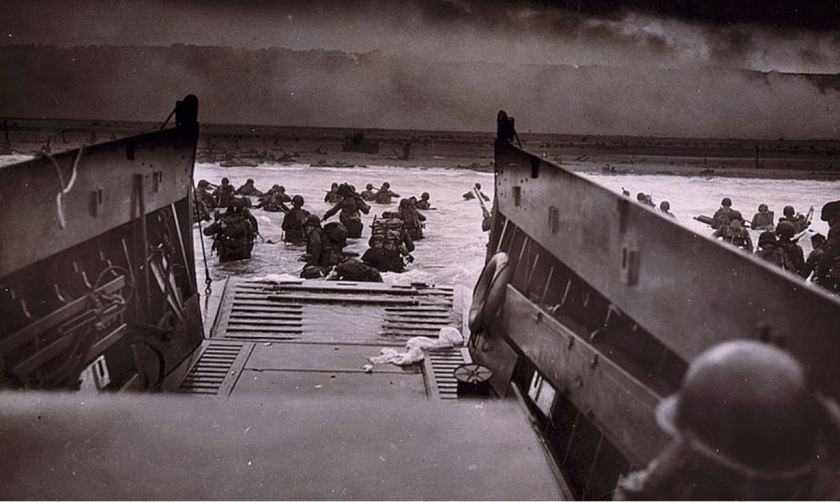
For two years Harold did whatever the army told him to do, and on June 6, 1944, they told him to bob around in the English Channel for 17 hours and then jump into the chest-deep water off Normandy with his M1 and hit the beach firing. So he did.

dday

It was chaos. Things didn’t go as planned for a million reasons. The weather was bad and waves mid-channel were five to six feet high.  Twenty-seven of the thirty-two tanks that were supposed to go ashore to support the infantry at Omaha Beach never made it out of the water. The Germans, high up on the bluffs above the beach, were mowing the Americans down as they waded ashore. There were 12,000 allied dead on the five landing beaches that first day.

Harold was one of the lucky ones. To his surprise, he was not hit.  But an even bigger surprise was waiting on the sand – Charlie was already there! The brothers were reunited after two years amidst the withering Nazi fire raining down on them.

Miraculously, they both survived the war and lived to tell about the unlikely meeting. Except they never did. It wasn’t until a couple of weeks before his death many decades later that Charlie ever mentioned it to his niece, Mrs. Stewie Generis, the daughter of the au-pair in the story.

Until that point, no one in the family knew anything about the brothers’ experience on D-Day  or what happened on Omaha Beach. As far as they were all concerned, the two had been in the army in WWII like everyone else, and that was about it.

To a couple of guys who had seen what they had seen and done what they had done, the amazing coincidence just didn’t seem important enough to mention.

dday2


Leo Frank and the logic of the alt-Right

If you’re like a lot of other people, this week you’re scratching your head trying to figure out what Nazis chanting anti-semitic slogans have to do with removing Civil War monuments. GOML is here to help.

First, let’s just clear the air about what Charlottesville was about. It was a “Unite The Right” rally, not particularly focused on the Civil War, and one of many planned in various parts of the country. There are nine similar rallies planned for next week alone in places like L.A., Pittsburgh, New York, Seattle, and the Google campus in Mountain View.

Turning this into a discussion of taking down symbols of the Confederacy is misdirection.

And, just for the record, here’s what Robert E. Lee said when asked about building a monument to the Confederate troops at Gettysburg:

“I think it wiser not to keep open the sores of war but to follow the examples of those nations who endeavored to obliterate the marks of civil strife, to commit to oblivion the feelings engendered.”

“As regards the erection of such a monument as is contemplated, my conviction is, that however grateful it would be to the feelings of the South, the attempt in the present condition of the Country, would have the effect of retarding, instead of accelerating its accomplishment; [and] of continuing, if not adding to, the difficulties under which the Southern people labour.”

And one other point: for all you Southerners who insist the Confederate side was not fighting to preserve the institution of slavery, but rather resisting the encroachment of federal government on the rights of the states to govern themselves, please be quiet. The only “States’ Rights” that anyone cared about was the right to continue the institution of slavery, on which the southern economy was based, and in which white southerners, in the main, deeply believed.

Still, the South is the natural place to try to “unite the right”, as racist and anti-semitic bacteria has always seemed to find a friendly petri-dish in which to grow there. The connection between white southern grievance and “foreigners” is central here in the thinking that outsiders are coming to take their jobs away and control them.

The belief of the various White Nationalist groups has always been that Jews would control and undermine local businesses, that the migration of black people to the North would  saturate the labor market, and that Catholics would steal the rest of the jobs from Americans.

That’s the crux right there: for these people, Jews, African-Americans, and Catholics are not “Americans”.

The KKK and the Anti-Defamation league were both born in the South at the same time, precipitated by the same event. They arose following the death of Leo Frank. Or, to be more accurate, the lynching of Leo Frank. Today is a good day to remind everyone who Leo Frank was because it was on this day, August 17, in 1915 that he was murdered.

Leo Frank was a 31-year old mechanical engineer, working in his uncle’s pencil factory in  Atlanta. Frank had graduated from Cornell in 1906, where he had been on the debate team, his class basketball and tennis teams, played a lot of chess, and was generally a happy and well-adjusted guy. He moved to Atlanta in 1908 and married in 1910. He was active in the Jewish community in Atlanta and became president of the B’nai B’rith fraternal society there in 1912.

He was accused (wrongly, as almost every scholar and historian now agrees) of the strangulation murder of Mary Phagan, a 13-year-old child of the confederacy from nearby Marietta.

He was convicted at trial primarily on the testimony given by the janitor, Jim Conley, who most historians now agree was the actual perpetrator. The verdict was appealed all the way to the Supreme Court on the basis that the trial was a travesty and that the verdict was driven by anti-semitism.

Frank had been sentenced to death, but the sentence was commuted to life in prison. From this Wiki:

The case attracted national press and many reporters deemed the conviction a travesty. Within Georgia, this outside criticism fueled antisemitism and hatred toward Frank. On August 16, 1915, he was kidnapped from prison by a group of armed men and lynched at Marietta, Mary Phagan’s hometown, the next morning. The new governor vowed to punish the lynchers, who included prominent Marietta citizens, but nobody was charged. In 1986, Frank was posthumously pardoned by the Georgia State Board of Pardons and Paroles, although not officially absolved of the crime. 

The Anti-Defamation League was founded in 1913, with the Frank case being specifically mentioned by the founder, Adolf Kraus. Also, from the Frank Wiki:

After Frank’s lynching, around half of Georgia’s 3,000 Jews left the state. According to author Steve Oney, “What it did to Southern Jews can’t be discounted … It drove them into a state of denial about their Judaism. They became even more assimilated, anti-Israel, Episcopalian. The Temple did away with chupahs at weddings – anything that would draw attention.” Many American Jews saw Frank as an American Alfred Dreyfus, both of whom were seen as victims of antisemitic persecution.

And the Klan was also revived by the trial:

Two weeks after the lynching, in the September 2, 1915 issue of The Jeffersonian, Watson wrote, “the voice of the people is the voice of God”, capitalizing on his sensational coverage of the controversial trial. In 1914, when Watson began reporting his anti-Frank message, The Jeffersonian’s circulation had been 25,000; by September 2, 1915, its circulation was 87,000. On November 25, 1915, a group led by William Joseph Simmons burned a cross on top of Stone Mountain, inaugurating a revival of the Ku Klux Klan.

The ADL and the KKK have remained on opposite sides of many arguments in the century since these events. Until the Tweety administration, the momentum of history was clearly operating against the forces of intolerance, as it became less and less acceptable  to hang on to or espouse the old views. And in recent decades, Jewish Americans have felt less pressure to deny their heritage to gain acceptance as Americans.

For reasons best known only to himself, the President of the United States has chosen this moment to once again release the genie of hatred from its bottle. Leo Frank is not resting peacefully tonight.

hat3

The death of the “dead ball”

On this day in 1920, Ray Chapman died, and so did the way baseball was played up until that point.

Chapman’s death signaled the end of the “Dead Ball” era and, in theory, the end of many of the “tricks” pitchers used to fool hitters, including the spit-ball, the scuff-ball, the grease-ball, the carved-up-on-my-belt-buckle-ball, and so on.

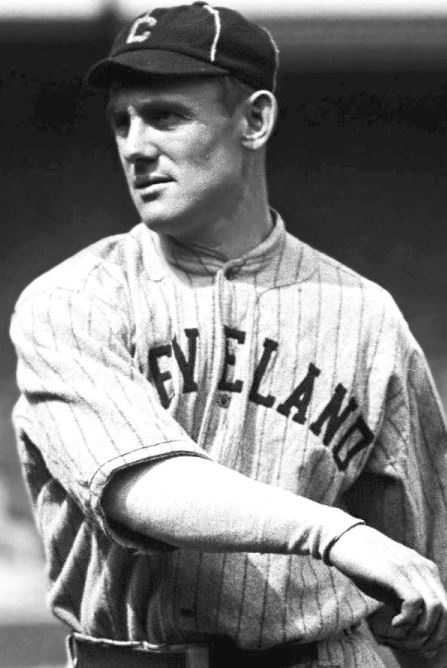
Chapman was a 29-year-old infielder for the Indians, their best, and was noted for hanging in tough against any pitcher and his willingness to “take one for the team”, i.e. getting hit by a pitch to get to first base. In his nine-year career, he had led the league in runs scored once, walks once, and plate appearances once. A solid guy.

On August 16, 1920, in the fifth inning of a game against the Yankees at the Polo Grounds, he stepped in to hit against Carl Mays, a submarine style pitcher who liked to throw inside. Mays hit Chapman on the left temple and the sound made by the impact reverberated through the Polo Grounds giving the fans the impression the pitch had been hit by Chapman. The ball hit him so hard that although he had been hit on the left temple, he bled from his right ear.

Chapman went down, was helped up and back to the dugout by team-mates, and died twelve hours later. The last words he uttered on a baseball field were, “I’m all right. Tell Mays not to worry”.

It was the only case of a player being killed by a pitch at the major league level, although there have been several serious and career-ending incidents since then.

Statistically, Mays had been a very good pitcher indeed, and went on to win over 200 games before he was done, including five seasons of 20 or more. He was a potential Hall-of-Famer and was last on the Veteran’s Committee ballot in 2007, when he was turned down for the final time. Most people say it was his complete lack of remorse for the Chapman incident that kept him out.  “It’s not on my conscience,” Mays said 50 years later, just before his death in 1971. “It wasn’t my fault.”

At the time of the incident, umpires Billy Evans and William Dineen issued a statement that blamed Mays:

“No pitcher in the American League resorted to a trickery more than Carl Mays in attempting to rough a ball, in order to get a break on it which would make it difficult to hit.” 

The next year, the rules about what kind of baseballs were allowed in play were changed. Until then, the same few balls were used throughout the game, and became very difficult for hitters to see after a few innings of abuse. After that, new, more tightly wound balls were used, and new ones were brought in whenever a ball was no longer white enough for a hitter to see clearly. The balls could be seen better and traveled farther when hit.

The “lively ball” era was born, and the home run would be king from then on. In 1919, the greatest slugger in baseball history and always a statistical outlier, Babe Ruth, led the league with 29 home runs, a total that exceeded the entire output for ten of the other MLB teams that year. In 1920, he hit 54 which exceeded the total for every other major league team except the Phillies, who had 64 in aggregate. Apart from Ruth’s 54, the 1920 Yankees had only 61 home runs hit by all other players combined.

But after the Chapman incident, the trend started changing radically, and, by 1930 the long ball was firmly established everywhere. The pitchers, or at least those that didn’t cheat, had lost their biggest advantages.

mays1

chapman

Happy birthday, Social Security

On August 14, 1935, President Roosevelt signed the Social Security Act into law, thereby creating a “safety net” for retirees who may not have saved enough to get by on their own after they stopped working. Unemployment was close to the all-time 1933 high of 24% in 1935, still at about 20%, with over 10 million unemployed.

At the time of the enactment, there were 37 workers paying in to the system for every retiree drawing out of it. Life expectancy was 61 years in 1935, so fewer people ever got to the point of collecting, and those that did collected for a much shorter time than they would today.

Today, there are only three workers paying in to the system for every retiree receiving benefits, and this number is expected to shrink even further going forward. The average life expectancy is now about 85, so many more people will collect Social Security and for much much longer.

Something’s got to give. The main problem, as we have seen most recently in the A.C.A. Repeal/Replace effort, is that once an entitlement is put in place, it is very, very hard indeed to take it away.

The apparent solutions to the new SSA math would be to extend the age of retirement so that there would be fewer retirees collecting for shorter periods, and also to institute further means tests for benefits. But it isn’t that simple.

The problem is  compounded by pressures on corporate leadership to reduce all benefits to employees, which are the biggest drag on their profits, the poor job prospects for older workers in the digital age, the freedom of a poorly-regulated financial industry to siphon off large chunks of “retirement” savings in the form of fees,  and the inevitable migration of jobs to cheaper labor markets.

dil1

I suppose all this is one of the main causes of younger people’s resentment against the Baby Boomer generation. Their view of it is the Boomers are selfish, entitled, and want to get paid now, while flipping off their kids and grand-kids who will have to fend for themselves. Again, it’s not that simple.

boomer1

Speaking as a Boomer who paid in to this pyramid scheme for decades, I certainly do want to get paid now, and, yes, I feel entitled to it. If that makes me selfish in the bargain, then so be it.

I fully understand that when the revolution begins, they will be coming for me first. Keep your eye out for me on the bread line – I’ll be the one carrying the sign that says, “Will work for C.O.P.D. meds”.


Ken Starr, please be quiet.

The other day Kenneth Starr said that the investigation of Special Counsel Robert Mueller might be overstepping its bounds, and should not turn into a “fishing expedition”. He said the original “gravamen” of the investigation was Russian collusion in the election, and that it would be inappropriate to go beyond this question into other areas.

On hearing this, everyone who remembers Ken Starr’s years-long quest to find something, anything, that would reflect badly on Bill Clinton threw up a little bit in their mouths. CNN filed this story under the headline “Ken Starr killed irony today”.

For those too young to remember, Ken Starr was the “Independent Counsel” charged with investigating the potential wrongdoings of Bill and Hillary Clinton in a failed 1970’s real estate development called “Whitewater”.  The Clintons lost money on this investment, there was never any wrongdoing found, and they were never charged with anything.  There was no “there” there.

Starr was appointed to head a three-judge panel to investigate “the scandal” in 1994, just a year and a half into the Clinton administration. Even though there was never anything to it, Republicans were bound and determined to keep the travesty going, and Starr moved from one subject to the next until, with the investigation finally winding down in 1998, he got wind of some inappropriate sexual conduct  between Clinton and an intern named Monica Lewinsky.

The Lewinsky scandal became a 24/7 cable news obsession in 1998, basically blocking out the sun and other real news for months on end. It led ultimately to Clinton’s impeachment trial for lying under oath about the nature of his relationship with Lewinsky.  He was absolved and continued in office.

Today is the anniversary of the 1998 bombings of the American embassies in Nairobi, Kenya and Dar es Salaam, Tanzania. The bombings were carried out by operatives of Osama bin Laden, and presaged the 9/11 attacks. 224 people were killed in the bombings, including 12 Americans, and 4500 were wounded.

On August 20, 1998, Clinton ordered a retaliatory attack on bin Laden’s sanctuary in Afghanistan and 70 missiles hit three al Qaeda sites there, killing 24 people, but not bin Laden. 13 missiles hit a pharmaceutical plant in Sudan, killing a night watchmen.

But because of the relentless and idiotic persecution of Bill Clinton by Ken Starr, who had clearly exceeded the “gravamen” of his original investigation, none of these events were regarded as particularly alarming or even newsworthy, and, tragically, none led to any increased effort to neutralize al Qaeda.

Instead, the events were reported, mainly but not exclusively by the young FoxNews network, as “wagging the dog”, meaning Clinton trying to create a distraction to get Monica Lewinsky off the TV for a day or two. A typical example of the coverage from the Washington Post:

Several Republicans yesterday raised the issue expressly. Sen. Dan Coats (R-Ind.) said: “After months of lies and deceit and manipulations and deceptions — stonewalling — it raised into doubt everything he does and everything he says,” Coats said.

Administration officials said yesterday they had anticipated criticism that Clinton was following a “Wag the Dog” strategy — so-named after the recent movie in which a president tries to draw attention away from a sexual scandal by staging a phony war — but had no choice but to ignore it.

Perhaps there is a legitimate discussion about Mueller’s scope to be had now, but Ken Starr should not be part of it. His past transgressions and current hypocrisy exclude him. I don’t think it’s going too far to say that without this biased, self-important, corrupt and disingenuous fool, we may well have succeeded in limiting al Qaeda’s ability to carry out the 9/11 attacks.

To Ken Starr, I would say, “Thanks for nothing and shut the fuck up.”

One giant leap for mankind

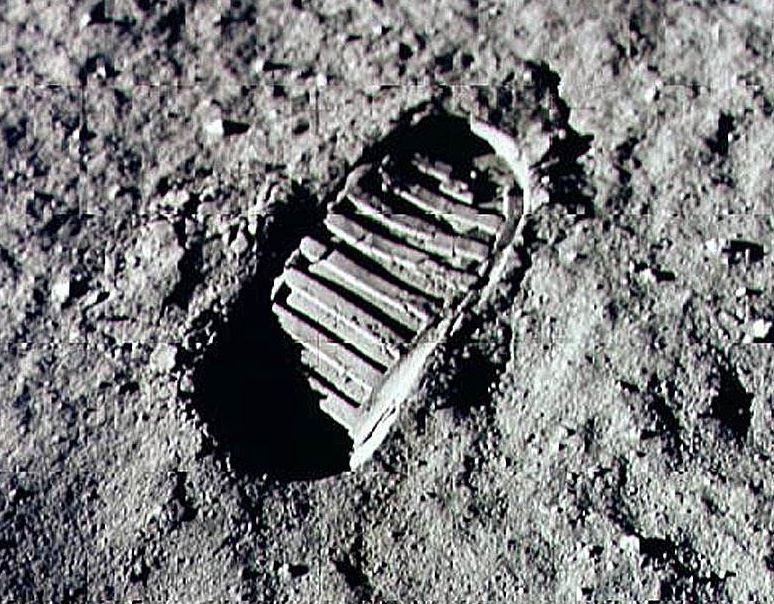
It was 48 years ago today that Neil Armstrong became the first person to set foot on the moon.

moon1

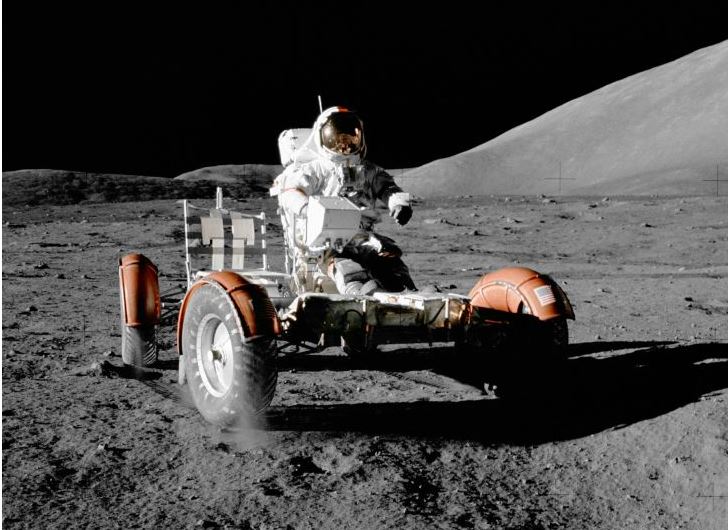
In the following three years, five more successful missions to the moon’s surface were completed (and one, Apollo 13, that didn’t quite get there). By December, 1972, 12 people had walked on the moon. No one has been there in the 45 years since then. No one has even left low earth-orbit.

moon2

The primary reason we undertook the moon-landing adventure was to beat the Soviet Union and assert our dominance in the “space race”. To the lay person all these years later, it doesn’t seem like we got much out of it, though physicists, materials scientists, cosmologists, and others would disagree.

It all seems like it happened a million years ago. In fact, to a lot of people, it seems like it never happened.

This morning, when I googled “Moon landing 1969”, I got 1,620,000 hits. Pretty good. Then I googled “Moon landing hoax” and got 3,730,000 hits. Turns out, the whole thing was probably a big phony government cover-up. Thank God for the internet – I’d be walking around with all the wrong info without it.

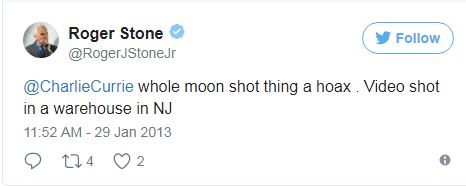
Your president is keeping an open mind about it so far. One of his most trusted advisers, Roger Stone, knows that the moon landings were faked.

stone

But Tweety hasn’t taken a firm position, on the record at least. Campaigning in Sacramento a year ago, he seemed on the fence about it:

Republican presidential nominee Donald Trump said today he believes the moon landing in 1969 was real but “many people” believe the whole thing was orchestrated by the federal government to impress the world and scare the Soviets. “I’m not saying I believe that, but many people have questions about it,” Trump said at a campaign appearance here. “There are people who know about these things who say they saw the interior of a warehouse in Los Angeles converted to look like the surface of the moon, complete with fine dust and craters and the whole thing. Lot of tinfoil lying around. Did NASA hire a Hollywood crew to distract us from Vietnam? I don’t know.”’

To paraphrase Armstrong: One step for a small man.

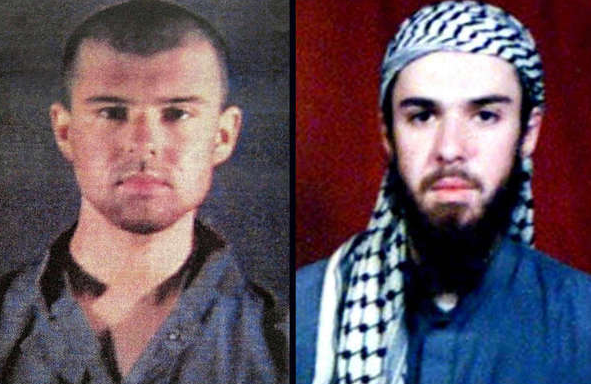
John Walker Lindh

I used to think Paul Theroux was a smart guy whose books I liked. Then I heard him being interviewed somewhere and was surprised at his British accent. “Is this guy a Brit?”, I wondered. “Why did I always think he was American?” Well, yes, he is in fact an American, born and raised in Medford, MA where he went to high school and then on to the University of Maine.  After that, he joined the peace corps, and started a life of travel and travel writing, and ultimately settled in the U.K. where he started talking like the people around him, which I guess makes sense.

I suppose the British version of English is kind of like a second language to Americans, and it’s worth learning it if you live there, not only for the challenge but for increased acceptance by your neighbors. But most people are able to live abroad and speak the local language without losing the ability to speak the unaccented version of their first tongue. I have a cousin who has lived in Sweden for decades and doesn’t use English much, but also does not now speak English with a Swedish accent. I have another cousin who’s lived in Australia, also for decades, and does not greet me with “G’Day, mate” when she sees me.

I started to suspect Theroux was kind of a jerk, a self-hating poseur who wanted to appear to be something much more exotic than he actually is. A few months ago, I read an opinion piece by Theroux in the Failing New York Times that really cements this notion. In it, he explains what a naive 24-year old he was when he ran afoul of the Malawi authorities and was kicked out of the country and the Peace Corps as well. He explains that he had become

“…involved with a group of political rebels — former government ministers mostly — who had been active in the struggle for independence.”

And that he

 “…performed various favors for the rebels, small rescues for their families, money transfers, and in one effort drove a car over 2,000 miles on back roads to Uganda to deliver the vehicle to one of the dissidents in exile. On that visit he was asked to bring a message back to the country. He did so, without understanding its implications. It was a cryptic order to activate a plot to assassinate the intransigent prime minister.”

So, first let me just say that driving a car over 2000 miles of back roads is not a “favor” – it’s a huge undertaking.

Theroux explained himself to his “de-briefing” interrogators at the State Department back home. He said he was just a silly idealistic kid, had gotten in over his head, and that history and events had “overtaken” him.  The government realized they were dealing with a now-terrified moron, albeit one who seemed well educated, and let him go.

This story was prologue to Theroux’s defense of the “American Taliban”, John Walker Lindh, who Theroux sees as much like his own 24-year-old self: idealistic, naive, overtaken by events, and who now surely sees the error of his ways and is remorseful.

lindh1

In the piece, written in the last days of the Obama administration, Theroux was advocating that Lindh, who has now served 15 years of his 20-year plea-bargained sentence, should be given a pardon by President Obama and have his sentence commuted. As I said, Theroux seems like kind of a jerk, and we really don’t need to listen to his opinions on this. He may be missing the bigger picture here, as he did in Malawi.

Lindh is 36 now, and is scheduled to be released in two years. He will leave prison with an Irish passport, and, according to the U.S. government,  “a stubborn refusal to renounce violent ideology”.

This piece in Foreign Policy paints a different picture from Theroux’s young, remorseful, innocent victim who happened to be in the wrong place at the wrong time. It cites a report of the National Counterterrorism Center from January of this year, which says that Lindh continues to advocate for global Jihad and continues to write and translate extremist texts.

The document says intelligence agencies have noted a high rate of recidivism among home-grown extremists, and claims that in March of last year Lindh “told a television news producer that he would continue to spread violent extremist Islam upon his release”.

Soon, it will be up to President Tweety to figure out what to do with “Johnny Jihad” on his release. It’s hard to imagine he’ll be as magnanimous as Paul Theroux would be, but you never know what Tweety might do.

At the time of his trial, Lindh apologized for fighting alongside the Taliban, saying, “had I realized then what I know now … I would never have joined them.” He said Osama bin Laden is against Islam and that he “never understood jihad to mean anti-American or terrorism.”

Lindh’s  father said,  “John loves America and we love America. God bless America.”

lindh2

We shall see.


Marat and The Third Estate

Yesterday was the anniversary of the death in 1793 of Jean-Paul Marat. He was in his bath tub when he died, where he typically worked and sometimes received guests, as he had a bad skin condition and sought relief for it there. He had agreed to an interview with Charlotte Corday, who produced a dagger and stabbed the defenseless Marat to death.

Jacques-Louis David’s depiction of the scene:

marat

Marat had been a doctor and a favorite of French aristocrats, based in part on his success in curing cases of gonorrhea. He published works on eye diseases. In 1777, he was appointed physician to the bodyguard of the comte d’Artois, Louis XVI’s youngest brother, who was to become king Charles X in 1824.

This position gave him the money needed to pursue various scientific studies, and he published works detailing experiments on “The Physics of Fire”, his responses to Newton’s ideas about the nature of light, and research on the nature of electrical force. He reached various conclusions that were accepted by official censors and the Academy of Science,  but  that were disputed by the likes of Lavoisier, e.g. that fire was an “igneous fluid”. Lavoisier demanded that the Academy repudiate the findings, and they ultimately did so, creating a rift between Marat and several important scientists of the day. It also soured Marat on the aristocracy.

Marat gave up science and medicine for politics in 1788, as the French Revolution was at hand. In 1789, he published his “Offering to a Nation”, detailing his thoughts on the Third Estate, i.e. the common people (the First Estate was the clergy, and the Second Estate was the aristocracy).

He had “radical” ideas, arguing that society should provide all its citizens the fundamental needs like food and shelter if they were expected to follow its laws, that the king was simply the “first magistrate” of his people, that the death penalty should be applied the same way for anyone regardless of class, and that every town should establish an advocate for the poor to ensure fair trials.

He started a newspaper called “The People’s Friend”, in which he railed against the various centers of influence in Paris and conservative revolutionary leaders. He was forced into hiding several times during this period and took refuge in the sewers of Paris.

Marat was elected to the National Convention in 1792. He thought that Louis XVI should be executed, but not actually accused of anything until he accepted the constitution of 1791. Marat was arrested and imprisoned in April 1793, on charges that he had called for widespread violence, but was acquitted at trial.

Charlotte Corday, a young woman from Caen, came to his apartment claiming to have information about the whereabouts of Marat’s opponents in Caen, the Girondists. Marat’s wife, Simone, objected to granting her an audience, but he saw her anyway. He talked to her for about fifteen minutes, at which point she pulled a 5″ knife from her clothing and stabbed him. His last words were to Simone,  “Aidez-moi, ma chère amie!”.

Corday was from an aristocratic family who had been impoverished by the Revolution, and was a sympathizer of Marat’s antagonists. She was tried for her crime, and testified that, “I killed one man to save 100,000.”

She was guillotined on July 17th 1793.

corday

Marat was gone, but the ideals he articulated for the Third Estate are as relevant now as they were then.

Yesterday, our president was in Paris on the occasion of Bastille Day. He read a speech which he was apparently seeing for the first time.

In it, he noted that our two nations are forever joined in the spirit of revolution. I would like to think that Tweety understands what the French Revolution was about, and the changes it brought to the dynamic between the Second and Third Estates. However, I’m certain he doesn’t have a clue, and that his ideas more closely resemble Corday’s than Marat’s.

He said that France is America’s first and oldest ally and that “a lot of people don’t know that”. Well, at least one person.

Mother of Exiles

Happy birthday, America! This is still the greatest country on earth.

It’s the greatest not because we have the best roads and bridges and airports. We don’t.

And not because we have the best healthcare system in the world, or the cleanest air, or even the best broadband internet or cell-phone systems. We don’t.

And not because we have the best education system or the highest literacy rate. We don’t.

And not because we have the highest standard of living in the world. We don’t.

standard

And not because we score very highly on the “Social Progress Index” which attempts to aggregate most of these measures, including medical care, sanitation, shelter, education, access to technology, life expectancy, personal rights, freedom of choice, and general tolerance. We barely squeak into the top 20.

And not because all twelve men who have walked on the moon were Americans. They were, but that’s not it at all.

moon

America may not be the best place to live, using any truly objective measure. And we may be causing as much misery in other parts of the world as we’re preventing.

Worst of all, we may not be living up to own ideals.

But it is those ideals that make us the best. If we come up short in trying to make those ideals reality, that’s one thing. But if we abandon them altogether, we are lost.

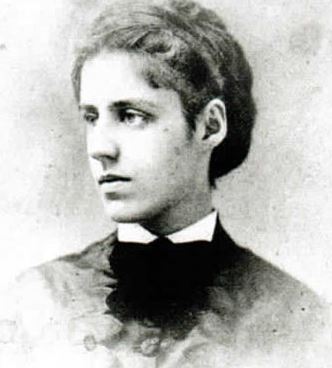
emma

Emma Lazarus was born in 1849, the fourth of seven children. She died at age 38 of Hodgkin’s Lymphoma. Her interest in her Jewish background and in the idea of Zionism was raised by the assassination of Tsar Alexander II in 1881, and the terrible anti-semitic pogroms that followed.

Tens of thousands of destitute Jews fled the “Pale of Settlement” because of these events and Emma tried to help them and advocate for them as much as she could. She helped establish the Hebrew Technical Institute in New York in order to give new arrivals useful training so they could have a way to support themselves in the new land.

Most of all, Emma Lazarus understood the vital importance of the American promise to these unfortunates and others, and the role it played in giving them a home and life itself. Her most famous poem, The New Colossus, was written to help raise money for the construction of a pedestal for the newly acquired Statue of Liberty, and, since 1903, has adorned the inner wall of the pedestal.

Not like the brazen giant of Greek fame,
With conquering limbs astride from land to land;
Here at our sea-washed, sunset gates shall stand
A mighty woman with a torch, whose flame
Is the imprisoned lightning, and her name
MOTHER OF EXILES. From her beacon-hand
Glows world-wide welcome; her mild eyes command
The air-bridged harbor that twin cities frame.

“Keep, ancient lands, your storied pomp!” cries she
With silent lips. “Give me your tired, your poor,
Your huddled masses yearning to breathe free,
The wretched refuse of your teeming shore.
Send these, the homeless, tempest-tost to me,
I lift my lamp beside the golden door!”

liberty

In America, it doesn’t matter who your parents were, or where you came from, or how or even if you worship God. Everyone is free to pursue their interests and strive to achieve their goals. Everyone is protected by the same law and everyone has the same rights.

In America, anyone can become the President, the most powerful and influential position in the world. Even someone who has never held any elective office at any level. Even someone who is ignorant of all our history and traditions. Even someone who doesn’t understand the basic principles of our founding, or what “Mother of Exiles” means, or where it is inscribed, or who wrote the words, or why. Even a childish and vindictive demagogue who would use the privileges that have been freely given by our country to abuse and abolish those same privileges.


Fred Noonan

It was 80 years ago yesterday that Fred Noonan went missing at age 44. He was declared dead a year later, though his body was never found.

Noonan

His mother had died when he was four and relatives in the Chicago area took him in. He took off for Seattle at age twelve where he became a seaman. He worked on many ships and rose to the rank of bosun’s mate. In the Merchant Marine during World War I, he was on ships that were sunk by German U-boats three different times.

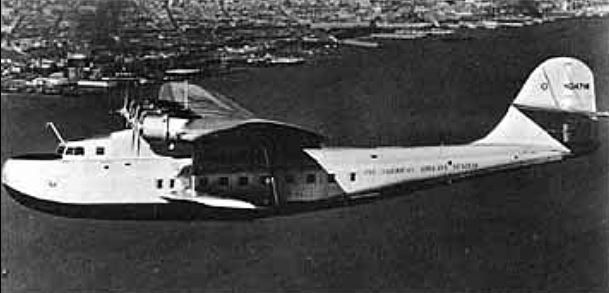
As a sailor, he traveled around Cape Horn seven times, three times under sail. After 22 years at sea, he learned to fly airplanes and ultimately went to work for Pan Am as a navigator. He was the navigator on the first Sikorsky S-42 Flying Boat out of San Francisco in 1935.

sikorsky

And also on the historic mail flight across the Pacific of the China Clipper a month later.

clipper

Noonan mapped Pan Am’s pioneering routes across the Pacific, always carrying a ship’s sextant with him to navigate by the stars.

In 1937, he resigned from Pan Am, having gone as far as he could in the company as a navigator. He hoped to open a navigation school, and he signed on for a “record-breaking” around-the-world flight that he thought would bring him the needed fame to get a good start. The plane to be used was a very highly advanced one for the day,  the Lockheed Model 10 Electra.

electra

When he disappeared, he had navigated 22,000 of the planned 35,000 kilometers of the flight. On July 2 1937, he took off from Lae, New Guinea and headed for Howland Island, a tiny speck less than half a mile long in the middle of the Pacific.

howland

There was a second person on the plane, but it was up to Noonan to find the way. They reached the vicinity of Howland and established radio contact, but they never saw the island itself, and were never heard from or seen again. Some research later showed that the island was wrongly located on their charts – off by about five miles.

Many books have been written about the disappearance. Movies have been made, songs written, conspiracy theories advanced. Tons of websites, literally millions, speculate on exactly what happened. Many people have latched on to an apparently bogus claim that Noonan may have been drunk, though the most accepted theory is that they simply ran out of gas and ditched. In recent years, there have been claims that their remains had been found on a nearby island.

By now, you’re probably wondering why, if so much attention has been given to this, do you not know who Fred Noonan is and have never heard his name before. Well, I guess I buried the lede – the other person on board was Amelia Earhart.

Noonan hoped to capitalize on the attention that Amelia Earhart’s “exploits” garnered. Her husband and business partner, publisher George Putnam, promoted the flight as if she was flying solo, careful to keep Noonan out of the publicity as much as he could. He micro-managed the whole stunt, actually, causing Earhart’s original choice for navigator, Harry Manning, to quit after a bungled first attempt when Earhart crashed on takeoff in Hawaii. 

For those who study these things, Noonan has received virtually all of the blame for the screw-up, though it’s clear he would have received very little acclaim had he succeeded.

A beautiful song called “Amelia Earhart’s Last Flight” was written by Red River Dave McEnery, and it became the first song ever performed on commercial television at the 1939 World’s Fair.  The song got Noonan’s name wrong  in the original version, published in “Sing Out” magazine, giving it as “Captain Newman”, though I believe they got the “Captain” right.

newman

Even today some web sites are confused about his name,  though in most versions you’ll find on the web today, this mistake has been corrected.

I like this version by Kinky Friedman and the Texas Jewboys, though, as always, Kinky plays it for smiles.

As the song says, Happy landings, Captain Noonan.

The Judensau, 500 years after Luther

On October 31st, we will mark the 500th anniversary of the posting of Martin Luther’s “95 Theses”,  a list of questions and propositions for debate which he nailed to the door of the Wittenberg Castle church. It sparked the Protestant Reformation by arguing against the corrupt practice of selling “indulgences” to absolve sin. He argued that salvation could only be achieved through faith, not deeds.

At first, Luther was willing to welcome Jews into his congregation, reasoning that with the corrupt practices of Catholicism removed, they would have little reason not to accept Christ. He wrote in 1523 that Catholics had treated Jews “like dogs”, making it difficult for them to convert. He said,

“I would request and advise that one deal gently with them …If we really want to help them, we must be guided in our dealings with them not by papal law but by the law of Christian love. We must receive them cordially, and permit them to trade and work with us, hear our Christian teaching, and witness our Christian life. If some of them should prove stiff-necked, what of it? After all, we ourselves are not all good Christians either.”

But when few Jews proved willing to abandon their view that a man could not be God, Luther gave up on them and had plenty to say against them in his famous book, “On the Jews and Their Lies. “

In the treatise, he argues that Jewish synagogues and schools be set on fire, their prayer books destroyed, rabbis forbidden to preach, homes burned, and property and money confiscated. They should be shown no mercy or kindness, afforded no legal protection, and “these poisonous envenomed worms” should be drafted into forced labor or expelled for all time. He also seems to advocate their murder, writing “[W]e are at fault in not slaying them”.

The Wittenberg Castle church had been a Catholic church before Luther, and has remained a Lutheran church through today. Like many Catholic churches across Germany, it had a Judensau, a Jew-Pig, carved on its facade in 1305.

wittenberg judensau

sau

The Judensau iconography taunts and vilifies Jews. It’s often located on the outside of the building where all can see it, but it can also be present inside on choir chairs, on wall paintings, woodcuts, and so on.

The Wittenberg Judensau includes a nonsense inscription, “Rabini Shem hamphoras,” which seems to be a version of “shem ha-meforasch”, the full-form name of God regarded by Jews as too holy to be spoken.

Luther talks about the sculpture in his 1543 Vom Schem Hamphoras, in which he equates the Jews with the devil, and indicates their Talmud is located in the sow’s bowels:

“Here on our church in Wittenberg a sow is sculpted in stone. Young pigs and Jews lie suckling under her. Behind the sow a rabbi is bent over the sow, lifting up her right leg, holding her tail high and looking intensely under her tail and into her Talmud, as though he were reading something acute or extraordinary, which is certainly where they get their Shemhamphoras.”

Last year, an online petition was started to finally take the Wittenberg Judensau down.  The thinking is that 700 years of this kind of thing is enough, particularly given modern regional history which is very much present in the memories of many still alive.  But the petition has only got about 7500 or so signatures so far.

If the people of South Carolina can finally be persuaded to lower their confederate flags, maybe some of those open-minded, progressive Germans we keep hearing so much about could think about taking a similar baby-step here.

If you ever get the urge to see some other Judensau examples still in place today, here’s where you can find them:

judensau map

And here are some pictures showing some variations on the theme:

What was it about?

In early 1963, most Americans could not find Viet Nam on a map of the world.  I’m pretty certain Donald J. Trump couldn’t do it on his first try even today.

southeast asia

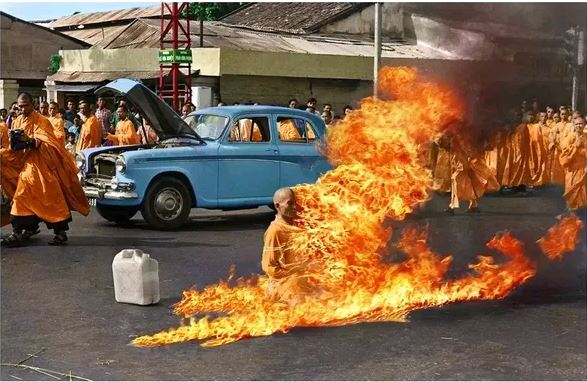
The first time the words “Viet Nam” penetrated the consciousness of the average person here was in May, 1963 when Life Magazine published this picture of a Buddhist Monk named Quang Duc burning himself to death:

monk1

The government of President Ngo Dinh Diem, a Catholic, had been brutally repressing the country’s Buddhist majority, despite protests and pleas from the U.S. to liberalize their policy.  Quang Duc burned himself to protest the bad treatment, and other monks did the same shortly thereafter. Madame Nhu, the president’s sister-in-law, referred to the burnings as “barbecues” and offered to supply matches.

Diem and his brother were assassinated in a military coup in November, 1963. But these events are really secondary to U.S. involvement in the region.

Viet Nam had been part of  colonial “French Indochina” before World War II, after which increased nationalist feelings and a desire to escape colonialist rule led to the First Indochina War.  seen from the Vietnamese point of view as a war of independence

This ultimately resulted in the partition of the country in 1954, with the North being supported by China, which only five years earlier had its own revolution, which had resulted in communist rule of mainland China. It was the Chinese influence that got the interest of the U.S., which at that moment was beginning to base virtually all foreign policy on the need to resist the communist “aggression” worldwide. This policy led us into supporting every nutty military dictator we could find around the globe, as long as he was “anti-communist”, while ignoring the legitimate aspirations and rights of local populations. We are still feeling the blow-back from that policy today.  That, among other things, is why Iran hates us, for example.

President Kennedy was firmly committed to the Cold War policy of pushing back communists, but at first thought the Vietnamese army had to do it. He said,

“to introduce U.S. forces in large numbers there today, while it might have an initially favorable military impact, would almost certainly lead to adverse political and, in the long run, adverse military consequences.”

But after the failure at the Bay of Pigs, the development and success of the Russian space program, and the construction of the Berlin Wall, he figured the credibility of our military might was at stake.  Into the quagmire we went.

Our involvement is sometimes known as the Second Indochina War, or, to the Vietnamese, the Resistance War Against America. There had been only 900 American advisers in Vietnam when Kennedy took office, none serving in a combat role. But by November 1963, when he was assassinated, there were 16,000.

That’s how it began. From our point of view, we were fighting communism and from their point of view, they were fighting for independence from colonial powers. Lyndon Johnson didn’t know how to extricate us and, through steady escalation recommended by the generals, ultimately deployed 536,100 Americans on the ground in Southeast Asia.

By the time we finally understood the folly, and got out once and for all in 1975, the price we had paid was awful.  The war destroyed one presidency and contributed enormously to the destruction of another, and damaged our prestige worldwide. But that was the least of it. Over 58,000 American kids were killed fighting in Viet Nam, and over 304,000 wounded, many of whom are still being cared for in VHA hospitals today.

There were 1.3 million Viet Namese military and civilian deaths all told.

The “culture war” that took root at home during that period could be viewed as the greatest tragedy of all. The Red-Blue divide that poisons our society today is directly descended from the Viet Nam era divisions.

What was it all for? The “communists” won. We lost. So what? Do they threaten us more now? Did they threaten us at all then? Did our involvement there achieve anything positive? Are we better off for it in any way?

It is completely understandable that many families of those who lost their lives want to believe the cause was “just”, and that their loved ones served honorably and even heroically. You often hear it said, even now, that we “could have won” if we had only bombed the north, or deployed more troops, or whatever. But it should be clear now that there was nothing to “win”.  And the the honor and heroism of those who answered the call and paid with their lives or limbs is not diminished by the fact that the “cause” was illusory.

SS Arandora Star

On this day in 1940, Benito Mussolini declared war on Britain and France. The Brits and French had been trying to get the Italian dictator to join their fight against the Germans, and he almost did. But after Paris was occupied by the Germans, he had second thoughts, mainly that he didn’t want to stand by and watch one country conquer the entire European continent.

About the Italians joining their side, Hitler groused that,  “First they were too cowardly to take part. Now they are in a hurry so that they can share in the spoils.” Mussolini explained that he wanted to join the fight before the complete capitulation of France, because fascism “did not believe in hitting a man when he is down.” Right. They were famous for that, as I recall.

Anyway, Britain responded to this by rounding up Italian residents between the ages of 16-70 who had been in the country less than 20 years and putting them in internment camps. Kinda like what the U.S. did with their citizens of Japanese descent, no? Only without all the recriminations and apologies for years thereafter.

When the war began in 1939, the British set up tribunals across the country, 120 of them in all, to evaluate resident aliens and classify them into three categories based on what kind of threat they seemed to represent: Category A meant internment, Category B was no internment but subject to restrictions, and C was no internment or restrictions. By February, 1940, all 73,000 or so cases had been evaluated, with about 66,000 designated as Category C.

In May, the Brits interned another 8000 Germans, and, after Mussolini made his choice, went to work on the Italians. The British internment camps were filled up, so Canada and Australia generously offered to take some of the internees. 7500 of them were shipped oversees, using a fleet of five passenger liners, including the SS Arandora Star.

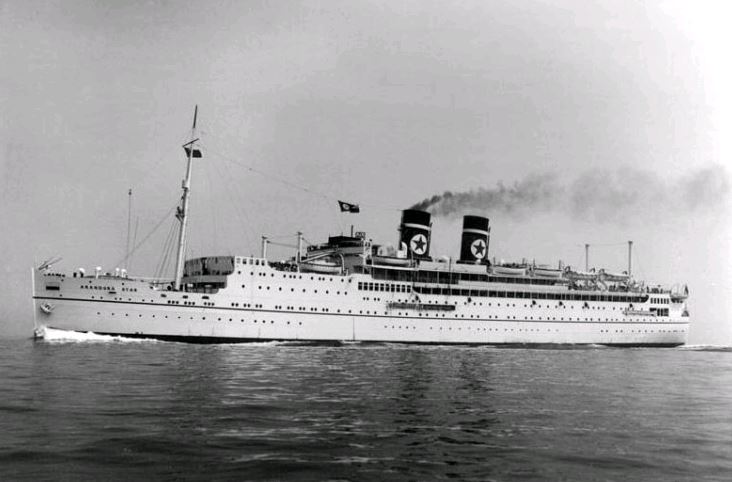
Arandora Star

On Tuesday, July 2, 1940, the Arandora Star was torpedoed and sunk, while en route to Canada, by a German U-boat, 75 miles west of the Irish coast.

According to this Wiki, the ship carried “734 interned Italian men, 479 interned German men, 86 German prisoners of war and 200 military guards. Her crew numbered 174 officers and men”.  805 people lost their lives before the Canadian destroyer, HMCS St. Laurent, arrived on the scene and rescued 868 survivors, of whom 586 were detainees. About a month later, bodies from the tragedy began washing up on the shores of Ireland and Scotland, and were buried there.

This account of the sinking begins by vilifying the British for their “callous disregard” of people based on their nationality, though it doesn’t mention the callous disregard of the Nazis who torpedoed a ship carrying civilian detainees who were allegedly their sympathizers. It notes that the loss of life, about half that of the Titanic sinking,

…”has no place in our common historical consciousness. It is, however, well known among the British-Italian population, and among the Scottish and Irish communities who tend the graves of the dead to this day.”

“Despite the impoverishment of their communities, over and over again these remote coastal villages paid and organised to bury the victims as if they were their own. In Scotland, these were not only enemy nationals but ones singled out for vilification by the government, but no matter; they were given the same reverence and respect as anyone else.”

This article on the sinking provides interesting background on the British internment policy as well as the sinking.

As the Germans often noted, krieg ist krieg.


Angry Germans on the move

This article in the Washington Post yesterday describes Angela Merkel giving a speech in which she says that Europe “really must take our fate into our own hands.”  She’s the leader of the most powerful country in Europe and is saying that, based on Trump’s behavior and words on his recent trip, they can no longer rely on U.S. support, that those days were  “over to a certain extent. This is what I have experienced in the last few days.”

Trump managed to piss off the Germans and all the other members of NATO on this trip, as only he can do. Here at GOML, we have mixed emotions about all this.

Our first, visceral reaction is, “yeah, good idea – fight your own battles for a change”. But then I realized I was taking a baby step towards falling under the spell of the man-baby’s populist, history-averse, fact-free, bullying, Make-America-Great-Again, ignorant blathering.

Hang on, I thought, I’m looking at the leader of Germany advocating German strength to over a thousand closet übermenschen in a Munich beer hall, and getting a prolonged standing ovation. We’ve seen this picture before,  and should understand where it can lead.

merkel

Today’s German loves to think of himself as an environment-respecting, tolerant, pacifist and conscientious objector, or, if he’s of a certain age, a heroic member of The Resistance. But scratch the surface and add a couple of liters of Weizenbock, and you’ve got, well, the same old German we’ve all learned to admire so much over the years. For 70-some years, they’ve been keeping their heads down and channeling all their energy into building expensive cars and whatnot, but now the man-baby has them stirring again.

In the comment section of the WaPo piece, someone calling himself AngryGermans, starts by rightly pointing out that the Germans have promised to spend 2% of their GNP on NATO by 2024 and they are not in arrears, as Trump has bloviated (is there no one who can correct him on these things?), and so on. But he finally works himself up to:

Everyone in Germany hates the thought to have nuclear weapons. That said, i don’t think we would hesitate to build them if needed. Yeah and Germany won’t take years for it, like North Korea or Iran. We can do that in weeks.

To which someone who sounds suspiciously like Stewie Generis replies,

The proof that Trump is an idiot: he’s now got AngryGermans bragging that they can build nuclear weapons in weeks and their leader getting a standing ovation in a Munich beer hall for advocating German strength (sound familiar?). Angry Germans have shown themselves, repeatedly, to be the greatest threat to peace and sanity the world has ever seen. Thanks, President Crazypants. Wait till you get a load of what angry Germans will do to the rest of us as soon as their economy turns south.

Anyway, how does it serve our interests to undo decades of European/American diplomacy intended to keep the Russian bear out of Europe and the Germans under our military control?

It doesn’t. But you know whose interests it does serve? Wait for it…

I’ll give you a clue: his name begins with “P” and rhymes with shootin’.

putin

Fritz Knöchlein

Yesterday was the anniversary of the 1940 Massacre at Le Paradis, in northern France. Trying to reach boats waiting at the port at Dunkirk to evacuate them, about 100 soldiers of the Royal Norfolk Regiment, part of the British Expeditionary Force fighting alongside the French, retreated to a farmhouse at Le Paradis, about 40 miles from the port.

They held off units from Germany’s SS-Totenkopfdivision (Death’s Head division) until they ran out of ammunition, and then tried to surrender. Two soldiers came out of the farmhouse waving a white flag and were mowed down by machine-gun fire from the Germans.

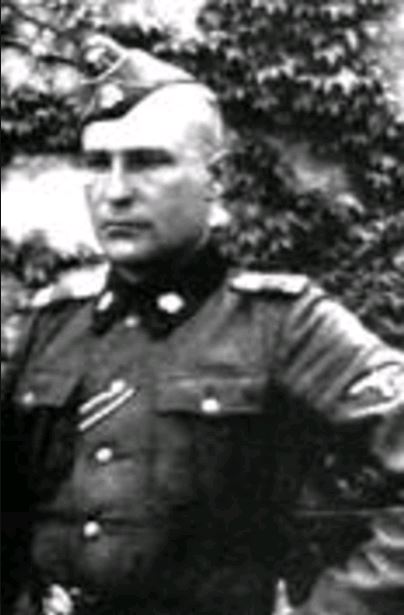
When they tried again, they were led to an open field where all their property was taken from them, then stood up against a barn wall where machines guns on tripods had been placed and where a pit had been dug.  Fritz Knöchlein was the SS-Haupsturmfuhrer and commander of SS-Totenkopf-Infanterie-Regiment 2 who gave the order to shoot the British soldiers. The Germans, as was their custom, then bayoneted any that were not yet dead.

farm

The massacre site

Miraculously, two soldiers survived. Albert Pooley and William O’Callaghan waited in the rain until dark then crawled out and hid for a couple of days in a pig-sty. They managed to get their wounds tended to, but they had no way to escape and again surrendered to the Germans. This time they were held as POWs, and, in April 1943, Pooley, who had a badly injured leg, was exchanged for some German POWs. When he got back to England, his account of the events was not believed.

But when O’Callaghan returned after the war and confirmed the story, an investigation was opened. A British military tribunal in Hamburg found Captain Fritz Knöchlein guilty of a war crime, and he was hanged at age 37 on January 21, 1949.

In this video, at about the 1:30 mark, you’ll find a story that includes the recollection of Bill Pooley who returned to the site.

fritz

Fritz Knöchlein

Fritz always proclaimed his innocence with the usual progression of Nazi reasoning that went, more or less, along these lines: It never happened. OK, it happened, but I wasn’t there. OK, I was there but not in charge. OK, I was in charge, but I had no choice under the circumstances. OK I had a choice, but I followed orders. OK, I did it on my own, but you did worse and deserved it. You tortured me while in custody. Spare me because I have a wife and family.

Knöchlein was held in the infamous London Cage, and wrote letters of complaint about his treatment there.

In the internet age, it is always possible to explore all “sides” of any issue. This site for example, reiterates Knöchlein’s version:

Knöchlein alleges that because he was “unable to make the desired confession” he was stripped, given only a pair of pyjama trousers, deprived of sleep for four days and nights, and starved. The guards kicked him each time he passed, he alleges, while his interrogators boasted that they were “much better” than the “Gestapo in Alexanderplatz”. After being forced to perform rigorous exercises until he collapsed, he says he was compelled to walk in a tight circle for four hours. On complaining to Scotland that he was being kicked even “by ordinary soldiers without a rank”, Knöchlein alleges that he was doused in cold water, pushed down stairs, and beaten with a cudgel. Later, he says, he was forced to stand beside a large gas stove with all its rings lit before being confined in a shower which sprayed extremely cold water from the sides as well as from above. Finally, the SS man says, he and another prisoner were taken into the gardens behind the mansions, where they were forced to run in circles while carrying heavy logs.

  “Since these tortures were the consequences of my personal complaint, any further complaint would have been senseless,” Knöchlein wrote. “One of the guards who had a somewhat humane feeling advised me not to make any more complaints, otherwise things would turn worse for me.” Other prisoners, he alleged, were beaten until they begged to be killed, while some were told that they could be made to disappear.

That piece goes on to give a long “proof” about how Knöchlein was the wrong guy, and how the real culprit was already dead, and the Brits just needed someone to hold accountable, and poor Fritz was elected, and so on and so forth.

It’s like everything else nowadays. You get to decide for yourself which side of the story you like best, and one is no better than another.

Wilhelm Gustloff

The Soviet Union suffered far more than Germany did in World War II, and far, far more than the U.S. or even the U.K.

24 million Soviet citizens lost their lives, including 14 million civilians. They were invaded, bombed, starved, robbed, raped, enslaved, and executed en masse. To the Germans, they were subhumans, “üntermenschen”, and were treated thusly as only the Germans know how to do.

By contrast, the United States and Great Britain lost less than half a million people each, and, in the case of the U.S., almost no civilians.  Japan lost a total of about 3 million, and Germany lost about 8 million, including 2 million or so civilians. Full stats by country here.

The U.S. mainland was not occupied or bombed. There was no siege that starved out any city. No enemy invaded to rob and rape. Life at home was as close to “normal” for the women and children there as you could expect during wartime.

And, until the last months of the war, you could have said the same about the German home-front, too (except of course, for the Jews).

In the closing weeks of the war, when the Red Army was advancing on Germany from the east and the allies from the west, the German people began to feel some of the blow-back from what their country had done in the east for the previous five years. The Russians exacted revenge in the most brutal and, it must be said, sometimes barbaric ways imaginable (though the limits of the German imagination are still unknown).

Over two million German women were raped, many again and again. In 2008 a movie based on the diaries of journalist Marta Hillers  attempted to tell the story from the German point of view.

Stalin explicitly approved of all the rape and plunder, saying people should “understand it if a soldier who has crossed thousands of kilometres through blood and fire and death has fun with a woman or takes some trifle”, and “We lecture our soldiers too much; let them have their initiative.”

When everyone finally realized the war was lost, the primary objective of every German was to avoid being taken by the Red Army, and everyone tried as hard as they could to flee to the west where they knew they would get better treatment from the Americans and Brits.

In late January, 1945, “Operation Hannibal” was undertaken to evacuate German military and civilians from Courland, East Prussia. On January 31, some 10,582 passengers and crew crammed aboard the MV Wilhelm Gustloff. About 9000 were civilians, of which about 5000 were children. And some Gestapo, members of the Organisation Todt,  were on board as well.

III.Reich: KdF-Schiffe - Jungfernfahrt der Gustloff

Once under way, the ship was spotted by Soviet submarine S-13, under the command of Captain Alexander Marinesko, who had sunk more German ships, measured by tonnage, than any other Soviet submarine commander. The sub followed the Wilhelm Gustloff for a couple of hours, and, when it was about 20 miles offshore, fired three torpedoes at it. Forty minutes later the ship was 140 feet deep in the icy waters of the Baltic Sea.

9,343 people lost their lives, including about 5,000 children. The death toll was six times that of the Titanic sinking, and was the largest single loss of life in maritime history.

According to Wikipedia,

Before sinking Wilhelm Gustloff, Alexander Marinesko was facing a court martial due to his problems with alcohol and was thus deemed “not suitable to be a hero” for his actions and was instead awarded the Order of the Red Banner. Although widely recognized as a brilliant commander, he was downgraded in rank to lieutenant and dishonorably discharged from the navy in October 1945. In 1960 he was reinstated as captain third class and granted a full pension. In 1963 Marinesko was given the traditional ceremony due to a captain upon his successful return from a mission. He died three weeks later from cancer. Marinesko was posthumously awarded Hero of the Soviet Union by Mikhail Gorbachev in 1990.

Also from Wikipedia,

Günter Grass, in an interview published by The New York Times in April 2003, “One of the many reasons I wrote Crabwalk was to take the subject away from the extreme Right …They said the tragedy of Wilhelm Gustloff was a war crime. It wasn’t. It was terrible, but it was a result of war, a terrible result of war.

Maybe it was a war crime, maybe it wasn’t. Maybe the victims were better off than if they had been taken by the Red Army, maybe they weren’t. Maybe the Russians were justified in giving the Germans this taste of their own medicine, maybe they weren’t.

As is often said, history is written by the victors.

There once was a union maid…

Clara Lemlich was born in 1886 the town of Gorodok in what is now Ukraine. She grew up in a Yiddish-speaking household and learned to read Russian over her family’s objections, paying for her books by sewing buttons and writing letters for illiterate neighbors.

In 1903, when she had just turned 17, there was a murderous pogrom in the city of Kishinev . The new York Times described it this way:

The anti-Jewish riots in Kishinev, Bessarabia, are worse than the censor will permit to publish. There was a well laid-out plan for the general massacre of Jews on the day following the Russian Easter. The mob was led by priests, and the general cry, “Kill the Jews,” was taken- up all over the city. The Jews were taken wholly unaware and were slaughtered like sheep. The dead number 120 and the injured about 500. The scenes of horror attending this massacre are beyond description. Babes were literally torn to pieces by the frenzied and bloodthirsty mob. The local police made no attempt to check the reign of terror. At sunset the streets were piled with corpses and wounded. Those who could make their escape fled in terror, and the city is now practically deserted of Jews

The pogrom became a pivotal event for hundreds of thousands of Jews in the region, who saw the tacit approval of the authorities, and their lack of response, as a signal that life under the Tsar would be more and more intolerable from that point forward. A poem describing the Kishinev pogrom by H.N. Bialik, In the City of Slaughter, was widely read and served as the catalyst that ignited a wave of immigration of Russian Jews to the United States.

Clara Lemlich was among the first, and arrived with her parents in New York in 1903. She went to work in the garment industry, like many others, making women’s blouses, or “shirtwaists”.

clara

The advent of the sewing machine had actually contributed to worsening working conditions in the garment industry. Workers often had to supply their own machines, carrying them to and from work, while making extremely low wages, typically $2 per day for 14-hour days in the busy season, with only a short break for lunch, and in oppressive conditions. Workers were locked in overcrowded rooms, denied bathroom breaks, and abused by their bosses who demanded more and more production.

Lemlich joined the International Ladies Garment Workers Union (ILGWU) and rose quickly because of her intelligence, charm, and beautiful singing voice. She became known even outside the industry after a Nov. 22, 1909 meeting in the Great Hall of Cooper Union in New York. The meeting was to support striking workers of the Triangle Shirtwaist Company, and Lemlich, after hearing a few uninspiring speeches from leaders of the American labor movement, including Samuel Gompers who counseled against striking, demanded to speak. She said,

I have listened to all the speakers, and I have no further patience for talk. I am a working girl, one of those striking against intolerable conditions. I am tired of listening to speakers who talk in generalities. What we are here for is to decide whether or not to strike. I make a motion that we go out in a general strike!

Cooper Union then and now

Her words inspired the crowd to action, and, led by the 22-year-old Lemlich, 20,000 out of the 32,000 workers in the shirtwaist trade walked out in the next two days, in what became known as the Uprising of the 20,000.

Management was unimpressed. One manufacturer was quoted in the New York Times, November 25, 1909, saying:

“We cannot understand why so many people can be swayed to join in a strike that has no merit. Our employees were perfectly satisfied, and they made no demands. It is a foolish, hysterical strike.”

They hired scabs and thugs to intimidate the strikers and Lemlich endured beatings and six broken ribs, but this just strengthened her resolve. Although she probably wasn’t, she could have been the model for the Woody Guthrie song, Union Maid.

The strike lasted for three months, ending in February 1910, and won the workers better wages and some improvements in conditions. Union contracts were also implemented at many shops, but not Triangle Shirtwaist, where conditions remained terrible. One year later, it was the scene of one of the deadliest industrial disasters in U.S. history.

The Triangle Shirtwaist factory was on the 8th, 9th, and 10th floors of what is now an N.Y.U. building at 23–29 Washington Place in Greenwich Village. This week was the 106th anniversary of the unconscionable, preventable fatal fire there.

Triangle factory then and now

On Saturday, March 25th, 1911, at 4:40 P.M., someone apparently threw a cigarette into a scrap bin and a fire began. Within half an hour 146 people were dead: 123 women and 23 men. They died from burning, smoke inhalation, falling from collapsed fire escapes, or jumping to their deaths.

Triangle Shirtwaist Factory fire escape collapsed during the March 15, 1911 fire. 146 died, either f

Collapsed fire escape

triangle2

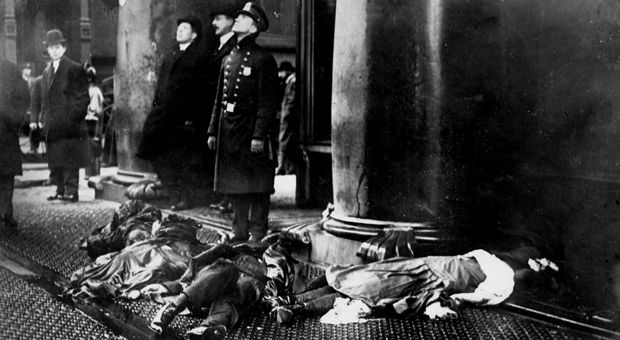
Police look up at jumpers, some already dead at their feet

The stairwells and exits had been locked to prevent theft and unauthorized breaks from work. The owners, Max Blanck and Isaac Harris, who themselves had immigrated from Russia ten years earlier, were in the building when the fire started and escaped by jumping from the roof to an adjacent building.

Blanck and Harris

The victims were predominantly girls and young women, mostly 18-22 years old, with the youngest only 14. About half of them were recent Jewish immigrants from Russia, much like Clara. About a third were Italian immigrants.  This interesting website at Cornell’s Industrial and Labor Relations school gives a biographical sketch of each of the victims and links to more info, even death certificates.

Clara went to the armory where the bodies of the workers had been taken in order to find a missing cousin. A newspaper reporter said she broke down into hysterical laughter when she couldn’t find her.
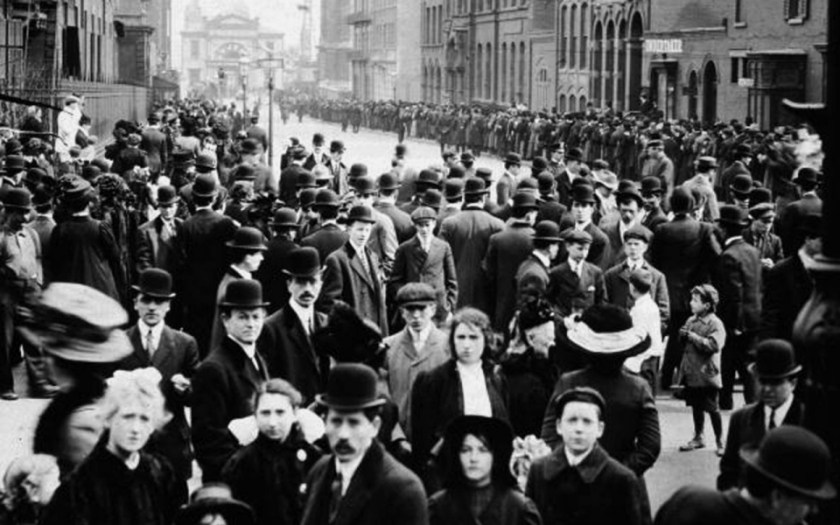
body identification

Waiting in line to identify bodies

In the aftermath, hearings were held about factory safety and working conditions, and thirty new safety and workplace laws were passed.

Harris and Blanck were tried for manslaughter, but acquitted as it couldn’t be proven they knew the doors were locked.

Clara remained an activist throughout her life. From this piece about her:

As for Clara, she left the ILGWU because of disgust with its conservative leadership and her inability to work in the industry. She joined the women’s suffrage movement. However, her working class roots conflicted with the upper class movement and she was fired less than a year later. Eventually she got married, had children, and became a housewife and consumer advocate, but she never drifted far from the union movement. She led eviction protests and organized relief for working strikers. To her dying day she was an unapologetic communist.

At the end of her life she entered the Jewish Home for the Aged in Los Angeles. She organized the orderlies into a union and prodded the management to join the United Farm Worker’s boycott of grapes. Clara Lemlich passed away on July 12, 1982 at age 96.

Check out this PBS documentary made at the 100th anniversary of the fire. About 53 minutes, but lots of interesting background and detail.

Time illuminates the moral high ground

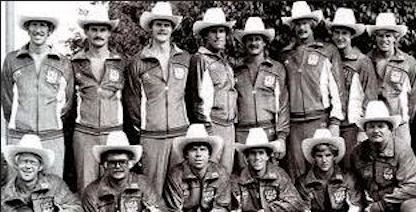
The Summer Olympics of 1980 took place in Moscow, capital of the (then) Soviet Union. But prior to the games, in March, President Jimmy Carter shocked and deeply disappointed the U.S. team by informing them that the U.S. would be boycotting the games.

1980 water polo

1980 Olympic Water Polo Team

Sixty-six other countries joined the U.S. boycott, while seven countries participated in the games but not the opening ceremonies, and five countries allowed their athletes to participate under the Olympic flag rather than their own national flag (great idea – this should be the standard!).

All in all, it was a gigantic mess. And it reverberated for years – the Soviets, in turn, boycotted the 1984 Olympics in Los Angeles because of U.S. “chauvinism” and “anti-Soviet hysteria”.

I’m guessing most of the people reading this are old enough to remember this event, but I’ll also bet most of you can’t remember what the fuss was all about. You win the standard GOML prize, an honorary Bachelor’s degree from Trump University, if you can explain why we boycotted without first looking it up. Tick tock.

Give up?

We boycotted the 1980 Summer Olympics, destroying the dreams of more than 450 of our athletes, and rendering pointless their sacrifices and years of training, because the Soviets sent their military into Afghanistan, who they then shared a border with, to overturn the unpopular regime there.

map

We asked, “Who but an arrogant, belligerent nation of monsters would send their military into Afghanistan to overthrow a legitimate government?” Unacceptable! We, of course, occupied the moral high ground and had to act to end this outrage.

Naturally, the Soviets weren’t about to pull in their horns and say the equivalent of , “Well you got us – maybe we really are immoral”, so they held the games without us and stayed in Afghanistan for eight years.

It was a fight that resembles all the other fights in the region and in many other regions as well:  liberal and tolerant urban interests versus conservative and less tolerant rural interests, modernity versus tradition, believers versus apostates, kleptocrats versus suckers, sect versus sect, gang versus gang, family versus family, and so on. Just like always and forever.

Some background from this wiki:

Prior to the arrival of Soviet troops, the People’s Democratic Party of Afghanistan took power after a 1978 coup, installing Nur Mohammad Taraki as president. The party initiated a series of radical modernization reforms throughout the country that were deeply unpopular, particularly among the more traditional rural population and the established traditional power structures. The government vigorously suppressed any opposition and arrested thousands, executing as many as 27,000 political prisoners. Anti-government armed groups were formed, and by April 1979 large parts of the country were in open rebellion. The government itself was highly unstable with in-party rivalry, and in September 1979 the president was deposed by followers of Hafizullah Amin, who then became president. Deteriorating relations and worsening rebellions led the Soviet government, under leader Leonid Brezhnev, to deploy the 40th Army on December 24, 1979.  Arriving in the capital Kabul, they staged a coup killing president Amin and installing Soviet loyalist Babrak Karmal from a rival faction.

Sounds familiar, doesn’t it? Is anything really different now? Have any of the factions been defeated or converted or even withdrawn from the fight all these years later? Were any of the issues different then than they are today? Were any of them ever resolved? Does a foreign power, whether the Soviets or the U.S. or anyone else,  installing a “loyalist” regime ever actually solve anything? Does anyone ever actually govern?

Our own brilliant assessment of the situation in 1980 was that we should support the good guys in Afghanistan against the Russians, which we did. We figured we could at least bog the Soviets down, make them deplete their resources, and keep them out of our hair elsewhere for a while. And maybe they’ll lose some support and credibility worldwide.

The good guys called themselves the Mujahideen and were led by an inspirational young lunatic called Osama bin Laden.

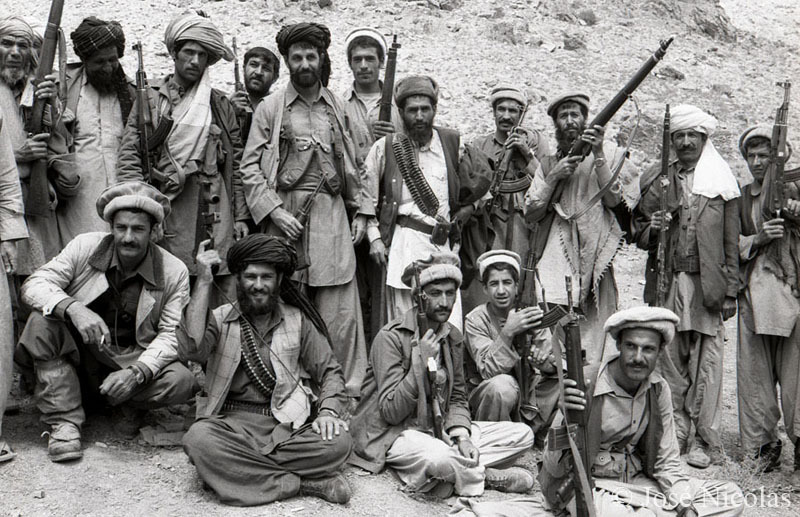
muja

Afghan Mujahideen, 1989

bin laden

Their Leader

When the Soviets finally threw in the towel, bin Laden figured, “We beat the Soviets and we’ll kick the Americans’ asses, too. They’re all infidels and have it coming.” And we all remember what happened next.

Bin Laden has been gone six years now, but our military is still in Afghanistan, and our boys are still in harm’s way. It’s been 16 years, now, with no end in sight. And that same arrogant, belligerent nation which caused all that commotion in 1980, now known as Russia, is not entirely disinterested in our involvement. They figure we’ll at least be bogged down, deplete our resources, and it will keep us out of their hair elsewhere for a while. And maybe we’ll lose some support and credibility worldwide.

From this piece:

On 9 February 2017, General John W. Nicholson, Jr told Congress that NATO and allied forces in Afghanistan are facing a “stalemate” and that he needed a few thousand additional troops to more effectively train and advise Afghan soldiers. Additionally, he also asserted that Russia was trying to “legitimize” the Taliban by creating the “false narrative” that the militant organization has been fighting the Islamic State and that Afghan forces have not, he asserted Russia’s goal, was “to undermine the United States and NATO” in Afghanistan. 

But we’ll prevail, by which we mean that we’ll win the hearts and minds of the Afghan people, who, at the end of the day, want all the same things we do: “freedom”, to send their kids to school, to buy stuff like we have, etc. etc. In short, to enjoy the western lifestyle just like we do. Right? Who wouldn’t want all that? It’s just their pesky culture, religion, and leaders that are standing in the way.

And after all, we have the moral high ground.

Andersonville vs. Belsen

Camp Sumter was the official name of the Confederate military prison at Andersonville, Georgia. It opened for business in late February of 1864 and remained in operation until the end of the Civil War, 14 months later.

Andersonville was needed to hold prisoners of war after the prisoner-exchange agreements between North and South were abandoned for lack of consensus on how to handle black soldiers.

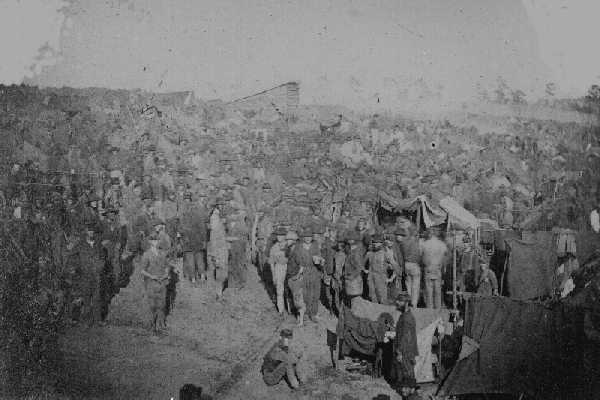
Andersonville quickly became known for its inhumane conditions and high death rate – 13,000 Union soldiers died there in the short time it operated.

It was originally designed for 10,000 prisoners, but the population quickly exceeded 30,000. Plans called for wooden barracks, but none were built as the cost of lumber was too great, so the Union soldiers imprisoned there lived out in the open, using only bits of cloth and whatever sticks of wood they could scrounge for makeshift shelters.

camp sumter

A small stream ran through the 16-acre site that was supposed to provide drinking water, but it quickly became a cesspool and source of disease, and in the summer it dried up. Rations were barely starvation-level and often over half the inmates reported ill.

Andersonvillesurvivor

Andersonville Prisoner

The commander of Andersonville, Captain Henry Wirz, was convicted of war crimes and hanged  shortly after the war. In his closing statement, the Judge Advocate General, Joseph Holt, said of Wirz,

“his work of death seems to have been a saturnalia of enjoyment for the prisoner [Wirz], who amid these savage orgies evidenced such exultation and mingled with them such nameless blasphemy and ribald jest, as at times to exhibit him rather as a demon than a man.”

wirz_001

Henry Wirz

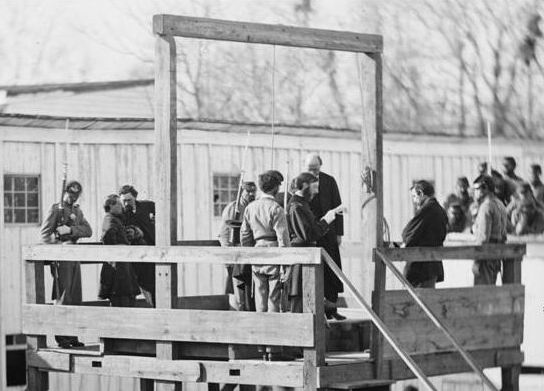
Wirz was executed in Washington, D.C. on November 10, 1865 at the age of 41. His last words, spoken to the officer in charge, were,  “I know what orders are, Major. I am being hanged for obeying them.”

Wirz execution

Execution of Wirz

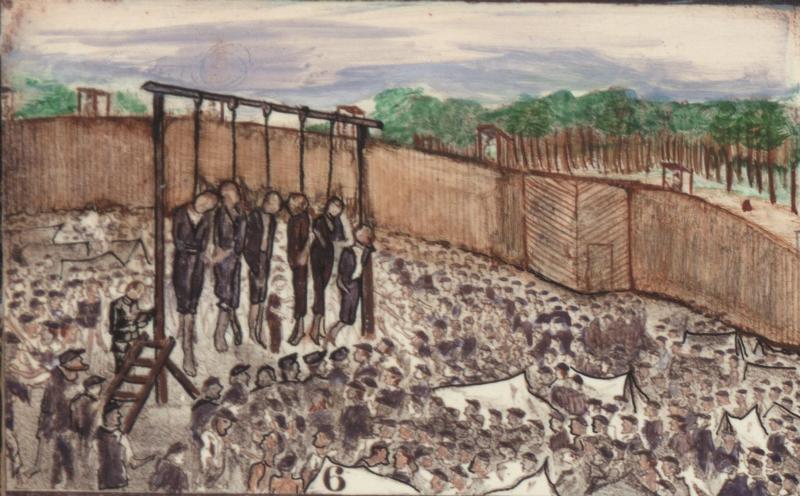
Here’s a sketch, made by a prisoner, showing some forms of punishment at Andersonville:

andersonville punishment

The “Andersonville Raiders” were inmates who preyed on others by stealing their possessions, terrorizing, and sometimes murdering them. They were a loosely organized group whose numbers have been estimated by various sources to be between 50 and 500, and who were led by a handful of “chieftans”. As a result of their activities, the Raiders were better fed and situated than other prisoners, and had weapons as well, assuring that they could continue their activities with ease.

The activities of the Raiders were ultimately halted by an internal police force organized by Wirz, called the Regulators, and the six Chieftans were executed.

andersonville execution

Execution of Raiders

There are a lot of similarities, I think, between Andersonville, and some of the Nazi-era concentration camps. In particular, Andersonville and Bergen-Belsen seem to me to share many characteristics.

About 50,000 people died at Belsen, perhaps most memorably Anne Frank and her sister Margot, just days before liberation. Like Andersonville, it was originally set up as a prisoner of war camp, and was expected to hold prisoners to be exchanged.

When the British walked into the camp in 1945, they discovered some 60,000 still barely alive, many lying on the ground among the thousands of unburied dead, and hardly distinguishable from them.  Over 13,000 people alive at liberation were too ill to recover.

After liberation, the camp was burned to prevent the spread of Typhus. Belsen had been  a much larger operation than Andersonville, of course, and persisted for years longer. It was the last year or so of operation that, for me, echoes Andersonville the most.

From July 1944 onward the population of the camp swelled from 7300 to the 60,000 at liberation, as Jews still alive in some of the big eastern camps were forced to march into Germany’s interior. These people were already weakened by years of persecution, and arrived in Belsen to find meager rations, no sanitation, little shelter and rampant disease.

They had already been robbed of all their possessions, but the equivalent of the Andersonville Raiders were certainly well-represented among them.

As with Andersonville, there were trials after the war and eleven of the Belsen staff were sentenced to death, including the Commandant, Josef Kramer, who was executed on December 12, 1945. Kramer’s previous post had been Lagerführer at Auschwitz, in charge of managing the gassing of newly arrived transports from May-November, 1944.

kramer under guard

Kramer under guard

Kramer, like Wirz, had a clear conscience, and thought of himself as a scapegoat. He explained to the British interrogating him,

“The camp was not really inefficient before you [British and American forces] crossed the Rhine. There was running water, regular meals of a kind – I had to accept what food I was given for the camp and distribute it the best way I could. But then they suddenly began to send me trainloads of new evacuees from all over Germany. It was impossible to cope with them. I appealed for more staff, more food. I was told that this was impossible. I had to carry on with what I had.

Then as a last straw, the Allies bombed the electric plant that pumped our water. Loads of food were unable to reach the camp because of the Allied fighters. Then things really got out of hand. During the last six weeks I have been helpless. I did not even have sufficient staff to bury the dead, let alone segregate the sick… I tried to get medicines and food for the inmates and I failed. I was swamped. I may have been hated, but I was doing my duty.”

There are similarities between Andersonville and Belsen, but also many differences – too many to address in this post.  Are they morally equivalent? I’d be interested in your thoughts.

Giordano Bruno

The Campo de’ Fiori is a lovely little square in the oldest part of Rome. A lively market for fruits, vegetables, flowers and more still flourishes there every day, just a couple of steps from the spot where Julius Caesar was stabbed to death. At night it’s filled with diners, strollers, and tourists soaking in the beauty and atmosphere, and exploring the boutiques and restaurants on the adjacent side streets.

Click anywhere on the picture below to see a live cam of what’s going on there right now.

campo-de-fiori

A couple of days ago, there was a small crowd gathered on this spot and a few speeches were given to remember what happened there on February 17, 1600. On that day, Giordano Bruno was led to the square on a mule, stripped naked, had his tongue bound, and was burned alive.

That’s a statue of Bruno, erected in 1889, in the center of the picture.

bruno

What crime had he committed? Heresy, of course. The Roman Inquisition found him to be a Pantheist. The Inquisition accused him of denying some basic Catholic tenets like the divinity of Jesus, the idea of eternal damnation, the virginity of Mary, and so on.

Bruno was a philosopher, mathematician and poet. He theorized about the cosmos, coming up with the ideas that the universe might be infinite and have no “center”, and that the stars were other suns perhaps with their own planets like ours, some possibly even supporting life. He figured all this out decades before Galileo, and, over the centuries, he has come to be regarded as a martyr for science.

Here is a nice little aggregation of reviews of the 2008 book, “Giordano Bruno – Philosopher, Heretic” by Ingrid D. Rowland, that provides some more insight about him.

Three gynocentric flicks

The French journalist, critic, and novelist,  Jean-Baptiste Alphonse Karr, famously observed, “Plus ça change, plus c’est la même chose”, or “The more things change, the more they remain the same.”

Antisemitism is on the march again. In Europe, it’s the same old story – right-wing nationalism is resurgent. But there are a few new elements in the mix, including the condition of rising Muslim populations and their catch-all grievance of Palestinian victimhood. They are abetted by the  “intellectual” left, which has increasingly lost the ability to distinguish between vilifying Israeli policy (OK, if you want to split hairs, “Zionist” policy), and vilifying Jews.

In this country, though, something new seems to be happening. The rash of bomb threats against Jewish Community Centers (60 so far this year), and the recent vandalizing of Jewish cemeteries in St. Louis and Philadelphia has us all on edge. There can be no doubt that Trump’s embrace of Steve Bannon, Breitbart, and the alt-right is a major contributing factor. It’s pretty clear Bannon doesn’t like Jews.

Is this what it felt like in 1933? Just a couple of news stories, but nothing to get panicky over? We don’t want to over-react, but we don’t want this to go unremarked either. What to do?

But you’re tired of hearing me rant about Trump, right? I get it. Man, he really sucks the oxygen out of normal daily life and social discourse, doesn’t he?  It’s exhausting.

I know – let’s go to the movies!

You know how everyone is always complaining about how there are no good roles for women, and how no movies pass the Bechdel-Wallace test any more?  Well, here are three fairly recent movies I can recommend, each with a strong female character at its center.

And the best part is they’re all about surviving the Nazis! Let’s go watch a couple of these and then we can reflect on Alphonse Karr’s aphorism. D’accord?

Ida (2014)

Phoenix (2014)

Sarah’s Key (2011)

If you haven’t seen these, I won’t spoil them for you (except maybe a little). In each case a young Jewish girl or woman survives the war against all odds. But, to me, the unifying theme of the three is the death not just of the Jews of Europe, but the death of Jewishness itself. Though the women survive, at least for a time, their Jewishness does not.

There is no doubt in my mind that the Europe of today very closely resembles the Europe of Hitler’s dreams. It’s hard to understand the enormity of the crime that was committed: one out of every three Jews alive in the world in 1941 was murdered by 1945. And in some swaths of The Pale, every single last Jew was killed.

Of course, the persecution and killing of the Jews is the thing that shocks and engages us, but it is the death of Jewishness itself that may be the larger crime, and therein lies the ultimate victory of the Germans. Yes, I said Germans. Despite all the retroactive claims of heroism and “resistance” that you hear about from today’s oh-so-liberal Teutons, in the 1930’s trying to separate the “good Germans” from the Nazis was a pointless exercise. It was a distinction without a difference – some people actively participated and others “only” watched.

It’s true that there may be a stray “Jew” here or there that has persevered in Europe, but not one Hitler would ever recognize.  That stray doesn’t dress “like a Jew”, isn’t part of a synagogue’s congregation, doesn’t speak Yiddish (an entire language and literature extinguished!), doesn’t read the “Jewish press”. All those trappings of Jewish life and culture have disappeared. “The Jews” are not a political force, not a cultural force, or really any kind of force, except in the paranoid fantasies of the right, which have survived the decades completely intact, also against all odds.

In the east, in Poland, Lithuania, Ukraine, Belarus, Romania, Moldova and elsewhere, young people are completely unaware of the history of the Jews or even that  Jews ever lived there, much less comprised 50% of the population in many places.  The small town or “shtetl” of Shalom Aleichem, once the center of Jewish life, is no more. And, more significantly, there is no trace it ever was there to begin with. There are no Jewish schools or libraries, no Jewish businesses, no buildings with Jewish iconography, no birth, death or marriage records.

And almost every Jewish cemetery is gone as well. Like today’s antisemites, the Nazis and their collaborators loved to harass the living Jews, and could not let the Jewish dead rest in peace, either. But unlike today’s antisemites, they didn’t stop at merely turning over the headstones and scrawling their messages of hate. They carted off the stones and used them to pave roads, latrines and basement floors, a practice finally halted in Ukraine in 2013. All traces of Jewish life, and death, were obliterated.

As I read the news of the day, I wonder when will it be time to sound the alarm, and when will it be too late? And, this time around, will the righteous be able to stop it?

Alphonse Karr also said, “Every man has three characters – that which he has, that which he thinks he has, and that which he exhibits.”

Do not obey in advance

In the days just after the election, Timothy Snyder, the Yale history professor who writes so well about Eastern European history, observed that  “Americans are no wiser than the Europeans who saw democracy yield to fascism, Nazism or communism.”

He was worried about what a Trump presidency would do to our democratic institutions, and hoped that the lessons that should have been learned from the rise of Hitler and Stalin would keep us from repeating the same mistakes again. He offered a list of things that any citizen could do to try to resist the terrible possibilities.

All of the 20 suggestions on the list are good, but a couple stand out for me:

1. Do not obey in advance. Much of the power of authoritarianism is freely given. In times like these, individuals think ahead about what a more repressive government will want, and then start to do it without being asked. You’ve already done this, haven’t you? Stop. Anticipatory obedience teaches authorities what is possible and accelerates unfreedom.

3. Recall professional ethics. When the leaders of state set a negative example, professional commitments to just practice become much more important. It is hard to break a rule-of-law state without lawyers, and it is hard to have show trials without judges.

13. Hinder the one-party state. The parties that took over states were once something else. They exploited a historical moment to make political life impossible for their rivals. Vote in local and state elections while you can.

20. Be a patriot. The incoming president is not. Set a good example of what America means for the generations to come. They will need it.

The problem I see with the list, and why the cause is already lost,  is that it speaks only to those who both understand what is happening and think it’s a bad thing. In other words, it’s a list for people who already knew that Trump would be bad for the country. It’s the other 60 million that need to be convinced, and it just ain’t gonna happen.

Some examples:

4. When listening to politicians, distinguish certain words. Look out for the expansive use of “terrorism” and “extremism.” Be alive to the fatal notions of “exception” and “emergency.” Be angry about the treacherous use of patriotic vocabulary.

Really? There is absolutely no way the people who love to hear the man-baby finally say the words “radical Islamic terrorist” and repeat the “Make America Great Again” slogan are ever going to act on this advice. FoxNews built a commercial empire (and now a political one) by betting that their viewers couldn’t do this. That’s exactly why we’re here.

8. Believe in truth. To abandon facts is to abandon freedom. If nothing is true, then no one can criticize power, because there is no basis upon which to do so. If nothing is true, then all is spectacle. The biggest wallet pays for the most blinding lights.

Okay, Professor Snyder, I’m going to give you a bye on this because you wrote it before we learned about “Fake News” and “alternative facts.” The problem is that the Trump supporters apparently do not have the tools or the will to distinguish facts from nonsense. In the internet world, everything is just as true as everything else, and they’ve already made their choices.

9. Investigate. Figure things out for yourself. Spend more time with long articles. Subsidize investigative journalism by subscribing to print media. Realize that some of what is on your screen is there to harm you. Bookmark PropOrNot or other sites that investigate foreign propaganda pushes.

Yeah, no. Even this blog entry is too long already for most people to get through. The digital assault on our senses is so heavy that you really can’t ask people to read/study/investigate anything more -they’re already being sprayed by a fire-hose of information that they can’t sort out or interpret. (Except for a very few voracious readers and lifelong students. I’m looking at you, faithful subscribers to GOML.)

18. Be reflective if you must be armed. If you carry a weapon in public service, God bless you and keep you. But know that evils of the past involved policemen and soldiers finding themselves, one day, doing irregular things. Be ready to say no. (If you do not know what this means, contact the United States Holocaust Memorial Museum and ask about training in professional ethics.)

Too late again. The people you’re talking to here are already beyond this suggestion and have chosen to violate suggestion #1 as well: they’re obeying in advance. If you doubt it, glance at this article from yesterday’s Failing New York Times about how Immigration Agents have been set free by Trump’s tweeting, and aren’t really waiting for the courts to sort it out.

5. Be calm when the unthinkable arrives. When the terrorist attack comes, remember that all authoritarians at all times either await or plan such events in order to consolidate power. Think of the Reichstag fire. The sudden disaster that requires the end of the balance of power, the end of opposition parties, and so on, is the oldest trick in the Hitlerian book. Don’t fall for it.

We’ve talked before here about how Trump seems to be goading the bad guys into attacking us in the hopes that he can consolidate his power, marginalize the courts, and, above all, become the most up-voted, liked, favorited, highest-ratings president ever.

I almost didn’t bother including #5 here, but I wanted an excuse to  link to this other Snyder article on the Reichstag fire of 1933. If you don’t know about the fire, brush up with this article. Snyder says, “The Reichstag fire shows how quickly a modern republic can be transformed into an authoritarian regime.”

Verdun

101 years ago today, the first shots in the battle of Verdun were fired. It was to become the longest and most destructive battle in what was then known as The Great War (World War I), and in all of history. By the time the battle was over 10 months later, there had been 377,231 French and 337,000 German casualties.

The battle was meant to start nine days earlier, and thousands of Germans were ready in their “stollen”, or tunnels. But snow, wind, rain, and poor visibility kept them in place.  The tunnels had no heat and were flooded, and the condition of the troops deteriorated with hunger and medical issues. During the delay, the French had some time to move their troops into position.

stollen

Germans waiting to start 

At 7:15 A.M. on February 21st., the fierce German bombardment began. 80,000 heavy grenades fell at a rate of 40 per minute on an area of half a square kilometer. The French trenches were blown up and men were ripped to pieces, buried under the earth or disappeared into the air. Trees are uprooted and body parts hung in the branches. The bombardment lasts nine hours.

The Germans emerge from their stollen at 5:15 P.M. expecting to find no-one alive, but the bombardment was less effective then they hoped, and the French are there to resist. The Germans use flamethrowers as an offensive weapon for the first time.

The battle continues for four days before the Germans are able to capture their primary objective, Fort Douaumont.

douaumont

Fort Douaumont at war’s end

The French at Verdun are under the command of Henri-Philippe Petain, later the Chief of State of Vichy France. Retreat was not an option for him, and he orders the defense of a line between the remaining fortifications at Verdun “at all costs”. The battle for the village of Douaumont continues for days, and ultimately the Germans prevail on March 2nd, taking many prisoners, including Charles de Gaulle.

This was the battle of the Anthill. It is re-created in Kubrick’s superb anti-war movie, Paths of Glory, which has an unforgettable opening tracking shot of Kirk Douglas, as Colonel Dax,  moving through the French trenches. See this movie again soon.

But Petain has achieved his objective, which was to delay the German advance for a couple of days while French reinforcements could be assembled. The battle for Douaumont bogged down, and the battlefield became a muddy swamp where neither army advanced for months. Fort Douaumont was finally re-taken by the French in October.

The overall battlefield itself was tiny, less than 10 square kilometers. Men on both sides lived in trenches and were fighting for just a few yards of territory at a time.

World War One Battle Of Then

verdun3

Now

The Hell of Verdun

A French captain reports: …I have returned from the most terrible ordeal I have ever witnessed. […] Four days and four nights – ninety-six hours – the last two days in ice-cold mud – kept under relentless fire, without any protection whatsoever except for the narrow trench, which even seemed to be too wide. […] I arrived with 175 men, I returned with 34 of whom several had half turned insane….

The last note from the diary of Alfred Joubaire, a French soldier: …They must be crazy to do what they are doing now: what a bloodbath, what horrid images, what a slaughter. I just cannot find the words to express my feelings. Hell cannot be this dreadful. People are insane!…

A German soldier writes to his parents: …An awful word, Verdun. Numerous people, still young and filled with hope, had to lay down their lives here – their mortal remains decomposing somewhere, in between trenches, in mass graves, at cemeteries….

Henri Barbusse describes the trenches as:
…a network of elongated pits in which the nightly excreta are piling up. The bottom is covered with a swampy layer from which the feet have to extricate themselves with every step. It smells dreadfully of urine all over….

A French stretcher-bearer describes the consequences of a flame-thrower attack: …Some grenadiers returned with ghastly wounds: hair and eyebrows singed, almost not human anymore, black creatures with bewildered eyes….

A German eye-witness: …The losses are registered as follows: they are dead, wounded, missing, nervous wrecks, ill and exhausted. Nearly all suffer from dysentery. Because of the failing provisioning the men are forced to use up their emergency rations of salty meats. They quenched their thirst with water from the shellholes. They are stationed in the village of Ville where every form of care seems to be missing. They have to build their own accommodation and are given a little cacao to stop the diarrhoea. The latrines, wooden beams hanging over open holes, are occupied day and night – the holes are filled with slime and blood…

A neutral contemporary feels: …that they, within the framework of this World War, are involved in some affair, that will still be considered horrible and appalling in a hundred years time. It is this Hell of Verdun. Since a hundred days – day and night – the sons of two European people fight stubbornly and bitterly over every inch of land. It is the most appalling mass murder of our history…

ossuary

15,000 French rest at Douaumont

Ronald McNair

Thirty-one years ago today, Ronald McNair died.

He was only 36 years old and had already accomplished more than most do in a full lifetime.

In an NPR interview a couple of years ago, his brother, Carl, said  Ron saw possibilities where others only saw closed doors. Carl told this story about the nine-year-old Ron:

Ron, without my parents or myself knowing his whereabouts, decided to take a mile walk from our home down to the library. The library was public, but not so public for black folks, when you’re talking about 1959 in South Carolina. As he was walking in there, all these folks were staring at him — because they were white folk only — and they were looking at him and saying, you know, ‘Who is this Negro?’

So, he politely positioned himself in line to check out his books. Well, this old librarian, she says, ‘This library is not for coloreds.’ He said, ‘Well, I would like to check out these books.’ She says, ‘Young man, if you don’t leave this library right now, I’m gonna call the police.’

So he just propped himself up on the counter, and sat there, and said, ‘I’ll wait.’ 

The librarian called the police — and McNair’s mother, Pearl. When the police got to the library, two burly guys come in and say, ‘Well, where’s the disturbance?’ And she pointed to the little 9-year-old boy sitting up on the counter. And the policeman says, ‘Ma’am, what’s the problem?’

By then, the boys’ mother was on her way.  She comes down there praying the whole way there: ‘Lordy, Jesus, please don’t let them put my child in jail.’ And my mother asks the librarian, ‘What’s the problem?’  “He wanted to check out the books and, you know, your son shouldn’t be down here,” the librarian said.

And the police officer said, ‘You know, why don’t you just give the kid the books?’ And my mother said, ‘He’ll take good care of them.’ So, the librarian reluctantly handed over the books. And then, Carl says, “my mother said, ‘What do you say?’ 

And Ron answered, “Thank you, ma’am.”

Ron ultimately earned a PhD. in Physics from M.I.T.  He was an accomplished saxophonist and a black belt in karate.

In 1978, he was selected as one of thirty-five from a pool of 10,000 for the astronaut program at NASA. He was a mission specialist on the Challenger in 1984, only the second African-American to fly in space, and the first of the Bahá’i faith.

He had composed a piece of music to be played on his second Challenger mission, STS-51-L, which lifted off January 28, 1986. It would have been the first piece of original music recorded in space.

mcnair3

mcnair1.jpg

mcnair-3

America First. Again.

I like being an American. I wouldn’t want to live anywhere else. To my antecedents, America was a lifeboat. They clung to it and embraced it and tried hard to forget the dismal sea they had been drowning in before there was America for them.

No one is more dismayed by the steady rise of anti-Americanism around the world than I am. I like to think we still represent the city on a hill that J.F.K. referred to in a 1961 speech:

“We must always consider that we shall be as a city upon a hill—the eyes of all people are upon us. Today the eyes of all people are truly upon us—and our governments, in every branch, at every level, national, state and local, must be as a city upon a hill—constructed and inhabited by men aware of their great trust and their great responsibilities

When people around the world need help, it’s American intervention they hope for. Of course, they tire of it almost immediately when it is offered. You often hear the “criticism” that America doesn’t act out of altruism or magnanimity, but only out of self-interest. Duh. Yes, of course. We’re not going to act against our own interests, and neither is anyone else. It’s quite absurd to expect that.

And I totally get that we have often made things worse. We propped up every right-wing dictator we could find in the name of anti-communism after WWII, and there are plenty of people and governments who won’t forgive us for that. All this tends to strengthen our natural desire for isolationism and protectionism at home, as people of good will grow weary of having their efforts to benefit others turn sour and cause resentment. Let’s focus on fixing problems at home, they say, and they have a point. I feel that way myself.

Trump’s inauguration speech was notable for its combativeness, and absence of the traditional themes of reconciliation and working together to make things better. It did, though, revive an old slogan, “America First”. The man-baby may or may not know the provenance of this slogan as he knows so little, but I’m quite sure some of the people around him, Steve Bannon for example, know exactly where it comes from and who it’s directed at.

For those who have forgotten, or perhaps never knew, “America First” is the slogan of anti-semites. In 1941, the America First movement, led by the estimable hero and noted crackpot, Charles Lindbergh, campaigned tirelessly to keep America out of World War II. They were sympathetic to the cause of the Nazis, thought England should be left to its own inevitable defeat, and accused “the Jews” of both trying to take over Germany and agitating for America to enter the war against its own best interests.

In a Des Moines speech, Lindy says,

It is not difficult to understand why Jewish people desire the overthrow of Nazi Germany. The persecution they suffered in Germany would be sufficient to make bitter enemies of any race.

No person with a sense of the dignity of mankind can condone the persecution of the Jewish race in Germany. But no person of honesty and vision can look on their pro-war policy here today without seeing the dangers involved in such a policy both for us and for them. Instead of agitating for war, the Jewish groups in this country should be opposing it in every possible way for they will be among the first to feel its consequences.

Tolerance is a virtue that depends upon peace and strength. History shows that it cannot survive war and devastations. A few far-sighted Jewish people realize this and stand opposed to intervention. But the majority still do not.

Their greatest danger to this country lies in their large ownership and influence in our motion pictures, our press, our radio and our government.

I’ll leave aside the “us and them” for today.

The trick of “not condoning” persecution while strongly advocating steps that will increase it is a favorite of Bannon, Breitbart, and the alt-right. That Trump is oblivious to it is upsetting and disheartening. To Bannon, “the Jews” are whiny brats. And while, according to him,  he is not an anti-semite and doesn’t condone it, he has created a petri dish for it to grow and mutate, and now has inserted his thoughts and language into the brain and mouth of our clueless new Chief Executive.

Are Jews in America more at risk today than, say, Muslims? Who knows what the Orange Dystopia will bring. Uncertainty and chaos is assured, but, beyond that, no one can say. We will reel from one slogan, idea, and policy to the next.

For now it’s America First. Again.

Syria: All vs. Everyone

Having a hard time figuring out who the good guys are in Syria? It’s unbelievably complex. That’s why there’s no good “solution”, political or military. Also, there are no clear, achievable objectives for us that could shape a coherent policy and that’s why we’ll be the loser no matter who is deemed the winner. Even if we stay out of it, we’ll be someone’s enemy.

Above all, it’s too complex for Trump. You can’t sum this thing up in a tweet.

The first thing to know is it’s not ISIS vs. The West. This would be a convenient explanation and one that is very attractive to  Trump: a simple, patriotic narrative that would energize our military and that our population would support. And it’s what is being put forward by Trump’s man-crush, Vladimir Putin. For Putin, anyone who opposes Assad is a terrorist. Trump ran on a platform of “bombing the shit out of ISIS”.

Apart from the Syrians themselves, there are five countries involved, each with it’s own set of interests: Iran, Saudi Arabia, Turkey, Russia, and the U.S.

Turkey wants to keep Kurdish separatists in check, both in Syria and Iraq. They supported anti-Assad rebels early on and would like to see him gone.

Iran wants to prop up Assad to maintain its access to Lebanon, where its client, Hezbollah, opposes Israel, whose nuclear weapons Iran fears. Also, maintaining Shiite control of Syria’s Sunni majority  increases Iran’s regional influence. Assad is a member of the Shiite Alawite sect.

Russia also wants to prop up Assad. Syria is one of Russia’s few allies and buys weapons from them. Syria contains Russia’s only military base outside the former Soviet Union.

Saudi Arabia wants to check the spread of Iranian power. Saudi Arabia and Iran are the two regional proxies in the never ending conflict of Sunni vs, Shia.

The U.S. would like to see Assad gone. We’ve given weapons to the “rebels” (hopefully the good ones) and the Kurds in order to fight ISIS.

Lots more explanation here.

syria

Within Syria, you’ve got the weak Assad government and its Alawite followers. You’ve got anti-Assad “rebels” who are the remnants of the Arab Spring. You’ve got Syrian Kurds, the Sunni civilian majority, factions within the military, a variety of extremist groups battle-hardened from fighting in Iraq. And you’ve got ISIS, which seems composed mainly of foreign kids that have been lured into the mess by Jihadist propaganda.

As is the nature of all things in the middle east, each sect, tribe, gang, and family has its own interests, and as time has gone on, each has felt more threatened by reprisals from all the others. The factions have become smaller, more numerous, and more intractable. Assad’s indiscriminate bombing of cities is the most extreme example of this splintering – everyone who is not part of his clique is his enemy.

aleppo

Aleppo

What to do? Who knows. When it’s over, it won’t be over. There will be vendettas and plots, executions and assassinations. If Assad remains, he will be the president of nothing with enemies all around.

But I am quite confident that, before then, the man-baby will find a way to make it worse.

Midway revisited

Midway Island is a tiny dot of land, only 2.4 square miles, thousands of miles from anywhere else. It’s literally in the middle of the Pacific Ocean, about “midway” between Asia and North America.

You know its name because the greatest naval battle of all time was played out there over a couple of days only six months after Pearl Harbor. All four of Japan’s aircraft carriers were sunk in a decisive victory for the U.S. It permanently crippled the Japanese Navy and changed the course of the war in the Pacific. The name might also be familiar as Chicago named it’s downtown airport after this battle.

Today, only about 50 people inhabit the island, all employed by the U.S. Fish and Wildlife Service.   There had been a National Wildlife Refuge there, but no tourists have been there since 2012, as the tourism program was suspended for lack of funding.

You can try virtual visitation if you’re desperate to see it.

Midway has always been home to a large population of birds, including three species of Albatross.

three-albatross-512x219

Today, Midway is again on the front lines of battle, and the stakes this time are much more important even than WWII. It’s a battle all of us are certainly losing. Americans, Japanese, and everyone else. All of us.

Every piece of plastic that has ever been created is still in existence. Over five trillion pieces of plastic are already in the ocean, and according to the Ellen MacArthur Foundation, there will be more plastic than fish, by weight,  in the ocean by 2050. Some eight million tons of plastic trash leak into the ocean annually, and it’s getting worse every year. Americans are said to use 2.5 million plastic bottles every hour.

Even though Midway is in the middle of nowhere, and should be a pristine beach free of any human impact (other than that of the ecologists working there), it is a landing place for a lot of the sea-borne debris. It just happens to be in the way.

great_pacific_dump

Weirdly, marine life seems to like eating plastic as much or more than anything else. I guess it’s also possible that the food chain has been so disrupted  by garbage and climate change that they just don’t have the same food available now that they’ve had in the past. In any case, the Albatross population at Midway has been eating a lot of it.

Click on an image to enlarge it

If you stick your hand into the sand at Midway, you can pull up an array of colored particles. Some people call this “new sand” – it’s plastic that has broken down into smaller pieces. The smallest are called nano-plastics and end up in plankton and become part of the food chain.

They’ve tried to stay ahead of the garbage on Midway, cleaning it up and flying it out – but it’s hopeless. Too much new garbage washes ashore every day or is flown in by the birds.  Midway will certainly disappear under the ocean before any of the plastic  decays. For now, they’re shoveling plastic against the tide.

As always, a few dedicated souls are doing what they can to reverse the damage. You can see what the Friends of Midway are up to. But obviously action on a much larger scale is required.

Are you optimistic?

A day that will live in infamy

Seventy-Five years ago tomorrow, 353 Japanese fighter planes, bombers, and torpedo planes launched from six aircraft carriers sneak-attacked the American naval base at Pearl Harbor.

pearl

There were eight battleships in the harbor. All were damaged and four were sunk.  The Japanese also damaged or sank three cruisers, three destroyers, an anti-aircraft training ship, and a mine layer. 188 aircraft were destroyed.

2403 Americans were killed. 64 Japanese attackers died.

America declared war on Japan the next day, and less than four years later, Japan, its population and resources exhausted and its cities in smoldering ruins, surrendered unconditionally.

peace-sign

Uh, what was the question again?

With the help of U.S. largess in the form of the Marshall Plan and the Allied Council led by Douglas MacArthur, Germany and Japan were rebuilt and gradually became economic superpowers that rival the U.S.   Neither had to spend any money on their defense over the decades, and, along with everyone else, relied on the U.S. to be the world’s policeman.

Sixty years later, there was another sneak attack on American soil.

never-forget

There were 2877 Americans killed in the 9/11 attacks, hundreds more than were killed at Pearl Harbor. Unlike Pearl Harbor, they were almost all civilians. Enemy losses: the 19 attackers died.

The whole world was aghast, and, for at least a few days, supported us.  They said, “We are all Americans”.

Student officers display a US giant nati

We are all Americans

After the 9/11 attacks, again unlike Pearl Harbor, the U.S. did not declare war on anyone.  No war was declared on Saudi Arabia where almost all of the attackers came from, where the poisonous ideology behind the attacks was created and spread, and where the money and support for the attackers originated.  Neither was war declared on Afghanistan, where the attackers had been given sanctuary to plan and train for the attacks,  and where the Taliban regime protected them as honored guests.

The U.S. figured the response should be a surgical one since, after all, the attack was launched by a only handful of fanatics, who certainly could not represent a widespread ideology or “movement”.  We’re not the bad guys, after all, and the whole world supports us.  Right?

Nothing happened for a few weeks while we ruminated on how to respond.  Then, with smoke still rising at the World Trade Center, an operation was undertaken to root out the plotters in their mountain hideout.

wtc-october

But first, we thought we should re-create the success of the Marshall plan – no need to wait until we’ve beaten the bad guys.  We need to win over the hearts and minds of all the poor people in Afghanistan who must hate the Taliban and who will regard us as liberators and saviors, and who would really like a western-style democracy, like everyone else.  Right?

We started dropping not bombs but food on Afghanistan.  They’ll love this!  But it wasn’t that simple.  They didn’t love it.  They found fault.  They liked to eat rice, bread, and meat but we were giving them peanut butter and beans and other things they didn’t care for.

They usually eat with their hands, but each American kit contained plastic cutlery and packs of salt and pepper!  The directions on each packet were printed in English, French and Spanish; but Afghans speak Dari!

And the packages were the wrong color – they looked like bombs!  And one hit a guy’s roof and caused some damage!  And it wasn’t enough!  They needed shoes, clothing, and meat, they said.

International aid agencies criticized us for combining military and humanitarian missions.

In other words, we’re monsters.

And we didn’t get the bad guys, either. They walked over to Pakistan and lived in protected luxury for another decade, plotting, propagandizing, and stirring up trouble the whole while.

Fifteen years after the attacks, the “war” is still going on.  Americans are still dying in Afghanistan, and the entire region is in turmoil.  And, all over the world, the “We are all Americans” thing is done forever, an embarrassing relic like your high school yearbook picture.

Where did it all go wrong?

Well, we weren’t doing too too well in Afghanistan, so, on March 20, 2003, we invaded Iraq, a country that had nothing to do with the attacks, and whose leadership hated the people responsible for them.  It’s as if, after Pearl Harbor, we had decided to kick China’s ass.   This, of course, is precisely what bin Laden had hoped for.

George W. Bush has been asked many times since then whether he thought the Iraq invasion was a mistake, and has almost always answered that “history will ultimately judge”.  He is a content man.
Well, George, history’s verdict is in. March 20, 2003 is a day that will live in infamy.

the-iraq-war-800x430

We are villains

In Can Life Prevail, Pentti Linkola writes,

“The US is the most wretchedly villainous state of all times. Anyone aware of global issues can easily imagine how vast the hatred for the United States – a corrupted, swollen, paralysing and suffocating political entity – must be across the Third World – and among the thinking minority of the West too.”

Clodovis Boff writes,

“The U.S. will never be a free and happy nation while they continue to exploit and marginalize the Third World. The Third World will never be happy or free so long as there is a First World stuck in the mire of consumerism, alienation, indifference.

WTF? How did we get here? How are we not only the bad guys, but the worst guys?

After WWII, we not only built our own economy, but helped improve the economic condition of people all around the world. Between 1970 and the 2008 financial crisis, global output quadrupled.

The number of people living in extreme poverty in developing countries fell from 42 percent in 1993 to 17 percent in 2011.

The percentage of children born in developing countries who died before their fifth birthday declined from 22 percent in 1960 to less than 5 percent by 2016.

Francis Fukuyama writes,

Yet statistics like these do not reflect the lived experience of many people. The shift of manufacturing from the West to low labor-cost regions has meant that Asia’s rising middle classes have grown at the expense of rich countries’ working-class communities. And from a cultural standpoint, the huge movement of ideas, people and goods across national borders has disrupted traditional communities and ways of doing business. For some this has presented tremendous opportunity, but for others it is a threat.

This disruption has been closely associated with the growth of American power and the liberal world order that the United States has shaped since the end of World War II. Understandably, there has been blowback, both against the United States and within the nation.

John F. Kennedy had understood these issues well. When he accepted his party’s nomination, he invented the “third world” idea, saying,

“Abroad, the balance of power is shifting. There are new and more terrible weapons, new and uncertain nations, new pressures of population and deprivation. One-third of the world, it has been said, may be free, but one-third is the victim of cruel repression, and the other one-third is rocked by the pangs of poverty, hunger and envy. More energy is released by the awakening of these new nations than by the fission of the atom itself.”

 And in his inaugural address,  he said,

“If a free society cannot help the many who are poor, it cannot save the few who are rich.”

But JFK is long gone. We are embarking on the era of DJT.

Will our position in the world be improved in the coming years? Will the U.S. be less hated or hated even more? Will our petulant man-baby engage with these issues?

jfk-djt

A Hell of a summer

In the summer of 1941, Europe was at war, but America wasn’t. During that summer, two of baseball’s immortals were in their prime and putting on a show that dominated the news, sometimes putting events in Europe in the shadows for the average American.

williams2-jumbo

Ted Williams, then only 22 years old and in his third year with the Red Sox, was having a season for the ages. It would end with him hitting .406, the last man ever to reach the .400 level. In the 75 years since, only a couple of players have ever come close, though Williams himself almost did it again 16 years later, when he hit .388.

Joe DiMaggio, in his sixth year with the Yankees at age 26, put together a 56-game hitting streak, a record most think will never be broken. He won the MVP that year, for the second of the three times in his career, though, by any objective measure, Williams had the better year.

During the streak, which went from May 15 to July 17, DiMaggio batted .408 (he finished the year at .357). Over that same span, Williams hit .412. Baseball experts agree that the most important individual statistic is On-Base Percentage.  Williams’ OBP for the season was an astounding .553, while DiMaggio’s was a very good .448.  Williams had a slugging percentage of .735 while  Joe D. slugged .643.

But DiMaggio was playing in New York where most of the MVP-voting writers worshiped him, and Williams was playing in Boston where he had already begun his lifelong war of words with the press.

On June 22nd, Joe extended the streak to 35 games, as the Yankees beat Detroit 5-4 at home. He went 2 for 5, including a hit off Hal Newhouser, a future Hall-of-Famer. On that same day, the Nazis began Operation Barbarossa. They crossed into eastern Poland, violating the German-Soviet Non-aggression Pact that had partitioned Poland since August 1939, and, in doing so, opened up a second front in the war.

barbarossa

The invasion of the Soviet Union brought millions of Jews under Nazi control. Jews in what is now Ukraine, Moldova, Belarus, and eastern Poland all paid the ultimate price as the Germans steamrolled their way to Stalingrad.

The big killing factories like Treblinka and Auschwitz were not yet fully functional, but the Nazis couldn’t wait. Village-by-village and city-by-city, the Jews were simply rounded up, marched to a suitable field nearby, and shot, often in full view of their neighbors, who were almost always the beneficiaries of the property left behind.

Within two years or so, 1.6 million Jews had been murdered in this Holocaust by Bullets.

On September 22, with only a week left in the 1941 baseball season, fans were rapt as Williams was still hanging on to his .400 average. He had a double in three trips against the Senators in Washington, which actually dropped his average a tick.

That same day was the end of the Jews in Vinnitsia, a good-sized Ukrainian city. More than 20,000 of them went to the pits to be shot. The last Jew alive in Vinnitsia is shown in this photo, where a proud member of Einsatzgruppe D finishes the day’s work.

the-last-jew-in-vinnitsa-1941

The Last Jew of Vinnitsia

I am quite sure the gentleman depicted here had a name, but it is lost to history. Any friend or family member who might be able to identify him from this picture was already dead in the pit below him by the time it was taken. He may have had children as well – did he sing them a lullaby at bedtime? He may have had a profession, hobbies, interests. Maybe he played a musical instrument – the violin, perhaps?  Maybe he liked chess. Maybe he was aware of DiMaggio’s streak, as Hemingway’s hero in The Old Man and the Sea was, or was hoping to find out if Teddy could finish above .400. It’s all possible.

On the last day of the baseball season, September 28, Williams’ average had dropped to .39955. The Red Sox had a meaningless doubleheader to play at Shibe Park in Philadelphia, and his manager, Joe Cronin, asked him if he wanted to sit it out so that his average could be entered into the books as .400. Williams famously declined, saying if he was going to hit .400, it would be for a full season, not a part of one. He then went out and got six hits in the two games, finishing the season at .406.

ted-williams-406

That same day, in Kiev, the city’s Jews received this order:

“All the Yids of the city of Kiev and its vicinity must appear on Monday September 29, 1941 by 8 a.m. at the corner of Melnikova and Dokhterivskaya streets (next to the cemetery). Bring documents, money and valuables, and also warm clothing, bed linen etc. Any Yids who do not follow this order and are found elsewhere will be shot. Any civilians who enter the dwellings left by Yids and appropriate the things in them will be shot”.

notice

The Germans were ordering the Jews to show up to be shot. If they failed to do so, they would be shot. Over the next two days, 33,771 Jews were marched to a ravine at the edge of the city called Babi Yar and murdered there. It was the largest single massacre of the war.

marching-to-babi-yar

Marching to Babi Yar

later-that-day

Later that day

The summer was over for Williams, DiMaggio and the Jews of Kiev. It was a Hell of a summer.


Turmoil, discovery, and creativity

In the 1960’s we experienced war, cultural upheaval, exploration of the unknown, and a creative explosion in the arts. But, for my money, it was the 90’s that was the real decade of turmoil, discovery, and creativity – the 1490’s.

Technology took a leap forward with DaVinci’s oil lamp in 1491 – its flame is enclosed in a glass tube placed inside a water-filled glass globe

In 1492, The Emir of Granada, Muhammad XII, surrendered to the army of Ferdinand II of Aragon and Isabella I of Castile bringing to an end the 780 years of Muslim control of Andalusia.

el_rey_chico_de_granada

Muhammad XII

In 1492, The Pentateuch, the first five books of the Old Testament, or Torah, was published for the first time.

Columbus set out to reach the orient by sailing west and stumbled on the “new world” in 1492, although it wasn’t really “new” to the people living there. The largest and slowest of his three ships, the Santa Maria, went aground on what is now Haiti and sank on a calm night in December. Only the cabin boy was steering the ship at the time as everyone else was asleep.

In 1492, the Spanish Inquisition, determined to enforce Catholicism and root out its enemies, was picking up steam. The Catholic monarchs issued the Alhambra Decree that forced the Jews of Castile and Aragon to convert, leave, or die. 200,000 Jews converted to Catholicism and between 40,000 and 100,000 were expelled. The Alhambra Decree was revoked in 1968.

isabella_clara_eugenia_spain_albrecht

Ferdinand and Isabella

The most fortunate of the expelled Jews succeeded in escaping to Turkey. Constantinople had fallen to Muslim rule in 1453. Sultan Bajazet II welcomed the expelled Jews warmly. “How can you call Ferdinand of Aragon a wise king,” he was fond of asking, “the same Ferdinand who impoverished his own land and enriched ours?”

const1493-g

Istanbul in 1493

In 1493, the Jews were expelled from Sicily

aragonese_empire

The Aragonese Empire

Florence was the artistic, commercial, and homosexual capital of the known world, but in 1495,  Girolamo Savonarola held it in thrall with his prophecies of Florentine greatness. “Florence will be more glorious, more powerful and richer than ever, extending its wings farther than anyone can imagine”.  He had been assigned to Florence in 1490 by Lorenzo de Medeci, who died in 1492. Savonarola became a fierce critic of the Medecis and contributed to their downfall in 1494.

rebr-095_girolamo-savonarola

Savonarola

In 1495, Savonarola began hosting his regular Bonfire of the Vanities. Anything associated with sin was thrown on the fire – combs, mirrors, jewelry, artwork, books, playing cards, cosmetics, fine clothing, musical instruments. Even Botticelli, swept up in Savonarola’s preaching, allegedly threw some of his paintings on the bonfire.

In 1496, King Manuel of Portugal concluded an agreement to marry Isabella, the daughter of Spain’s monarchs. As a condition of the marriage, the Spanish royal family insisted that Portugal expel her Jews. Only a few were actually expelled; tens of thousands of others were forcibly converted to Christianity on pain of death. The chief rabbi, Simon Maimi, was one of those who refused to convert. He was kept buried in earth up to his neck for seven days until he died. In the final analysis, all of these events took place because of the relentless will of one man, Tomas de Torquemada, the first Grand Inquisitor, who died in 1498.

81

Torquemada

In 1497, Savonarola was excommunicated. In 1498, he was condemned as a heretic and schismatic, and hanged in the Piazza della Signoria (live cam).

medieval_florence_piazza_signoria_savonarola_murder

The Murder of Savonarola

The Pieta, perhaps the most beautiful single object ever produced by a man, was sculpted by Michelangelo in 1498.

michelangelo_pieta_grt

Da Vinci’s  “Last Supper”, painted on the wall in the dining room of the monastery at Santa Maria delle Grazie in Milan, was completed in 1498

1-the-last-supper-leonardo-da-vinci

No doubt about it. The 1490’s were a wild ride with lots of high points and lots of lows.

“History will absolve me.”

As Donald Trump has informed us via Twitter, “Fidel Castro is dead!” Thanks, man-baby.  How would we ever get the latest without you?  And with that exclamation point you threw in there – well, who can say you aren’t The Great Communicator now?

For the people who loved Fidel, he was a heroic savior, and for the people who hated him, a murderous tyrant.  In any case, his was a remarkable life. A successful revolutionary at 32, the “maximum leader” of a country for most of five decades, and a major thorn in the side of the greatest military and economic power in history.

He was an educated man,  a man of great physical courage, unbreakable conviction in the rightness of his cause, and a spellbinding orator. When he was arrested by Batista in 1953, he said,

“I know that imprisonment will be harder for me than it has ever been for anyone, filled with cowardly threats and hideous cruelty. But I do not fear prison, as I do not fear the fury of the miserable tyrant who took the lives of 70 of my comrades. Condemn me. It does not matter. History will absolve me.”

In an effort to prove he wasn’t a dictator, Batista released him and his followers after being elected president the following year, and,  in 1959, he was overthrown by Castro.

As Maximum Leader, Castro micro-managed every aspect of life in Cuba. Many say he improved health care and literacy for the people of Cuba, or at  least the ones he didn’t rob, jail or murder.

Will history absolve him? No way.

As we have learned the hard way, the problem with overthrowing a regime is figuring out what to  put in its place, and Fidel chose to throw in with the bad guys.  He declared himself a Marxist-Leninist and cast his country’s fate with that of the Soviet Union.  Apart from bringing the world to the brink of nuclear war, this meant assuring dependence on an economic model that could never succeed.

To be fair, he had little choice in the matter.  With Castro instituting agrarian reform, “nationalizing” foreign oil interests, and eventually seizing all foreign-owned property, the U.S. figured he had to go.

Decades of mutual hostility and intransigence ensued, and it may still be difficult to get beyond that, even now with Castro gone.

But the real problem with Castro, and the reason history will not absolve him, is that he saw himself, personally, as the Cuban government.  Dictators all over the world, whether religious, military, or royal, all have the same problem.

When a country gives itself over to a cult of personality, when its military is accountable only to one individual, when no orderly succession is enshrined in the founding documents, and when the “strongman” retains his grip until he is incapacitated decades later, the “revolution” is lost and the citizens will suffer.

A benevolent dictator is still a dictator.

Uncertainty and fear

In November, seventeen years ago, the world was facing an unavoidable change in the coming January. No one knew what the impact would be, only that a big change was coming. Would factories shut down? Transportation systems stall causing huge economic disruption? Massive power outages affecting hospitals, food, traffic and all modern life? Missiles start launching and the end of everything? All of these seemed very possible and no one could really predict what was to come.

It was late 1999, and the millennium was coming to a close – Y2K was here.

Computer systems all around the world had been programmed to store only two characters to represent the year. 1999 was “99” and 2000 would be “00”. Any computerized system that contained algorithms based on the time and date would cease to function correctly, and such systems were embedded everywhere.

When January finally came around and Y2K  was “inaugurated”, we all held our breath. And then…

Nothing happened. The experts and doomers completely whiffed. Life went on. As Emily Litella used to say,

emily-litella

Fingers crossed, y’all. Fingers crossed.

I accept responsibility. To blame others.

Modern political dissembling may have been perfected by Richard Nixon. A really sweet example is his first Watergate speech, where he’s explaining to the country why Haldeman, Ehrlichman, Kleindeinst, and Dean have resigned, and where he takes personal responsibility for the whole affair. In it, he says:

“For the fact that alleged improper actions took place within the White House or within my campaign organization, the easiest course would be for me to blame those to whom I delegated the responsibility to run the campaign. But that would be a cowardly thing to do.

I will not place the blame on subordinates—on people whose zeal exceeded their judgment and who may have done wrong in a cause they deeply believed to be right.

In any organization, the man at the top must bear the responsibility. That responsibility, therefore, belongs here, in this office. I accept it. And I pledge to you tonight, from this office, that I will do everything in my power to ensure that the guilty are brought to justice and that such abuses are purged from our political processes in the years to come, long after I have left this office.”

Wait, what? You think blaming subordinates would be cowardly. The responsibility is yours.  And you  therefore pledge to find out which subordinates are responsible. Nice! That man knew how to dissemble. He was the best.

It’s a little hard to compare Trump to Nixon is this area, because Trump isn’t really dissembling. When he says, without irony, “No one respects women more than me”, he actually believes it, so it’s probably not technically a lie. Trump might even believe he’s going to build a border wall and Mexico will pay for it. With this guy, who knows?

In any case, we’re learning that you have to let Trump be Trump – you can’t expect too much in the way of accountability. His surrogates are another matter, though. At some point someone has to explain the excesses, and this is where some heavy duty dissembling is going to be needed.

At a campaign event this week, a gentleman wearing a “Hillary for Prison” T-shirt, spotted members of the media and yelled at them “We know who you are! You’re the enemy!” and repeatedly chanted “Jew-S-A”.  Get it?  Not “U-S-A”, but “Jew-S-A”.  So clever.

No one is really surprised by this kind of thing in Trump-world. Just google “leugenpresse” for a little more on this.

Trump spokeswoman Hope Hicks said the campaign “strongly condemns this kind of rhetoric and behavior.  It is not acceptable at our rallies or elsewhere”.  See, she figured saying “strongly condemns” is a lot more convincing than just saying “condemns”, so, you know, let’s go with that.

So, what can we look forward to here – what form will the strong condemnation and unacceptability take?  Kicking the next Nazi wannabe out of a Trump event, maybe?  Trump asking the crowd to dial it down?  Reminding everyone that his daughter is married to a Jew, converted herself, and is raising their children as Jews?  No, that won’t work – everyone knows Jewishness is in your blood, and you get it from your mother.

Well, I’ll end the suspense and tell you what to expect in the way of anyone taking responsibility here. Nothing. Movin’ on.  A surrogate dissembling for two seconds is all they have for you. Now, it’s back to the dog whistles and incitement.

We certainly can’t hold Trump responsible for the actions of others. Somewhere, Nixon is smiling.

Sleeping through the wake-up call

What’s the first thing you think when you hear, “Ralph Nader”? The first thing that comes to my mind is, “narcissist whose obstinacy led to the most disastrous presidency in our history”. It’s not right that this could be his epitaph, since he should be remembered for his lifetime of selfless consumer advocacy, and the genuine differences he made in our quality of life.

Nader also made many good points about our electoral process during his 2000 run for office. No one could argue with him that both major parties are beholden to corporate interests, that the American people deserve more and better choices, and so on.

But his blind spot was his insistence then (and now) that there was no real difference between Bush and Gore. Admittedly, it was a little hard to see why this wasn’t true at the time, as no one really knew much about GWB, and no one had a crystal ball. But the lesson should certainly have been learned in retrospect: one of the two major party candidates was going to be the next president and they were NOT the same.

The people who backed Nader were so convinced he was the only guy for the job, that a third of them said they would not have voted at all in a two-person race. When the dust cleared, Florida went to Bush by only 537 votes. Nader got 97,488 votes in Florida. Exit polls asked respondents how they would vote in a two-person race between Bush and Gore.  47% of the Nader voters said they would choose Gore, 21% would choose Bush, and 32% would not vote.

Here’s the thing. 16 years later, this important lesson has still not been learned. The people who still plan to vote for Jill Stein or Gary Johnson at this point are just delusional. They know not what they do.

But what about the Bernie voters who now insist they won’t vote at all?

capture

In this random article,  a young genius-for-Bernie says:

“I could, at this point, care less if Hillary Clinton won or lost because I think that Donald Trump winning might actually be a wake-up call for the rest of the country, and a wake-up call for the Democratic Party.”

Kid, try to understand. The wake-up call is not Trump winning the presidency. The wake-up call is Trump winning the nomination.